
The Future of the Stay: A Student’s Primer on AI & IoT in Hospitality
Feb 18, 2026 /Mpelembe media/ — The travel industry is undergoing a structural metamorphosis driven by the transition from generative to “Agentic AI,” the rise of the Asia-Pacific (APAC) region as the dominant market, and a shift toward hyper-personalized, “zero-touch” experiences. While technology promises to erase logistical friction, it introduces new challenges regarding algorithmic bias, data privacy, and the “complexity tax” of managing massive scale.
The Systemic Metamorphosis of Travel
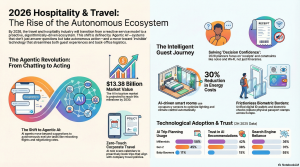
The hospitality industry is currently undergoing a “systemic metamorphosis,” transitioning from a reactive, service-based sector to a proactive, algorithmically driven ecosystem. As a student entering this field, you must view the hotel not merely as a building, but as a smart environment where technology anticipates guest needs before they are even articulated.By 2026, a hotel’s “tech stack” will be its primary competitive lifeline. The market for AI in tourism is projected to surge from $2.95 billion in 2024 to $13.38 billion by 2030 . This rapid acceleration is fueled by the “Millennial Efficiency Surge.” With 58% of millennials already using AI for travel, this demographic shift is a direct response to information overload; these travelers use AI to mitigate “FOBO” (Fear of Better Options) and “FOMO” (Fear of Missing Out).The industry standard is now defined by “Travel Mixology” : a strategic blend of machine-driven speed and authentic human connection. To understand this metamorphosis, we must look at the first interface where data meets desire—the “Digital Concierge” layer.
The Conversational Layer: Generative AI in Guest Discovery
To understand the software layer, we must look at Generative AI as the “Digital Concierge.” This technology has transformed the booking process from a static experience of clicking filters into a fluid, conversational journey. It moves the guest from “searching for inventory” to “designing an experience.”Three Ways Generative AI Redefines the Guest Experience:
- Hyper-Personalized Itineraries: Systems analyze individual passions—such as a “three-day art-focused tour of Switzerland”—to produce editable plans with real-time booking links and maps in seconds.
- Natural Language Search: Rather than using rigid keywords, travelers describe their ideal “vibe.” For example, Marriott Bonvoy utilizes natural language search to recommend properties based on conversational descriptions of activities and moods.
- Real-Time Translation: AI-powered tools like TripGenie break down language barriers instantly, allowing global travelers to navigate foreign signs and menus via smartphone overlays, fostering deeper local immersion.While Generative AI is the master of “words” and advice, the next layer of our architectural stack moves from conversation to autonomous execution.
The Action Layer: Agentic AI and the Autonomous Horizon
The “star of the tech stage” in 2026 is Agentic AI . While Generative AI suggests a solution, Agentic AI has the autonomy to take initiative and complete the task. This creates a “Trust Flywheel” : as travelers realize the system reliably finds and executes the best options, they stop looking for alternatives, reducing off-channel bookings and building deep brand confidence.Generative vs. Agentic AI: From Advice to Action| Scenario | Generative AI (Advice) | Agentic AI (Action) || —— | —— | —— || Room Service | Provides a menu and suggests a popular vegan dish. | Places the order, updates the kitchen, and dispatches a delivery robot. || Flight/Travel Shift | Notifies the guest of a flight delay or cancellation. | Proactively rebooks the airport transfer and adjusts the hotel check-in time in the PMS. || Housekeeping | Lists the standard cleaning times for the guest. | Executes dynamic re-prioritization based on real-time check-in/out data to optimize room turnover. |
Operational Synthesis: Behind the scenes, Agentic AI manages complex Revenue Management by synchronizing room rates with real-time data, including currency exchange rates and flight booking synchronization. It moves the hotel manager from a “policy enforcer” to an “AI auditor,” overseeing algorithms that handle the operational heavy lifting.
The Physical Layer: IoT and Robotic Integration
The Internet of Things (IoT) represents the “nervous system” of the smart hotel, where sensors and devices communicate to create a seamless environment. This layer is where software “agents” manifest in the physical world to reduce “transactional grunt work.”Real-World Robotic & IoT Pioneers:
- Connie (Hilton): A robot concierge powered by IBM Watson that learns from every interaction to provide increasingly accurate local tourism tips.
- Dash (Crowne Plaza): An autonomous robot that monitors Wi-Fi signals to navigate halls and deliver toiletries and snacks directly to guest doors.
- Henn-na Hotel (Japan): The world’s first fully robotic hotel, utilizing humanoid robots for reception and autonomous cleaners for floor maintenance.
- Aloft Hotels: Using a Siri-controlled model, guests use voice commands to adjust lighting and temperature, a feature that serves as a critical tool for both convenience and accessibility for guests with disabilities.These integrations allow staff to step away from repetitive tasks and move toward high-impact human interactions.
Operational Excellence and Sustainability
AI and IoT move beyond “cool features” to drive the Triple Bottom Line : Efficiency, Revenue, and Sustainability. Technology is now shifting toward “Embedded Sustainability,” where green practices occur without requiring guest intervention.
- Energy Optimization: AI sensors detect when a room is unoccupied, automatically adjusting HVAC and lighting. This reduces energy consumption by up to 30% while maintaining guest comfort.
- Data Visibility: In 2026, data is the currency of visibility. As Chris Hemmeter, Managing Partner at Thayer Investment Partners, states:”If hotels fail to manage their data, they will be invisible.”
Trust, Privacy, and the “Human Touch”
As we move toward Biometric Borders , trust is paramount. By 2026, 450 million Europeans will have access to the EUDI (European Digital Identity) Wallet , allowing for unified, secure credential verification. However, this level of data integration requires strict legal and ethical guardrails.Key Challenges & Ethical Guardrails:
- Algorithmic Bias: A critical risk is “Western-centric bias,” where algorithms may prioritize individualistic travel styles (e.g., solo adventure) over collectivist preferences (e.g., large family gatherings), inadvertently marginalizing certain cultures.
- Data Privacy Milestones: 2026 brings significant legal shifts, including the Oregon amendment (prohibiting the sale of data for users under 16) and California’s “Delete Act” (effective August 2026), which mandates streamlined data deletion mechanisms.
- The Human Element: Technology replaces tasks , not people . A robot can deliver a toothbrush and an algorithm can adjust a price, but they cannot provide empathy. A “genuine smile” and the ability to handle complex emotional needs remain the one thing technology cannot replicate.
Your Future in an AI-Driven Industry
The year 2026 represents a pivotal “window of opportunity.” The future belongs to hospitality professionals who can master the interface between high-tech efficiency and high-touch service. Your value will lie in your ability to act as an “AI trainer” and an “empathy specialist” simultaneously.The Hospitality Professional’s 2026 Competency Checklist:
- Data Literacy: The ability to interpret AI-driven insights and “interrogate constraints” to make real-time operational decisions.
- Tech-Augmented Empathy: The skill to use the time saved by automation to provide deeper, more personalized human connections and problem-solving.
- Algorithmic Oversight: The competency to audit automated systems for bias and ensure that technological “Mixology” stays true to the brand’s authentic voice.