
Zambia’s Digital Vault: 6 Takeaways from the New Cybersecurity Revolution
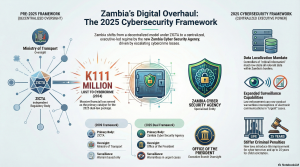
Feb. 24, 2026 /Mpelembe Media/ –Zambia is currently undergoing a rapid digital transformation characterized by the expansion of financial technology (FinTech), increased internet penetration, and a concerted government push toward a digital economy. However, this growth has been accompanied by a surge in cyber threats, including massive financial fraud, online scams, and critical data breaches. In response, the Zambian government overhauled its legal framework by enacting the Cyber Security Act (2025) and the Cyber Crimes Act (2025). While the government champions these laws as necessary for national security and child online protection, civil society and digital rights advocates warn that the legislation grants the state sweeping surveillance powers, threatening freedom of expression, privacy, and democratic participation
The High Price of a Secure Connection
In an era where digital connectivity powers everything from copper mining to mobile money, Zambia finds itself at a precarious crossroads. While the internet has accelerated the nation’s “Smart Zambia” vision toward 2030, it has also opened a digital front for sophisticated criminals. Recently, cybercrime cost the Zambian economy over K111 million, with scammers targeting citizens through aggressive phishing and social media fraud.However, the stakes reached a fever pitch in early 2025 with claims of a massive 500GB government data breach. Reports alleged that data linked to 15 million individuals and over 34 million records had been compromised. While the Zambia Cyber Security Agency’s Director General, Dr. Schmidt Chintu, has classified these claims as “unverified,” the Agency remains on a “critical alert” status. This high-stakes atmosphere provided the momentum for a radical legislative shift. This post examines the surprising and impactful shifts in Zambia’s 2025 digital governance framework and what they mean for the future of digital rights in Sub-Saharan Africa.
The Presidential Pivot: Centralizing the Cyber Command
The most significant institutional change in the 2025 framework is the “unbundling” of the previous 2021 unified legislation. By separating infrastructure security (Act No. 3) from criminal prosecution (Act No. 4), the government claims to offer more granular oversight. Central to this is the creation of the Zambia Cyber Security Agency .Crucially, this is not a total replacement of the existing regulator. The Zambia Information and Communications Technology Authority (ZICTA), currently led by Eng. Collins Mbulo, remains the foundational regulator for licensing and standards. Instead, the new Agency represents a “carve-out” of security powers, placed under the direct oversight of the Office of the President .”The lack of an independent governing board or parliamentary oversight mechanism makes the Agency vulnerable to political interference,” noted the Law Association of Zambia (LAZ), expressing concern that the Agency’s vast powers could be used to suppress dissent rather than merely secure infrastructure.
The Warrantless Loophole: Surveillance in Real-Time
The new legislation solidifies the role of the Central Monitoring and Coordination Centre (CMCC) as the hub for national surveillance. Under the 2025 Act, telecommunications providers are mandated to install systems that facilitate “full-time monitoring” and real-time interception of calls, emails, and messages.The most controversial shift involves a departure from standard privacy protections. While a High Court order is generally required, the 2025 Act allows for warrantless interceptions in “urgent cases” where law enforcement believes a delay could result in bodily harm or property damage. This shift was largely shrouded in secrecy; many Zambians only learned of the law’s intrusive nature after the U.S. Embassy in Lusaka issued a stark warning, suggesting the framework effectively turns telcos into state informants and risks making Zambia a “Police state.”
Data Sovereignty or Digital Cage? The Localization Mandate
Zambia has introduced a strict “data localization” requirement for Critical Information Infrastructure (CII) . Controllers of data in these sectors must now store all information on servers physically located within Zambia. While framed as “digital sovereignty,” this mandate presents massive operational challenges for international banks and NGOs that rely on global cloud architectures.Sectors designated as “Critical Information Infrastructure” include:
- Banking & Finance: Payment gateways and core banking systems.
- Health: National patient databases and hospital systems.
- Mining: Resource mapping and extraction control data.
- Public Sector: Civil registries and taxation systems.
- Defense & Security: Military and intelligence communications.
- Energy: Power grid controls (e.g., ZESCO distribution).
The Return of “Humiliation”: Vague Crimes and Clear Penalties
The Cyber Crimes Act No. 4 of 2025 marks a return to the criminalization of subjective speech. The law introduces penalties for the transmission of data intended to “harass or humiliate” another person, as well as the dissemination of “inauthentic data.”The subjectivity of these terms is already having a “chilling effect.” In January 2025, three individuals were arrested for “spreading false statements” regarding the President’s health—a move seen by analysts as a harbinger of how the law might be weaponized against political dissent or satirical expression.The International Center for Not-for-Profit Law (ICNL) has characterized these provisions as the “re-criminalization of defamation” for the digital age, warning that a satirical cartoon or a research report contradicting government data could now lead to a prison cell.
The K111 Million Justification: Scams as a Catalyst for Control
The political momentum for these intrusive acts was built on the back of the K111 million lost to online scammers. The government successfully utilized the ZM-CIRT (Zambia Computer Incident Response Team)—the nation’s “digital fire brigade”—to pilot the * 707# shortcode . This allowed citizens to report suspicious numbers, resulting in the deactivation of over 10,000 SIM cards in the first quarter of 2025 alone.While these operational successes are undeniable, they highlight the central trade-off of the 2025 framework: the same technical mechanisms that protect citizens’ wallets from scammers also provide the state with the infrastructure for unprecedented civilian monitoring.
A Hard Line for Protection: The Child Online Safety Drive
Perhaps the most universally praised aspect of the framework is the National Child Online Protection Strategy (2025–2029) . With 38% of Zambia’s internet users being under 18, the government has committed to a $1.8 million implementation plan to reduce online child abuse by 50% by 2029.The strategy combines aggressive penalties with support mechanisms:
- Reporting Infrastructure: The ZICTA Online Reporting Portal and the Child Helpline 116 .
- Severe Penalties: Minimum 25 years to Life imprisonment for online human trafficking.
- Digital Literacy: Collaborations with UNICEF and the SMART Zambia Institute to train youth in recognizing “digital footprints” and scams.
Sovereignty at a Crossroads
Zambia’s 2025 digital framework represents a bold duality. It is a sophisticated model for regional cyber-resilience that empowers the state to fight financial fraud and protect children. Yet, by centralizing power within the Office of the President and legalizing warrantless surveillance, it risks prioritizing state security over individual liberty.As the nation marches toward its 2030 digital goals, the 2026 general elections will serve as the ultimate stress test for this “Digital Vault.” The question remains: can a nation truly be digitally secure if the foundation of absolute privacy is sacrificed for state control?