Border Shifts: 5 Things Every Modern Traveler to Britain Must Know Right Now
For decades, the passage across the English Channel was defined by its invisibility. Borders were conceptual—perhaps a brief pause for a friendly nod at a booth—but largely a seamless experience for the modern nomad. However, the post-transition era has fundamentally reconfigured these old certainties. The “common knowledge” many travelers rely on—that a Parisian lunch is a harmless carry-on or that a dual-national’s second passport is an all-access key—is now dangerously outdated. As the United Kingdom moves toward a fully digitized “permission-to-travel” model, the friction at the border is increasing for those who haven’t kept pace with the fine print. From biosecurity crackdowns to strict documentation mandates for British citizens, the rules of the game have shifted. Navigating Britain’s borders today requires the precision of a policy analyst and the preparation of a seasoned explorer; a single oversight can now lead to a quiet dismissal at the boarding gate.
The Dual-National “Gotcha”: Foreign Passports are No Longer a Golden Ticket
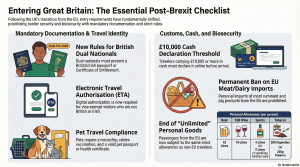
As of February 25, 2026, the era of “informal tolerance” for British dual nationals has come to an abrupt end. Historically, many citizens holding both British and a second, visa-exempt nationality (such as an EU passport) traveled to the UK using only their foreign documentation. Under the new enforcement regime, this practice is a recipe for being grounded.The catalyst is the full implementation of the Electronic Travel Authorisation (ETA) system. Because British citizens are ineligible for an ETA, carriers—airlines, rail, and ferry operators—must verify citizenship status before allowing anyone to board. In this new digital era, there is no room for “human discretion” at the gate; if the system does not see a valid travel permission or a British passport linked to your identity, the digital gates simply will not open.To ensure you aren’t denied boarding, British dual nationals must present one of the following:
- A valid British Passport .
- A valid Irish Passport (specifically for Irish dual nationals).
- A Certificate of Entitlement to the Right of Abode, affixed to your foreign passport.”The catalyst for these changes is the UK government’s implementation of a comprehensive ETA system, which came into full enforcement on 25 February 2026… Carriers and border officials must verify British citizenship before permitting travel.”
The “Sandwich Crisis”: Why Your Lunch is a Biosecurity Threat
While travelers often fret over visas, the most immediate threat to a smooth arrival might be tucked inside a picnic bag. The UK is currently navigating an “illegal meat crisis,” driven by the existential threat of African Swine Fever to national livestock. What once seemed like a harmless personal allowance has been replaced by an uncompromising ban.In April 2025, the government extended strict biosecurity restrictions to cover all ruminant and pig meat and dairy products from the EU single market. While it may feel counter-intuitive to view a gourmet ham sandwich as a threat to national security, the government’s stance is clear: a single contaminated import could devastate the British livestock industry.”The Government also works with the Devolved Governments, as an incursion through illegal imports could affect the whole of Great Britain.”
The Pet Passport Evolution: Ferrets and the Four-Month Rule
Traveling with a four-legged companion has evolved from a simple weekend addition into a feat of strategic planning. The regulations now explicitly cover not just cats and dogs, but ferrets as well, and the paperwork requirements are exacting.The primary “catch” lies in the origin of your documentation. While EU-issued pet passports remain valid for entering Great Britain, UK-issued passports are no longer recognized for entry into the EU. For those without an EU-issued document, the alternative is a Great Britain pet health certificate—a process that requires a rigorous four-month lead time for vet visits and vaccinations.Precision is paramount: ensure your vet has meticulously documented the ownership signature in Section I; a single missing ink stroke or a date error regarding rabies vaccinations can derail a return trip. To enter Great Britain, your pet’s documentation must include:
- Meticulous Details of Ownership: Signed by the owner in Section I.
- Marking and Identification: Accurate microchip or marking details.
- Rabies Protocol: Valid vaccination records and, if required, blood test results.
- Tapeworm Treatment: Specifically required for dogs and documented by a vet.
The “Rules of Origin” Allowance: When 0% Duty Actually Applies
The cultural era of the “unlimited booze cruise” has reached its conclusion. EU travelers are now treated as non-EU passengers, meaning strict personal allowances apply. There is, however, a sophisticated nuance: the “Preferential 0% Duty Rate.”The “catch” for the modern luxury traveler is that this 0% rate is not automatic. Goods must not only be purchased in the EU, but they must also originate (be produced) there. A bottle of Japanese whisky purchased in a Parisian boutique, for instance, does not qualify and will attract full duty. Crucially, if you exceed your allowance by even a single bottle, you must pay tax and duty on the entire category, not just the excess.| Category | Allowance for Great Britain Entry || —— | —— || Beer | 42 litres || Still Wine | 18 litres || Spirits | 4 litres OR || Fortified/Sparkling Wine | 9 litres (ABV less than 22%) || Tobacco | 200 cigarettes OR 100 cigarillos OR 50 cigars OR 250g tobacco || Other Goods | £390 (£270 if arriving by private plane or boat) |
Pro-Tip: You can “mix and match” within the spirit and fortified wine category. For example, you could bring 2 litres of spirits (50% of the allowance) and 4.5 litres of sparkling wine (the remaining 50%) to stay within the limit.
The £10,000 Threshold: The Digital Cash Declaration
In its drive for border modernization, the UK has moved cash declarations into the digital realm. Travelers carrying £10,000 or more must now use the HMRC “Online Declaration Service.” This allows you to fulfill legal obligations up to five days before arrival, ensuring you don’t become a bottleneck at the physical border.However, there is a vital distinction regarding Northern Ireland (NI). While a €10,000 threshold applies when entering NI from a country outside the EU, there is no declaration requirement when carrying any amount of cash between the EU and Northern Ireland. This exemption is a key remnant of the specific protocols governing the island of Ireland, aiming to keep regional traffic flowing while the rest of the UK border shifts toward a high-security digital model.
A Forward-Looking Perspective
The current complexity of the UK border may soon face another shift. Formal negotiations for a UK-EU Sanitary and Phytosanitary (SPS) Agreement are expected to begin in late 2025. If successful, this could establish a “common SPS area,” potentially ending the “sandwich crisis” and easing the friction for agri-food trade.Yet, as the ETA system becomes the new bedrock of security, one must ask: will a new agreement return us to the seamless borders of the past, or has the “digital border”—with its mandatory pre-declarations and automated gates—become the permanent tax on the modern nomad’s spontaneity? For now, the successful traveler is the one who treats the fine print as their most essential travel document.