
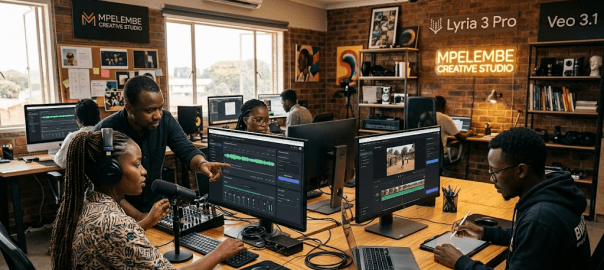
April 8, 2026 /Mpelembe Media/ — This is a comprehensive overview of the 2026 generative AI landscape, heavily focusing on Google’s latest media models, enterprise orchestration, and the broader impacts of AI on industry and regulation. This article analyses a report from Google Cloud titled “Transformation Today,” which highlights new generative media tools available on Vertex AI. The primary focus is the launch of the Lyria 3 Pro and Veo 3.1 Lite models, designed for advanced music and video creation. It categorizes the Veo 3.1 family into three tiers—standard, fast, and lite—to help developers balance visual quality, processing speed, and cost. Additionally, the text offers a specific prompting formula to help users achieve better control over cinematic elements and subject actions. Technical experts contribute to the guide, providing frameworks for applying these AI innovations to professional workflows. Overall, the document serves as an educational resource for engineers looking to integrate high-volume video generation into their applications.
Google’s Advanced Media Models (Veo 3.1 & Lyria 3): The sources extensively detail Google’s new generative models. Veo 3.1 introduces cinematic video generation with native, synchronized audio across three tiers: Lite, Fast, and Standard. It features advanced workflows like “Ingredients to Video” and “Start-End-to-Video”. Lyria 3 and Lyria 3 Pro revolutionize AI music by allowing creators to generate full-length, structured songs (up to 3 minutes) with explicit control over intros, verses, choruses, multi-language vocals, and instrumentation.
Enterprise AI Orchestration via Vertex AI: For professional deployment, Vertex AI serves as the critical backbone. It allows media enterprises to manage data, automate machine learning pipelines, and deploy models securely. It also features built-in IP protection, compliance adherence (such as SOC 2), and SynthID watermarking to guarantee content authenticity and protect corporate data from being used in future training sets.
Media, Gaming, and Tech Industry Trends: AI is fundamentally shifting content creation. In media, it drives incredible production efficiency but also introduces challenges like workforce reductions, copyright disputes, and “AI slop”. In the gaming sector, AI agents are powering “living games” with autonomous, evolving worlds. Additionally, AI integration is democratizing creation through platforms like Google Vids, WaveSpeedAI, and LTX Studio.
Data Privacy & Regulatory Governance: 2026 presents a complex regulatory environment, including the EU AI Act, strict U.S. state laws on high-risk AI, and executive orders regarding AI standards. Organizations are also facing severe cybersecurity threats from ungoverned “shadow AI” and agentic AI systems, necessitating zero-trust data protection architectures.
The 2026 AI Great Realignment: High-Fidelity Creation Meets the Sovereign Splinter
1. Introduction
The opening months of 2026 have effectively slammed the door on the “wild west” era of artificial intelligence. We have moved beyond the novelty of “chatting” with machines into a period of violent acceleration, where the tension between unprecedented creative accessibility and a tightening regulatory noose is the new baseline. While tools like Google’s Veo 3.1 and Lyria 3 Pro have made professional-grade media production a one-click reality, a massive legal and political tug-of-war is unfolding over who owns the guardrails.This is the year of the “sovereign splinter”—a shift where the roadmap for AI is dictated as much by courtrooms and insurance underwriters as it is by compute power. To help enterprise leaders and creators navigate this landscape, we have distilled the five most significant takeaways that define the cost of doing business in 2026.
2. The Great AI Power Struggle: Federal Preemption vs. State Oversight
The defining conflict of 2026 is a high-stakes jurisdictional clash between the U.S. federal government and a coalition of resistant states. Building on the Trump Administration’s Executive Order (EO) from December 11, 2025, the White House is aggressively pursuing a “minimally burdensome national standard” to ensure American AI dominance. The primary legislative vehicle for this is the TRUMP AMERICA AI Act , introduced by Senator Marsha Blackburn on December 19, 2025. The Act seeks to codify the EO, establishing a single federal rulebook to “eliminate regulatory interstate chaos.”This federal push faces a wall of state-level resistance. California (S.B. 53), New York (RAISE Act), and Colorado (Colorado AI Act) continue to enforce their own sweeping safety and transparency mandates. The Department of Justice has already been instructed to sue states over what the administration deems “unconstitutional AI regulations.” As industry analysts watch the fallout:”According to public statements by Trump Administration officials… laws in California, New York, Colorado, and Illinois are in the crosshairs.”For now, AI laws in these states remain in full force. Businesses must navigate a fragmented reality where following federal guidance may still leave them vulnerable to state-level enforcement.
3. The End of “Silent” AI: Native Audio as the New Creative Standard
Until recently, AI video was a silent medium, an eerie pantomime that required creators to manually layer sound in post-production. In 2026, “Native Audio” has become the mandatory baseline. With the rollout of Veo 3.1 and its integration into Google Vids, the model now generates synchronized dialogue, sound effects, and ambient noise—from the hiss of an espresso machine to the specific crunch of footsteps on frost—alongside the visuals.This shift comes as the market landscape undergoes a dramatic consolidation. While OpenAI shuttered its original Sora app and US-based Sora 1 experience on March 13, 2026, and is slated to discontinue the Sora API entirely by September 24, 2024, Google has pivoted to a “complete output package.” By delivering video that “hears” its own environment, Google has transformed AI from a visual-only generator into a production-scale partner for high-volume content.
4. The “Legal Safety” Differentiator: Why Training Data is the New Battlefield
As AI enters the enterprise at scale, “legal safety” has overtaken raw performance as the primary product differentiator. This is most evident in the music sector, where Google’s Lyria 3 Pro is competing directly against Suno and Udio. While those competitors face active copyright lawsuits from major record labels, Google is leveraging its use of licensed training data and permissible YouTube content as a shield for corporate users.Transparency is no longer a corporate choice; it is a legal requirement. California’s AB 2013 now mandates that developers of generative AI systems publicly disclose:
The total number of data points in their training sets.
Whether the data includes personal information or protected intellectual property.
Whether the datasets were purchased, licensed, or otherwise obtained.However, even these transparency laws are under fire. On December 29, 2025, xAI filed a legal challenge against AB 2013 , arguing it violates the Takings Clause by forcing the disclosure of trade secrets without compensation. This legal friction ensures that the question of what a model was fed will remain a major risk factor for developers and users alike throughout 2026.
5. Insurance and Governance: The Emergence of the “AI Security Rider”
Even in the absence of finalized federal laws, oversight has effectively been outsourced to the private sector. In 2026, the cyber insurance market has fundamentally transformed, with carriers now conditioning coverage on “AI-specific security controls.” The “AI Security Rider” is now a standard prerequisite for underwriting.To qualify for coverage and demonstrate “reasonable security,” organizations must provide documented evidence of:
Adversarial red-teaming to stress-test model vulnerabilities.
Model-level risk assessments integrated into the development lifecycle.
Specialized safeguards for data sourcing and ingestion.
Alignment with recognized AI risk management frameworks.This pressure is echoed by the SEC’s FY2026 focus areas, which explicitly target third-party vendor risk and AI-driven threats to data integrity. For the modern enterprise, AI governance is no longer just a compliance checkbox—it is a requirement for operational resiliency and insurability.
6. The Democratization of Production-Scale Video
High-fidelity video production has seen a massive price correction. The release of Veo 3.1 Lite has introduced a 50% cost reduction compared to previous “Fast” tiers, and Google Vids now offers 10 free generations monthly to all personal accounts. This democratization is fueling a surge in high-volume applications, from localized social ads to small business marketing.Below is the strategic breakdown for developers choosing between the new high-efficiency tiers:| Feature | Veo 3.1 Lite | Veo 3.1 Fast (Effective Apr 7, 2026)
|| —— | —— | —— ||
Primary Goal | High-volume, cost-sensitive | Speed and quality balance
|| Price (per sec, 720p) | $0.05 | $0.10 || Native Audio | Yes (Synchronized) | Yes (Synchronized)
|| Aspect Ratios | 16:9, 9:16 | 16:9, 9:16 || Max Duration | 8 Seconds (720p/1080p) | 8 Seconds (All resolutions)
|| Resolution Support | 720p, 1080p | 720p, 1080p, 4K |
Note: For the Lite model, 1080p support is limited to 8-second generations.
7. Conclusion: Navigating the 2026 Frontier
The roadmap for 2026 is defined by a paradox: AI is becoming exponentially higher in quality and lower in cost, yet it is facing unprecedented legal and security oversight. We are moving away from the “black box” era and toward a world of transparent, legally clean, and insurance-verified systems.As we move deeper into the year, the central strategic question remains: Will the “minimally burdensome” federal vision of the TRUMP AMERICA AI Act succeed in creating a unified market, or will the rigorous state-level protections of California and New York define the cost of doing business for the entire AI sector? The answer is currently being written in the courtrooms, but the tools for the next creative revolution are already in your hands.