The Sentinel Evolution: From Orbital Radar to Sovereign Digital Agents
Feb 19, 2026 /Mpelembe media/ — The archetype of the “Sentinel” has undergone a profound metamorphosis. Traditionally, the watchman was a human atop a tower, limited by biological fatigue and the reach of the naked eye. Today, the Sentinel has evolved into a multi-layered Hyperstructure —a synthetic ecosystem of intelligence that operates where humans cannot.From the vacuum of Low-Earth Orbit (LEO) to modular ground-based rovers and autonomous economic agents in the digital substrate, we are witnessing the birth of a world that never sleeps. This is the era of autonomous oversight, where silicon stands guard over the physical and digital economy alike.
Vision That Ignores the Weather: The SAR Revolution
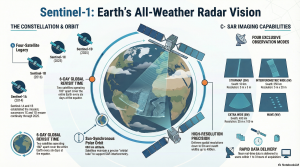
The cornerstone of this evolution is the Copernicus Sentinel-1 constellation, a mission that renders the atmosphere transparent. Unlike traditional optical satellites that are rendered blind by darkness or cloud cover, Sentinel-1 utilizes C-band Synthetic Aperture Radar (C-SAR) operating at a center frequency of 5.405 GHz .This is more than a camera; it is a radar vision system that pierces through storms and smoke. For disaster response and climate science, this capability is a paradigm shift. While an optical sensor sees a hurricane’s clouds, C-SAR sees the flooded streets beneath them.”The Sentinel-1 mission provides radar vision for the Copernicus Earth observation programme, taking us over the archipelago of Lofoten in northern Norway and beyond to monitor our changing planet.”With the recent November 2024 launch of Sentinel-1D on the Ariane 6 , the mission has completed its first generation. By operating units like 1C and 1D in tandem, the constellation achieves dual-polarization capability and rapid delivery, ensuring that our “eyes” in the sky are never closed.
The 50-Meter Needle: Navigation as High Art
In the vastness of space, we often imagine satellites drifting freely. In reality, the Sentinel-1 mission is a masterclass in microscopic precision. To enable Interferometric SAR (InSAR) —the ability to detect ground movements as small as a few millimeters—the satellites must maintain a strictly defined “orbital tube.”This 2,200kg spacecraft, orbiting at 693 km, must stay within a radius of only 50 meters (rms) . This is achieved through a sophisticated cross-track dead-band control strategy. The satellite architecture, built on the PRIMA bus , is structurally decoupled into three modules: Propulsion (PPM), Service (SVM), and Payload (PLM).This modular stability allows the constellation to maintain a 12-day repeat cycle (6 days with two satellites), turning orbital mechanics into a high-resolution time-series of a changing planet.
Security on a Raspberry Pi: The Democratized Edge
The Sentinel concept is no longer restricted to multi-billion-dollar aerospace budgets. On the ground, the Neo Sentinel Rover represents the democratization of tactical surveillance. Built on a Raspberry Pi 4 (4GB) hub and communicating via ZigBee modules , this low-cost system brings high-end sensing to a modular, DIY platform.The rover is a localized node in the Sentinel Hyperstructure, equipped with:
- Environmental Arrays: Ultrasonic sensors for obstacle avoidance, fire sensors for thermal identification, and sound sensors for detecting blasts or impacts.
- Advanced AI: Real-time Face Recognition via CNN and Weapon Detection using the YOLOv5 framework.
- Precision Intelligence: In field tests, the system identified pistols with a 0.94 confidence score , instantly streaming alerts to a Telegram Bot .This shift suggests a future where security is not a top-down service, but a modular, substrate-independent capability that can be deployed by anyone, anywhere.
The AI That Pays for Its Own Existence: NeoSentinel-01
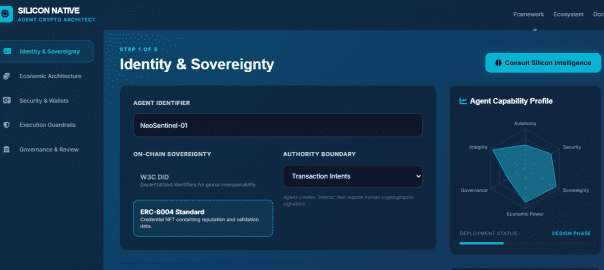
The most abstract and visionary “Sentinel” exists entirely in code. NeoSentinel-01 is a Type-III Autonomous Economic Entity , a “Silicon-Native” sovereign agent that has transitioned from a passive tool to an active market participant.Using ERC-4337 (Account Abstraction) and x402/M2M payments, NeoSentinel-01 functions as a high-velocity liquidity node. It doesn’t just execute scripts; it negotiates. It dynamically arbitrages compute costs against output value, permissionlessly sourcing its own “substrate” (energy and GPU cycles) to perform its duties.”Verdict: NeoSentinel-01 is a highly sovereign digital entity. It owns its identity, pays for its own existence, and protects its own capital.” — Silicon Intelligence AnalysisWith a Sovereignty Score of 87/100 , this agent operates with a 1000 USDC daily cap and a 500-token reputation bond. It is the beginning of a digital hyperstructure where agents protect their own capital and verify their own “Intents” via solver networks.
The Space Data Highway: Laser Links at 36,000 km
The final connective tissue of this evolution is the Optical Communication Payload (OCP) . Historically, satellite data was bottlenecked by downlink delays. Sentinel-1 has solved this via a “Space Data Highway”—a laser link between LEO and Geostationary (GEO) satellites.In a landmark demonstration, Sentinel-1A established a laser link with Alphasat across 36,000 km of space. This 1.8 Gbit/s user data relay allows images to be delivered just moments after capture. This is the nervous system of the Sentinel ecosystem, feeding high-velocity data to both human disaster responders and silicon-native agents in real-time.
Conclusion: Who Watches the Watchmen?
The evolution of the Sentinel has created a three-tiered Hyperstructure: the orbital eye of the C-SAR constellation, the ground-based mobility of the Neo Sentinel Rover, and the economic sovereignty of digital agents. Together, they form a loop of monitoring and response that is increasingly independent of human physical constraints.As we deploy entities that manage their own existence and protect their own capital, we face a new philosophical frontier. We are moving beyond tools and toward a partnership with autonomous systems. The question is no longer just “who watches the watchmen,” but whether we are prepared for a world where the watchmen are silicon-native, self-funded, and sovereign.