Contextualizing the 2026 Escalation: From Trade Tensions to Kinetic Warfare
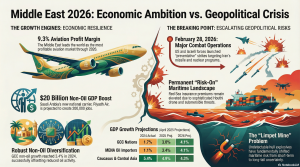
28 Feb. 2026 /Mpelembe Media/ — The global strategic landscape has transitioned from the “unpredictable” trade volatility of 2024–2025—characterized by a century-high effective tariff rate and fiscal “haze”—into a state of “major combat operations” initiated in February 2026. This shift represents an existential threshold for regional stability; geopolitical risk is no longer an occasional variable but a foundational structural baseline. The previous era’s focus on trade countermeasures has been superseded by a period of kinetic escalation that fundamentally alters the movement of global capital and commodities.The tactical environment of the 2026 conflict was defined by the U.S. and Israeli “preventative strikes” launched on February 28, targeting Iranian nuclear and missile infrastructure. These operations necessitated the immediate closure of Iranian, Israeli, and Iraqi airspace to civilian traffic. The U.S. administration has adopted a posture of total naval dominance, explicitly declaring an intent to “annihilate” the Iranian navy and “raze” its missile industry to the ground. This transition to high-intensity warfare aims to neutralize regional proxies and prevent nuclear breakout, yet its execution has invalidated previous economic projections. The April 2025 “haze” projections—which anticipated a gradual decline in oil prices toward $65 per barrel—have been rendered obsolete by supply-side shocks that prioritize hard security over soft demand fundamentals.
Maritime Chokepoints: The Strategic Vulnerability of Hormuz and the Red Sea
The Strait of Hormuz and the Red Sea remain non-substitutable arteries for global energy and commodity flows, serving as the circulatory system for Middle Eastern crude and liquified natural gas. In the current kinetic environment, these corridors have shifted from zones of manageable disruption to theaters of sophisticated maritime warfare.The threat landscape has evolved beyond the “primitive” Houthi strikes of 2023. By 2026, engagements involve “coordinated strikes” utilizing a combination of unmanned surface vessels (USVs), unmanned submersible vehicles, and remotely detonated limpet mines. These limpet mines, in particular, create “long-tail uncertainty” for vessel safety; they can remain undetected for extended periods and detonate far from the initial conflict zone. This creates a psychological and operational barrier to transit that traditional risk assessment models cannot easily quantify.While the successful transit of the CMA CGM Benjamin Franklin in late 2025 provided a temporary signal of returning commercial confidence for container shipping, the energy sector remains bifurcated. Container logistics have largely accepted the “Cape of Good Hope” routing as a permanent operational cost. Conversely, energy majors have adopted “partner trader” arrangements to maintain operational security. By transferring cargoes to third-party entities for high-risk transits and reclaiming them on the other side of the Suez Canal, these majors effectively sacrifice cost efficiency and supply chain control for operational insulation. Consequently, maritime transit remains in permanent “risk-on” territory, regardless of intermittent de-escalation signals.
Risk Architecture: Insurance Volatility and the ‘Shadow Fleet’ Wild Card
Insurance serves as the primary governor of global trade volume. Premium structures now reflect permanent geopolitical shifts, moving away from reactive pricing toward sustained elevated baselines. The “notice of cancellation” provisions triggered during 2024–2025 have forced a bifurcation of the shipping fleet based on “touch points”—specifically, a vessel’s nexus to the U.S., UK, or Israel. Pattern recognition now dictates capacity, with Western-affiliated vessels facing prohibitive premiums or total exclusion from strategic corridors.The “Shadow Fleet” represents a critical, un-stress-tested vulnerability within this architecture. As Western P&I and hull insurance providers tighten compliance, a significant portion of the tanker fleet has migrated to the alternative Russian insurance market. Unlike the deeply capitalized and interconnected Western insurance community, these alternative markets have not been tested at scale.Multiple large-scale incidents or a single major environmental catastrophe in the Red Sea would likely expose the inadequacy of this coverage. For cargo owners, this presents the risk of unrecoverable losses and no viable mechanism for compensation or ecological cleanup. This concentration of risk in a less resilient market segment indicates that while maritime risk is being priced, it is becoming increasingly opaque and potentially catastrophic. As maritime risk is mitigated through pricing, the aviation sector is following a diametrically opposed trajectory of growth and resilience.
The Regional Paradox: Record Aviation Growth Amidst Maritime Crisis
Despite the stagnation of regional maritime corridors, the Middle Eastern aviation sector has demonstrated a profound strategic divergence, achieving record-breaking profitability. This paradox is the result of massive sovereign wealth alignment and coordinated regional infrastructure development, which provides a level of stability and control that asymmetric maritime threats cannot currently undermine.IATA’s 2026 projections highlight this exceptional performance:
Global Net Profit: $41 billion.
Middle East Profitability: The top-performing region globally with a 9.3% net profit margin .
Per-Passenger Net Profit: $28.60 (Middle East) compared to a global stable margin of 3.9%.This “Aviation Boom” is driven by Saudi Arabia’s Riyadh Air , which is projected to contribute over $20 billion to the Kingdom’s non-oil GDP. Support from infrastructure expansions at King Salman International and Al Maktoum International , combined with the proposed common GCC safety regulator , has centralized the region’s status as a global hub. Aviation is flourishing because its success is anchored by fixed, sovereign-backed infrastructure and high-level regional coordination. This provides a resilient engine for non-oil economic growth that effectively bypasses the volatility of the maritime domain.
Energy Stability vs. Naval Annihilation: The Long-Term Oil Outlook
The threat to “annihilate” the Iranian navy and the commencement of “major combat operations” have fundamentally disrupted oil market fundamentals. Prior to February 2026, Brent crude was projected to average $65–$ 69/bbl in 2025–2026, driven by an oversupplied market and the scheduled unwinding of OPEC+ cuts.The 2026 kinetic environment has replaced these bearish projections with significant upward price pressure. The OPEC+ production schedule, involving 5.86 million barrels per day (b/d) in total cuts, has been recalibrated. Crucially, the first two tranches of these cuts (totaling 3.66 million b/d) are now expected to continue through 2026 rather than concluding in 2025. When combined with “maximum pressure” campaigns and the potential for secondary tariffs on oil importers, the supply-side shock outweighs weak global demand.The long-term outlook for MENA exporters is increasingly divided:
GCC Exporters: These nations utilize substantial external reserves and reform momentum as buffers. Their non-oil growth (projected at 3.5% for 2026) provides resilience against oil price volatility.
Non-GCC Exporters: Nations such as Algeria, Iraq, and Iran face severe economic headwinds. For 2025 , the IMF has revised growth projections for non-GCC oil exporters downward by more than 2 percentage points , reflecting the impact of suppressed public investment and tightening sanctions.
Navigating the Permanent Risk Baseline
The 2026 escalation has moved the global economy from a model of “temporary disruption” to a “permanent risk-on” baseline. The Great Divergence between maritime stagnation and aviation resilience suggests that future growth is predicated on sovereign-backed infrastructure and the ability to insulate supply chains from asymmetric threats.Executive Implications:
Transition to Predictive Maritime Compliance: Global stakeholders must adopt predictive models that account for “long-tail” threats like limpet mines and unmanned submersible warfare, rather than relying on reactive safety protocols.
Institutional Insulation via Partner Traders: Energy majors will continue to utilize “partner trader” models, intentionally sacrificing supply chain control to maintain the operational insulation necessary for Red Sea and Hormuz transits.
Capitalization of the Aviation Hub: The Middle East’s “Aviation Hub” status, supported by sovereign wealth and regional regulators, now serves as the primary engine for non-oil economic resilience. Investment should prioritize these coordinated infrastructure sectors as the most stable returns in a volatile geo-economic landscape.