
Jan. 6, 2026 /Mpelembe Media/ — This publication gathers expert opinions on how artificial intelligence will revolutionize the legal sector by 2026, focusing on its role in litigation, court preparation, and law firm strategy. While the text highlights that AI will become a strategic asset, it maintains that human legal expertise remains irreplaceable for ethical and defensible outcomes. Artificial intelligence is set to evolve from a simple efficiency tool into a strategic asset, fundamentally altering the entire litigation lifecycle.
The report specifically identifies the following key workflows that AI is expected to transform:
Strategic Evolution: A core focus is the evolution of AI from a basic efficiency tool into a strategic asset. This includes its impact on the entire litigation lifecycle and how it reshapes the role of litigators themselves.
Workflow Transformation: The text details how AI will specifically alter key legal workflows, such as motion practice, eDiscovery, and trial preparatio.
Human-Centric Approach: Despite the advancements in technology, the experts share a firm belief that AI cannot replace human legal expertise. Instead, the focus is on the ethical and defensible use of AI to augment human capabilities
Governance and Strategy: The eBook emphasises the necessity for law firms to establish clear governance and a firm-wide AI strategy to meet evolving court expectations and client relationships
Shifting Economic Models: It suggests that AI will act as a catalyst for a move towards value-based cost models, potentially replacing the traditional billable hour.
These transformations are intended to eliminate inefficiencies and allow legal professionals to work more effectively through collaborative software. While AI will handle many of these processes, the experts maintain that it is meant to augment, rather than replace, human legal expertise.
To visualise this, imagine a busy professional kitchen: while new automated appliances (AI) can now handle the precision chopping, temperature monitoring, and inventory tracking (the workflows of eDiscovery and motion practice), the head chef (the litigator) remains essential to season the dish, lead the team, and ensure the final meal meets the high standards required for the guests.
There is a shared belief among 14 industry leaders—including senior litigators, analysts, and legal tech experts—that artificial intelligence cannot replace human legal expertise.
The primary reasons identified in the sources regarding why AI will augment rather than replace legal professionals include:
Ethical and Defensible Application: A core theme among experts is the necessity of ensuring the ethical and defensible use of AI. This requirement places a premium on human judgement to oversee technology and ensure that its application adheres to legal standards and professional ethics.
Need for Governance: The sources highlight the importance of clear governance and a firm-wide AI strategy. These frameworks require human leadership to manage how AI is integrated into the litigation lifecycle and to meet evolving court expectations.
Strategic Oversight: While AI is evolving into a strategic asset, it is viewed as a tool to help legal professionals “work smarter and more effectively together”. It is designed to eliminate inefficiencies, allowing humans to focus on the high-level strategy and complex decision-making that AI lacks.
Human-Centric Roles: The future of litigation involves a transformation of the litigators themselves. The technology serves to connect professionals with collaborative software, but the “expertise needed to conduct resolution proceedings” remains a central human function.
In essence, AI is treated as a powerful enhancement to the legal toolkit rather than a substitute for the practitioner.
To understand this relationship, consider a master architect using advanced 3D modelling software. While the software can instantly calculate structural loads, simulate lighting, and generate blueprints (the efficiency and data-heavy workflows), it cannot possess the architect’s creative vision, understand the cultural significance of a building, or navigate the complex interpersonal needs of the client. The software builds the model, but the architect builds the legacy.
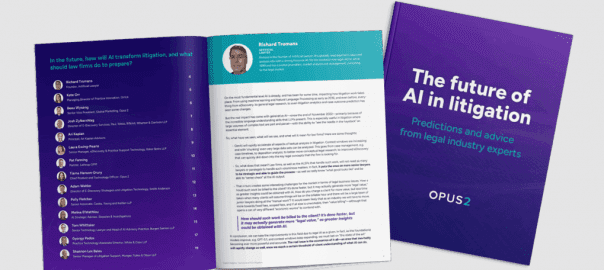
The eBook published by Opus 2, titled “The future of AI in litigation: Predictions and advice from legal industry experts”, explores several core themes regarding the integration of artificial intelligence into the legal sector for 2026 and beyond.
In summary, the key themes include:
Evolution from Efficiency to Strategy: A primary theme is the transition of AI from a basic efficiency tool into a strategic asset for law firms.
Workflow Transformation: The text explores how AI will specifically change critical workflows, including motion practice, eDiscovery, and trial preparation.
The Irreplaceability of Human Expertise: There is a shared belief among the 14 industry contributors that AI cannot replace human legal expertise. Instead, the focus is on how technology can augment the work of litigators.
Ethical and Defensible Application: Ensuring that the use of AI is both ethical and defensible is a significant area of focus for maintaining a competitive advantage.
Governance and Firm-Wide Strategy: The eBook emphasizes the necessity for clear governance and the implementation of a comprehensive firm-wide AI strategy.
Shifting Economic Models: AI is viewed as a catalyst for moving the industry away from the traditional billable hour and toward value-based cost models.
Client and Court Dynamics: The publication examines the broader implications of AI for client relationships and evolving court expectations.
Long-Term Impact on Litigators: The insights address how AI will reshape the litigation lifecycle and the professional roles of the litigators themselves.
To grasp the magnitude of these themes, one might compare the introduction of AI in law to the transition from manual drafting to CAD (Computer-Aided Design) in engineering; while the software dramatically changed the speed and nature of the workflow (efficiency to strategy), it did not replace the engineer’s fundamental responsibility for the safety, ethics, and overall vision of the project.
Download the eBook by Opus 2, titled “The future of AI in litigation: Predictions and advice from legal industry experts“