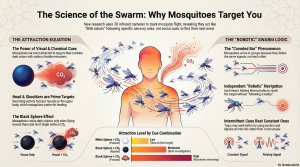
April 5, 2026 /Mpelembe Media/ — Recent research from Georgia Tech and MIT, published in Science Advances, explores how Aedes aegypti mosquitoes utilize different sensory signals to target their victims. Through experiments tracking the insects with 3-D infrared cameras, scientists discovered that mosquitoes are most strongly attracted to the combination of dark colors and carbon dioxide.
When study co-author Christopher Zuo acted as a human test subject, he confirmed that mosquitoes primarily target the head and shoulders, especially when drawn in by dark clothing. The data also revealed that mosquitoes do not actually follow a leader or swarm together intentionally; rather, they independently respond to the same visual and chemical cues, congregating in the same spot much like patrons independently drawn to the atmosphere of a “crowded bar”. Because these insects only stick around when both visual and chemical cues are present simultaneously, the researchers conclude that mosquito traps could be significantly improved by deploying intermittent cues and suction rather than continuous signals. Until those improved traps are built, the best way to avoid becoming a feast is to wear light colors.
Why You’re a Mosquito Magnet (And It’s Not Just Your Blood)
Introduction: The Summer StruggleWe’ve all been there: a perfect summer evening ruined by the realization that you have been chosen as the primary buffet for the local mosquito population. While your friends relax undisturbed, you are trapped in a frantic dance of swatting and scratching. It feels personal, almost like a targeted vendetta. However, new research published in Science Advances reveals that your status as a “mosquito magnet” isn’t a stroke of bad luck—it’s the result of a cold, calculated algorithm.By tracking the flight patterns of Aedes aegypti using 3-D infrared cameras, researchers from Georgia Tech and MIT have finally decoded the “robotic rules” that govern how these insects hunt. If you want to stop being the target, you have to understand the code.The Deadly Combo: Visuals Meet BreathTo figure out what makes a mosquito commit to a target, the Georgia Tech team placed hundreds of insects into a specialized chamber to observe their reactions to different stimuli. The results weren’t just about what the mosquitoes liked; they were about the specific “logic of the lock-on.”The researchers tested several scenarios to see what triggered a strike:
- The Black Sphere alone: Mostly ignored. Mosquitoes only noticed it if they happened to fly directly toward it, and even then, they didn’t stick around.
- The White Sphere + CO2: The insects could find the target, but they were slow and required close proximity to notice it.
- The Black Sphere + CO2: The ultimate attractant. This combination acted as a high-priority signal that locked the insects onto the target.The scientific takeaway is crucial: mosquitoes don’t just use a single sense. They require a simultaneous integration of chemical and visual cues. If both “keys”—the smell of your breath (CO2) and the visual contrast of your silhouette—aren’t present at the same time, the mosquito’s internal programming often resets, and it moves on.“Previous studies had shown that visual cues and carbon dioxide attract mosquitoes. But we didn’t know how they put those cues together to determine where to fly,” study co-author Christopher Zuo said in a statement. “They’re like little robots. We just had to figure out their rules.”The “Crowded Bar” Effect: They Aren’t Following Each OtherIt’s a common myth that mosquitoes follow a “pioneer” to find a host, resulting in a swarm. In reality, mosquitoes are rugged individualists—or rather, they are identical machines following the exact same programming.By analyzing 3-D flight trajectories, the MIT and Georgia Tech team determined that each mosquito arrives at a target independently. They aren’t following a leader; they are all reacting to the same environmental data points simultaneously. Study co-author David Hu uses a “crowded bar” analogy to explain this “social” behavior that isn’t actually social.“It’s like a crowded bar,” study co-author David Hu explained. “Customers aren’t there because they followed each other into the bar. They’re attracted by the same cues: drinks, music, and the atmosphere. The same is true of mosquitoes. Rather than following the leader, the insect follows the signals and happens to arrive at the same spot as the others. They’re good copies of each other.”The Target Zones: Why Your Head and Shoulders?Why do they always seem to go for your face? To find out, Christopher Zuo performed the ultimate sacrifice for science. He stepped into a chamber filled with hundreds of mosquitoes wearing various outfits, including a “half-and-half” suit that was black on one side and white on the other.The 3-D projections of the mosquito trajectories revealed a stark pattern: the swarm didn’t spread out. Instead, it was heavily concentrated around Zuo’s head and shoulders. This isn’t a coincidence; it’s where the “atmosphere” of the crowded bar is most intense. Your head and shoulders provide the highest concentration of CO2 from your breath combined with the sharpest visual contrast against the sky or background. To a mosquito, this area is the “VIP lounge” where all the signals—chemical and visual—converge perfectly.A Better Trap: Moving Beyond Constant SuctionThis “robotic” understanding is a game-changer for mosquito control technology. Most current traps are “always-on,” emitting a steady stream of CO2 or a constant light. But the research shows that mosquitoes are picky; they don’t stick around if the cues aren’t being reinforced in a way that mimics a living, breathing host.The study suggests a two-part strategy for the next generation of traps:
- Intermittent Cues: Instead of a steady stream, traps should pulse CO2 or alternate light signals. This keeps the mosquito’s “hunting” software engaged.
- Interval Suction: The suction mechanism should be synced to activate at intervals when the mosquitoes are most likely to be “locked on” to the intermittent cues.By mimicking the “start-stop” nature of biological signals, we can more effectively trick these biological robots into a trap they can’t escape.The Wardrobe Defense: A Practical TakeawayWhile we wait for better traps, the most immediate way to hack the mosquito’s algorithm is through your wardrobe. If a mosquito needs a “dark contrast” to complete its targeting equation, you can break the “lock-on” by reducing that contrast.The advice is simple: wear light colors. By opting for whites, tans, or pastels, you make your silhouette less distinct to the mosquito’s visual sensors. When you reduce the visual “half” of their required input, your exhaled CO2 alone may not be enough to keep them interested. You effectively become a “low-priority” target in their robotic eyes.Conclusion: Reframing the SwarmUnderstanding that mosquitoes are essentially “little robots” following a strict set of algorithmic rules changes the way we look at the summer swarm. It isn’t a personal attack; it’s a series of inputs and outputs. We are mobile signal towers, broadcasting our location through every breath and every dark piece of clothing.By recognizing that these insects require simultaneous signals to stay “locked on,” we can begin to coexist with the natural world—or at least avoid being the main course. This summer, remember that your “signals” dictate your experience. If you can break the code, you can break the swarm.