Understanding Zambia: Demographics, Linguistic Diversity, and the Push for AI
28 Feb. 2026 /Mpelembe Media/ — The artificial intelligence revolution is occurring primarily in English, which structurally excludes people who rely on local languages for their daily lives and deepens existing inequalities. Developing AI systems that “speak” local languages can bridge critical gaps in healthcare and education in the following ways:
Bridging Healthcare Gaps
Accessible Health Information: Local language AI can deliver crucial health information to rural communities that would otherwise be excluded by English-only pamphlets or systems.
Maternal Health Support: AI-powered conversational tools are already proving effective. For example, the “DA Health chatbot” currently serves over 14,000 mothers by providing maternal health information and support via WhatsApp in the Bemba and Nyanja languages. This acts as a lifeline, improving health outcomes and reducing language barriers in healthcare.
Specialized Health Datasets: Researchers are actively building domain-specific resources, such as a bilingual Bemba-English corpus containing 5,000 sentence pairs focused on health promotion, which paves the way for highly specialized health translation models.
Integration with Public Health: In the future, these local-language health chatbots could be linked directly to national public health systems to scale their impact.
Bridging Education Gaps
Mother-Tongue Instruction: Research consistently shows that children learn best in their mother tongue, especially in their early educational years. Educational AI tools built without local language support fail students who struggle simply because the materials are in English.
AI Tutoring Systems: An AI tutoring system tailored to local languages can explain complex concepts in a student’s native language—such as teaching mathematics in Bemba or reading stories in Tonga. This directly addresses one of the most persistent barriers to learning and comprehension.
Vocational E-Learning: Local language AI can also support e-learning tools that are monetized through vocational training, helping to bridge educational gaps for adults in the informal economy.
Demographic and Social Realities
Zambia’s socio-economic landscape is defined by a youthful, largely rural population that faces significant developmental challenges. According to the 2022 Census National Analytical Report, national literacy stands at 62.6% for individuals aged 5 and older. The country experiences a high economic dependency ratio of 3.9, meaning there are nearly four dependents for every employed person, with this ratio climbing to 4.8 in rural areas. Youth unemployment is notably high at 14.5%. Furthermore, the majority of the population relies on agriculture, with over two-thirds of households outside the Copperbelt and Lusaka engaged in crop cultivation and livestock raising. Understanding these demographics is crucial, as essential services like healthcare—where the crude death rate is 5.1 per 1,000 and maternal mortality remains a concern—must reach highly vulnerable populations.
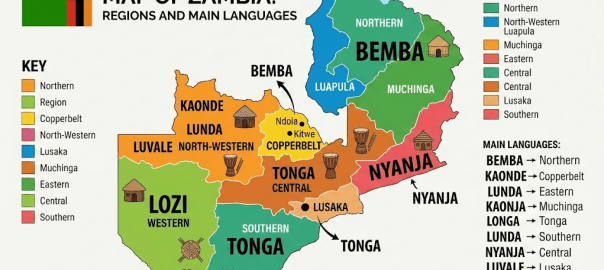
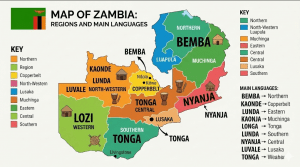
Deep Linguistic Diversity and Complexity Zambia features a rich and complex linguistic landscape of over 70 indigenous languages and dialects, which are the primary mediums of daily life. Academic studies reveal the intricate structures of these languages:
Bemba and its Dialects: Studies on Bemba and its regional dialects (such as Luunda and Ŋumbo) show rich variations in vocabulary (e.g., terms for agriculture, fishing, and kinship), word order, and phonological processes like vowel coalescence and semivocalisation. Urban varieties like Town Bemba also reflect the language’s dynamic evolution.
Mambwe and Nyanja: Mambwe exhibits complex morphophonological processes, including vowel harmony, gliding, and vowel fusion, which dictate verb structures. Similarly, Town Nyanja features unique tonal patterns that govern its grammar and distinguish it from related languages like Chichewa.
Senga and Lozi: The Senga language demonstrates high vitality, with 98% of surveyed speakers stating it is sufficient for expressing all thoughts and resolving disputes. In the Western Province, Lozi enjoys prominent status as a language of administration, economics, and cultural expression.
The Imperative for Local-Language AI Because the global artificial intelligence revolution is overwhelmingly English-centric, it risks structurally excluding the vast majority of Zambians whose daily lives operate in these local languages. To bridge the gap, Zambia’s tech ecosystem is actively working to digitize these languages.
Strategic Prioritization: Languages are being categorized into tiers for AI development, with Tier 1 (Bemba, Nyanja, Tonga, Lozi) prioritized for immediate benchmark development, and Tiers 2 and 3 targeted for community-driven data collection to prevent minority language exclusion.
Real-World Impact: There is massive demand for AI in education, health, and business. Early models, like the DA Health chatbot for maternal health and developing multi-language translation systems, prove that local-language AI can drastically improve service delivery and save lives.
Ecosystem Challenges: The push for digital inclusion is currently bottlenecked by severe data scarcity, lack of standardized orthographies, a “funding trap” of short-term grants, and limited compute infrastructure.
Ultimately, combining Zambia’s demographic realities with a deep understanding of its linguistic complexities is essential for building responsible, inclusive AI that serves the entire nation.
Download the full report Zambia’s Window of Opportunity