From Starlink to War Finance: Navigating the High-Stakes Paradox of the 2026 Economy
March 10, 2026 /Mpelembe Media/ — The provided text serves as a digital business and technology analysis hub known as the Mpelembe Network, focusing specifically on the African market. This platform highlights current global trends ranging from the geopolitical impact of war and inflation to advancements in artificial intelligence and satellite communications. It organizes content through a diverse system of trending tags that cover various academic disciplines, specific geographic regions, and major tech corporations. By bridging the gap between economic theory and modern innovation, the source offers a comprehensive view of the interconnected global economy. This specific snapshot emphasizes the growing importance of secure AI applications and data science within the modern business landscape.
The Digital Front Page: A Study in Contradiction
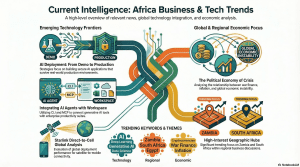
The current feed of the Africa Business – Mpelembe Network offers a jarring, yet essential, juxtaposition: the sleek technical architecture of AI agents sitting directly alongside the grim, grounded mechanics of war finance. To scan the “Trending” and “Latest” sections is to witness a collision between the aspirational and the existential. We see “Computational Neuroscience” and “Generative AI” trending alongside “The Political Economy of Crisis”—a reminder that our most advanced tools are being forged in an era of profound macroeconomic instability.For the modern professional, this isn’t just noise; it is the new signal. The overwhelming pace of change is no longer a linear progression of “better tech,” but a complex web where a breakthrough in satellite deployment in the Global South might be the only lifeline for a market strangled by inflationary pressures elsewhere. Understanding these specific intersections is no longer optional; it is the prerequisite for survival in a market that is simultaneously hyper-connected and deeply fractured.To navigate this frontier, we must look beyond the individual headlines and synthesize the underlying shifts. The following takeaways distill the current landscape from the perspective of both the builder and the strategist, reconciling high-tech optimism with the sobering realities of the global fiscal environment.
Connectivity Without Borders: The Starlink Direct-to-Cell Paradigm
The quest for universal connectivity has entered a transformative phase that renders traditional terrestrial infrastructure—towers, cables, and relays—increasingly obsolete in high-risk or remote environments. The move toward “Direct-to-Cell” capabilities represents a paradigm shift that bypasses the capital-heavy constraints of the past.”Starlink Direct-to-Cell: Global Deployment and Performance Analysis”This technology moves the cellular tower into the stars, promising a ubiquitous network that ignores borders and geographical barriers. However, the true insight lies in its timing. In regions cited in the Mpelembe Network tags, such as Ukraine or Russia, this “Direct-to-Cell” deployment isn’t just a convenience; it is a strategic necessity. Where war finance and infrastructure destruction have crippled traditional telecommunications, satellite-to-phone tech provides a resilient, decentralized alternative that keeps markets functioning even when the ground-level economy is in crisis.
Moving AI “Beyond the Demo”
As we look toward the benchmarks set by “Inside ODSC 2026,” it is clear that the industry has outgrown the era of the impressive chatbot demo. We have entered a rigorous, more mature phase where the value of an AI application is measured by its ability to survive the “wild” of a live production setting. This shift from experimental “wow” moments to foundational business infrastructure requires a move away from simple interfaces toward robust, secure architectures.To survive the transition to production, AI systems must be anchored by three non-negotiable pillars:
- Security: Moving beyond basic encryption to building models that can resist adversarial attacks and protect data integrity in high-stakes corporate environments.
- Scalability: Ensuring that AI frameworks can handle global demand without the latency or performance degradation that typically plagues experimental builds.
- Visionary Building: Shifting from the role of a “user” of AI tools to an “architect” of foundational systems that solve specific industry pain points.
The Quiet Revolution: Integrating AI Agents via MCP
While much of the public discourse focuses on AI as a destination—a website or a chat window—the real productivity revolution is occurring in the “plumbing” of our digital workspaces. The technical integration of AI agents into ecosystems like Google Workspace, facilitated by CLI (Command Line Interface) and MCP (Model Context Protocol), marks the end of the AI-as-a-chatbot era.The Model Context Protocol (MCP) is particularly significant because it allows different AI models to share context seamlessly. This technical bridge turns AI from an isolated tool into a functional workspace collaborator that understands the totality of a project across different platforms. By moving AI integration into the command line, developers and professionals are stripping away the friction of human-to-AI “chatting,” allowing agents to coordinate workflows and manage data as silent, effective partners in daily operations.
The Stark Reality of the Global Political Economy
It is easy to become enamored with the high-tech optimism of “Deep Learning” and satellite arrays, but these innovations exist within the friction of a broader economic reality. The Mpelembe Network’s focus on the “Political Economy of Crisis” serves as a necessary grounding mechanism for the tech industry.”The Political Economy of Crisis, War Finance, and Inflation”This is where the paradox of 2026 becomes clear. While digital connectivity expands at an unprecedented rate, the fiscal foundations of nations are being tested by war finance and currency instability. This economic friction acts as both a hindrance and a catalyst; while inflation makes the hardware for large-scale AI deployment more expensive, the urgency of crisis forces a leap toward more efficient, automated solutions. High-tech growth and macroeconomic volatility are now two sides of the same coin, with one frequently accelerating the adoption of the other out of sheer necessity.
The New Geography of Innovation: Neuroscience and Behavior
The geography of innovation is no longer a Western-centric map. The trending topics across the Mpelembe Network highlight a fascinating intersection of diverse regions—from Zambia and South Africa to China and the Bhutan Centre for Media and Democracy. This isn’t just about location; it is about a cross-disciplinary approach that merges “Computational Neuroscience” with “Human Behavior.”In tech hubs across Southern Africa, there is an increasing focus on using deep learning to decode human behavior in emerging markets. By leveraging neuroscience, these innovators are building AI that doesn’t just process data but understands the psychological and cultural nuances of its users. This democratization of high-level tech discourse suggests that the next breakthrough in how AI interacts with human society is just as likely to emerge from a tech hub in Zambia as it is from London or New York.
Conclusion: The Synthesis of Progress and Prudence
As we look toward the horizon, the threads of AI, global connectivity, and the macroeconomy are becoming inextricably woven together. The potential of “Direct-to-Cell” technology and production-ready AI offers a glimpse of a hyper-connected, automated world. Yet, these advancements remain tethered to the realities of inflation and political crisis.The challenge for the modern professional is to maintain this duality: to be bold enough to build “Beyond the Demo” while being prudent enough to account for the pressures of a volatile global economy. In a climate defined by crisis and inflation, how will you ensure your own business strategy is as secure and resilient as the AI applications you intend to build?