From Intake to Invoice: Proven Strategies to Streamline Your Auto Shop’s Workflow
Sat, May 16 2026 /Mpelembe Media/ — In the world of professional automotive repair, a shop is more than a building with lifts; it is a living ecosystem where the workflow serves as the heartbeat. As a technician or shop manager, you must understand that a structured workflow is the absolute divider between an “Excellent” high-performing shop and one that is spiraling toward failure. When you master this lifecycle, you maximize bay utilization and eliminate the “revenue leaks” that kill profitability.
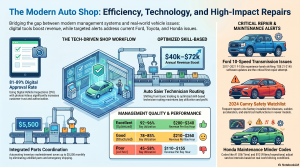
1. Digital Transformation and Shop Management A major focus across the sources is the transition from paper-based operations to digital Garage Management Software (GMS) to run automotive shops more efficiently. Features like online appointment scheduling, real-time workflow tracking, automated MOT reminders, and integrated accounting are essential for modernizing operations. Additionally, Digital Vehicle Inspections (DVIs) are heavily emphasized as a way to build customer trust by providing photo and video evidence of needed repairs, which significantly increases repair order approvals.
2. Workflow and Labor Optimization The texts detail strategies for maximizing shop profitability by improving technician workflow and properly setting labor rates. Best practices include skill-based job routing (assigning complex diagnostics to master techs and standard repairs to junior techs) and utilizing standardized labor guides (like MOTOR or ALLDATA) to ensure accurate, profitable, and consistent repair estimates. The sources also cover the legal and operational requirements for providing compliant, transparent estimates to customers.
3. Parts and Inventory Management Effective inventory management is critical to preventing bottlenecks and reducing vehicle downtime. Best practices include maintaining accurate records, establishing safety stock levels, utilizing Just-In-Time (JIT) ordering, and integrating inventory software with suppliers. The sources outline a strict procurement workflow—starting with a Material Requisition Note (MRN), generating a Purchase Order (PO), and confirming with a Goods Received Note (GRN)—to prevent unauthorized purchases and revenue leakage.
4. Vehicle Maintenance Schedules and Common Defects The materials provide comprehensive factory maintenance schedules for popular vehicles, emphasizing the importance of routine care (like oil changes, tire rotations, and transmission fluid service) for the Ford F-150, Toyota Camry, and Honda Civic. They also document widespread mechanical issues that shops should look out for, such as:
- Ford F-150: Harsh shifting and failures in the 10R80 10-speed transmission, often requiring software recalibrations or valve body replacements.
- Toyota Camry: Torque converter shudder and 8-speed transmission harsh shifting, as well as oil consumption issues in older 2.4L engines.
- Honda Civic: Specific technical service bulletins, such as fixing rear hatch water intrusion via drain plug installation.
Under the Hood: 5 Surprising Realities of Modern Car Ownership and Repair
1. Introduction: The High-Tech Blind Spot
For decades, the standard for a “reliable” car was simple: turn the key, and it runs for 200,000 miles with nothing but routine oil changes. However, as we navigate the landscape of 2026, that traditional definition of reliability is meeting a complex new reality. Modern vehicles have evolved from mechanical machines into rolling data centers. Consequently, “maintenance” today is as much about managing binary code and system integrations as it is about wrenches and lubricants. This shift has created a high-tech blind spot where even the industry’s most legendary icons face hidden defects that traditional mechanical intuition can no longer predict.
2. The “Reliability” Paradox: When Icons Falter
The Toyota Camry has long been the gold standard for mid-size sedan reliability. Yet, the “Lemon Report” data on the 2024 model reveals a counter-intuitive trend: critical failures are appearing within the first few hundred miles. The most pressing issues involve factory-installed Bridgestone and Firestone tires, which have shown sudden tread separation and blowouts shortly after delivery.Beyond the rubber, there is a deeper integration crisis. Owners have documented safety irregularities, including sudden acceleration and “lurching” while the brakes are firmly applied. These aren’t just mechanical slips; they are often tied to the vehicle’s electronic brake systems and their interaction with adaptive cruise control and forward collision warning sensors.“Within 1,000 miles of buying the car, I had a blowout. The dealer blamed the road, but this was clearly a defective tire,” noted one owner in a recent federal safety complaint.For the modern owner, the lesson is clear: a brand’s reputation for reliability does not exempt a new vehicle from the “infant mortality” of high-tech components.
3. The Ghost in the Gearbox: Why Your Next “Mechanical” Fix is Actually a Software Update
If your truck is shifting harshly or “clunking” between gears—specifically the notorious 3rd-to-5th gear transition—your first instinct might be to fear a $6,000 transmission replacement. In 2026, you might just need a technician with a dealer-level diagnostic scan tool.The Ford F-150’s 10R80 10-speed transmission frequently suffers from what we call “mapping errors.” Rather than broken hardware, the transmission’s “adaptive learning software” often gets lost “hunting” for the correct gear based on driver habits. Ford’s Technical Service Bulletin (TSB) 21-2145 addresses these hard shifts through software recalibration.This is a complete reversal from the 2015–2017 models equipped with the older 6R80 6-speed units. In those trucks, a “slip” usually meant a physical clutch pack failure requiring a total mechanical overhaul. Today, the “ghost” is in the code. Unless a shop has invested in high-level diagnostic software, they are effectively blind to these digital fixes.
4. The $72,000 Communication Gap: The Hidden Cost of Paper Checklists
From a service operations perspective, the difference between a “Fair” shop and an “Excellent” one isn’t just the skill of the mechanics—it’s the throughput of the data. Moving from paper checklists to an optimized Digital Vehicle Inspection (DVI) system can increase annual revenue by $40,000 to $72,000 for a typical 3-bay shop.As a consultant, I look at KPIs like Bay Utilization . A “Fair” shop using paper tracking typically hovers between 62–72% utilization. An “Excellent” digital shop hits 92–96% . Why? Because digital systems eliminate “unbilled parts” and drastically reduce “unbilled time.” Integrated inventory tracking can save a shop $800 to $1,400 a month just by eliminating emergency shipping fees for parts that should have been in stock.The most telling metric, however, is the customer’s “Effective Labor Rate” and authorization behavior:
- Phone Calls: 38–45% authorization rate ( $180–$ 240 average additional work).
- Digital Estimates (Photos/Video): 81–89% authorization rate ( $340–$ 420 average additional work ).When a customer sees a high-definition photo of their own leaking water pump, the “trust gap” vanishes, and the revenue per bay hour jumps from $200 to over $340.
5. The Hybrid Maintenance Myth: Different, Not More
There is a persistent myth that hybrids like the Honda Civic Hybrid are “burdensome” to maintain. The reality is that they simply follow a different rhythm. While hybrids feature unique “Blue-Highlighted” services in the manual—such as 15,000-mile high-voltage battery system inspections and 30,000-mile battery cooling loop services—they often stay in the shop for less time than their gas-only counterparts.A key distinction is the transmission. Modern Honda hybrids utilize an e-CVT that requires specific, specialized fluid changes to maintain the precision of the electric motor-generator interface. However, because these vehicles rely on regenerative braking, the physical wear on traditional pads and rotors is significantly reduced. Hybrid maintenance isn’t about fixing things that break; it’s about maintaining the software-calibrated efficiency of the powertrain.
6. The Design Flaw “Deep Dive”: The Case of the Leaking Hatch
Even in a world of sensors, basic physics can still trip up a manufacturer. A prime example is the 2022–2024 Honda Civic Hatchback. Owners have reported water dripping from the interior trim or pooling in the cargo area—a classic manufacturing oversight where water fails to drain from the hatch panel.The “fix” detailed in TSB 24-110 contains a striking journalistic irony. To repair this modern, high-tech vehicle, a technician must print a PDF of the service bulletin at “Actual Size” to use as a physical paper template. They then use a 5mm drill bit to create new holes in the hatch for drain plugs. It is a remarkably low-tech solution for a sophisticated car, and one that Honda explicitly warns is not for the “do-it-yourselfer.”CUSTOMER INFORMATION: “The information in this bulletin is intended for use only by skilled technicians who have the proper tools, equipment, and training… These procedures should not be attempted by ‘do-it-yourselfers.'”
7. Conclusion: The Future is Transparent (and Digital)
The automotive industry has reached a tipping point. The “new trust” in repair is no longer built on a greasy handshake or a mechanic’s verbal word. It is built on a foundation of digital transparency—high-resolution photos, real-time video of failed components, and automated workflows that keep the owner informed every second the car is on the lift.As vehicles become more complex, the only way to maintain them effectively is to bridge the gap between the mechanical and the digital. Ask yourself: The next time your service advisor recommends a $1,200 repair, would you trust them if they couldn’t send a picture of the problem to your phone?