A Continent Divided: How Zambia’s Hot Springs Point to the Birth of a New Ocean
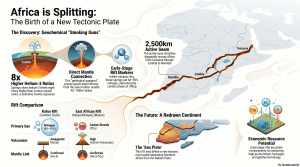
Thur, May 14 2026 /Mpelembe Media/ — Geologists have discovered unambiguous evidence that the Earth’s crust is actively splitting apart in Zambia’s Kafue Rift, a segment of the 2,500-kilometer-long Southwest African Rift System (SWARS). By analyzing the gases bubbling up from geothermal springs, researchers found unusually high ratios of Helium-3 to Helium-4, along with carbon dioxide signatures that match the mantle. This unique chemical fingerprint proves that these gases are escaping directly from the semi-molten mantle—located between 40 and 160 kilometers below ground—indicating that the faults have successfully fractured the entire crust.
This deep fluid connection serves as the first direct geochemical proof that the SWARS is an active tectonic boundary. This active rifting could eventually split sub-Saharan Africa in half and form a new ocean basin over tens of millions of years.
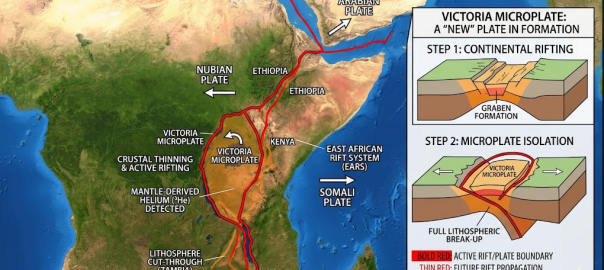
While the well-known East African Rift System is often thought of as the primary site of Africa’s eventual break-up, researchers now believe that the SWARS may actually be a more mechanically efficient pathway for continental rupture. The SWARS perfectly aligns with ancient Precambrian crustal weaknesses and the tectonic pull from surrounding mid-ocean ridges, giving it a lower structural threshold to successfully tear the continent apart.
Additionally, because the SWARS is in a very early, “amagmatic” stage of rifting, it has not yet been flooded by volcanic carbon dioxide. This lack of dilution makes the region a highly promising frontier for extracting valuable, high-purity resources, including geothermal energy, crucial helium reserves, and natural “white” hydrogen.
The Continent is Cracking: 6 Surprising Takeaways from Africa’s Hidden Tectonic Rift
1. Introduction: The Ground Beneath Your Feet is a Work in Progress
We tend to think of the continents as permanent, unmoving anchors of our world. But beneath the surface, the Earth is far from settled, and new research suggests a massive, slow-motion “divorce” is taking place across the heart of Africa.The first signs of this breakup are bubbling up in the Kafue Rift of Zambia, where hot springs are venting gases from the deep Earth. By decoding the chemical “fingerprints” of these gases, geologists are beginning to map a tectonic shift that could eventually reshape the planet’s map.
2. The “Bubbling Gun”: Mantle Helium in the “Wrong” Place
The most significant evidence of this tectonic split comes from helium, which acts as a “geological passport” for fluids traveling from the interior. In the Bwengwa and Gwisho hot springs, researchers found helium isotopes that proved the gas had traveled from the Earth’s mantle, 40 to 160 kilometers below the surface.Helium-3 is primordial—it has been trapped in the mantle since the Earth was formed—while Helium-4 is common and produced by radioactive decay in the crust. In the Kafue Rift, scientists found helium-3 levels eight times higher than what is found in normal crustal rock, proving the rift has fractured deeply enough to tap into the mantle.”The hot springs along the Kafue rift of Zambia have helium isotope signatures which indicate that the springs have a direct connection with the Earth’s mantle, which lies between 40 and 160km below the Earth’s surface,” said Professor Mike Daly of the University of Oxford.
3. The Rise of the “San Plate” and the Cratonic Divide
This discovery isn’t just about a few springs; it reveals a 2,500-kilometer diagonal slash across the continent known as the Southwest African Rift System (SWARS). This massive zone of stretching suggests the Nubian Plate is partitioning into smaller pieces, including a newly proposed micro-plate called the “San Plate.”The rift is currently unzipping along the boundary between two ancient, stable pieces of the continent: the Congo Craton to the north and the Kalahari Craton to the south. This tectonic boundary links several critical regions:
- Tanzania: Connecting at the Rukwa Rift and Rungwe Volcanic Province.
- Zambia: Cutting through the Luano, Luangwa, and Kafue rifts.
- Botswana: Extending into the seismic Okavango Rift.
- Namibia: Reaching the Eiseb Rift and potentially connecting to the Mid-Atlantic Ridge via the Walvis Ridge.
4. Why Zambia Might “Beat” Kenya in the Race to an Ocean
When we think of Africa splitting, we usually imagine the famous Great Rift Valley in Kenya (the East African Rift System, or EARS). However, the “subtle” rift in Zambia might actually be a more efficient path for a future ocean.While the EARS is more volcanic and dramatic, it is “hemmed in” by surrounding tectonic stresses that inhibit its expansion. In contrast, the SWARS follows ancient weaknesses in the Earth’s crust and is favorably aligned with the pull from mid-ocean ridges, creating a lower “mechanical threshold” for a total breakup.”This fluid connection is evidence that the fault boundary of the Kafue Rift is active and therefore the Southwest African Rift Zone is too — and may be an early indication of the break-up of sub-Saharan Africa,” Daly noted.
5. “Amagmatic” Rifts are Economic Goldmines
The Kafue Rift is currently “amagmatic,” which simply means it is a rift without volcanic activity or magma reaching the surface. Paradoxically, this lack of volcanic fire is an economic blessing for the region.In mature rifts, volcanic carbon dioxide ( $CO_2$ ) often flushes away other valuable gases, but because the Kafue Rift is in an early, quiet stage, it allows for the accumulation of high-purity helium and “white hydrogen”—a clean energy carrier produced by water-rock reactions. Additionally, the region shows exceptional geothermal potential, with heat flow exceeding 120°C per kilometer.
6. The Nitrogen Secret: A Sign of Tectonic Youth
Scientists can determine the age of a rift by looking at its gas chemistry. In mature, volcanic rifts, the air is flooded with $CO_2$ , but the gases bubbling up in the Kafue samples are 84% to 98% nitrogen.This “geochemical fingerprint” acts as a geological clock, indicating that while the faults have reached the mantle, the magmatic flux is still very low. The mantle fluids are currently acting as a thermal engine, mobilizing nitrogen that has been trapped in ancient rocks for billions of years, signaling that we are witnessing the very first stages of a continent’s birth.”The Southwestern African Rift System… has the required rift-related features, and regional basement fabrics — inherent weaknesses in the crust — favorably aligned to the surrounding mid-ocean ridges and continental geomorphology. This relationship may offer a much lower strength threshold for continental break-up,” the research team concluded in Frontiers in Earth Science .
7. Conclusion: A Continent in Transition
The discovery in Zambia reminds us that our planet is a living, changing entity. While the full separation of the African continent will take tens of millions of years, the mantle-derived gases in the Kafue Rift are definitive proof that the process is already underway.The “quiet” bubbles of a Zambian spring are more than just a curiosity; they are evidence that the map of the world is still being written. How does our perspective of the “permanent” ground change when we realize that the very continent we stand on is in the middle of a slow-motion departure?