
Beyond the Boutique: How Tech, Automation, and Logistics are Reshaping Luxury Gifting
Tue, Jun 16 2026 /Mpelembe Media/ — The global luxury goods market is positioned to reach USD $419 billion by 2028. For a global luxury house, this is not a target to be passively observed, but a market share to be aggressively defended. As online sales are forecast to ascend to 18.2% by 2027, the traditional “boutique-only” model has transitioned from an asset into a strategic bottleneck. We cannot rely on physical storefronts to carry the weight of brand prestige when the digital channel is growing three times faster than offline.
To capture our portion of the $65 billion projected digital luxury revenue by 2025, we must deploy “Premium Delivery” not as a logistical utility, but as a primary mechanism to protect brand equity in a non-physical environment. This strategy bridges the gap between digital browsing and physical exclusivity, ensuring that the unboxing at a customer’s residence is indistinguishable from the service provided on Avenue Montaigne. To execute this, we will transition to a global logistical architecture engineered for speed, exclusivity, and the emerging circular economy.
The provided documents explore the concept of elegance and luxury across multiple dimensions, spanning personal lifestyle habits, digital e-commerce experiences, and the complex logistics of shipping high-value goods.
- The Philosophy and Habits of Elegance: True luxury is not fundamentally about wealth or exclusivity, but rather presence, intentionality, and refinement. Elegance can be cultivated through habits like moving with poise, speaking with intention, practicing selective consumption, embracing silence, and curating a signature scent. In broader disciplines like mathematics, science, and engineering, “elegance” similarly describes resolving highly complex problems with unusually simple, effective, and parsimonious solutions.
- Friction in Digital Luxury and Gifting UX: The digital luxury experience frequently suffers when platforms fail to meet consumer expectations. For instance, an analysis of the “Elegance Possessions” ecosystem reveals a severe mismatch: users seeking high-end transactional gift curation are instead met with a manual, static inventory-tracking app filled with generic stock photography. To resolve this digital friction, e-commerce experts recommend optimizing the gifting user experience (UX) by prominently displaying gift options on product pages, allowing users to designate gifts in their carts, separating billing and shipping fields, and utilizing AI-driven conversational questionnaires.
- The Rise of Automated and Concierge Gifting: The corporate and personal gifting market is evolving rapidly to remove administrative burdens. Modern gifting platforms—such as Zest, Goody, Brilliant, and ekuBOX—offer “concierge” services and scalable automations. These platforms allow buyers to send luxury gifts without needing the recipient’s physical address; instead, recipients receive a digital link to select their preferred gift variant and input their own delivery details, virtually eliminating delivery failures and unwanted items. Gift curation increasingly focuses on the “Eat, Keep, Use” philosophy, ensuring that recipients get immediate sensory delight alongside long-lasting functional and decorative items.
- High-Value Logistics and Security: Shipping luxury items (like fine jewelry, designer fashion, and high-end electronics) requires extreme security measures and a premium “last-mile” experience. Logistics best practices include packing under video surveillance, using double boxes and clear tamper-evident tape, requiring adult signatures, and using discreet, neutral labeling to deter theft. Furthermore, companies like DHL are developing “Premium Delivery” services that mimic a “boutique handover,” utilizing uniformed couriers and flexible delivery windows to bridge the gap between the in-store and online shopping experience.
- Sustainability and Future Regulations: Luxury supply chains are facing strict environmental mandates. By August 2026, the EU will enforce regulations requiring that empty void space in shipping parcels not exceed 50% and banning harmful PFAS “forever chemicals” often used in high-gloss premium packaging. In response, the luxury industry is investing in sustainable aviation fuels, green last-mile delivery vehicles, and optimized reverse logistics for returns and pre-owned “circular” goods.
Suggested Headlines
Depending on the specific focus you want to take, here are several headline options for this compendium:
- The Logistics of Luxury: Re-Engineering High-End Gifting and Secure Delivery (Focus on supply chain, security, and e-commerce mechanics)
- The Friction of Digital Elegance: Transforming the Luxury Gifting Experience (Focus on the UX challenges and solutions in digital luxury)
- From Poise to Parcel: The Modern Anatomy of Elegance and Lifestyle (Focus on the blend of personal elegance habits and the physical delivery of luxury goods)
- Beyond the Boutique: How Tech, Automation, and Logistics are Reshaping Luxury Gifting (Focus on modern concierge platforms and the premium last-mile delivery)
- Curating Elegance: The Intersection of Intentional Living, Concierge Commerce, and High-Value Logistics (A comprehensive option that touches on all major themes)
The End of the Spreadsheet Abyss: Why the $306 Billion Gifting Industry is Going High-Tech
Introduction: The Corporate Gifter’s Dilemma
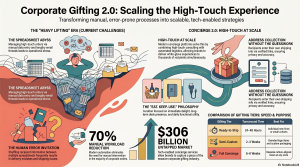
For years, the departmental “gifting season” has been synonymous with a specific kind of operational dread. It begins with the manual entry of hundreds of names into rows and columns, follows the “abyss” of back-and-forth emails to confirm shipping details, and ends with the high-stakes stress of shunting sensitive data between fragmented, error-prone spreadsheets. Historically, this logistical nightmare was simply the price of doing business.However, the landscape is shifting. Corporate gifting is a $306 billion industry, yet for most retail brands, it remains a painfully manual, untapped growth channel. While consumer e-commerce has moved toward one-click simplicity, gifting has remained stuck in the past—until now. A new era of “Concierge” technology and luxury logistics is finally bridging the gap between brand equity and scalable exclusivity, allowing companies to transition from simple transactions to deep, strategic relationship building.
Takeaway 1: Automation is Making “White-Glove” Scalable
There is a common misconception that technology removes the personal element from gifting. In reality, the most innovative platforms prove that automation is exactly what makes true “white-glove” service possible. By moving from manual uploads to automated status updates and verified addresses, teams can manage high-touch, customized orders in minutes rather than days.Consider the case of Milk Bar. By implementing self-service storefronts and automated order management, they successfully automated 70% of their corporate orders. This shift didn’t eliminate the human touch; it filtered the volume. By automating the high-frequency, lower-complexity orders, their team was freed to provide dedicated “concierge” service to high-value opportunities—typically orders over $1,000—where the human connection matters most.”I loved waking up each morning and seeing the orders placed overnight that I didn’t have to touch. I’d wake up and see $30K in revenue made while I was sleeping.” — Alex Ingram, Co-Founder & CEO of Zest (quoting Amelia Heller of Milk Bar)
Takeaway 2: You Don’t Actually Need an Address to Send a Gift
In a world defined by remote and hybrid work, the physical office is no longer a reliable destination. The “Address Collection Service” and “No Address Needed” models used by platforms like Goody and Packed with Purpose have turned a major logistical hurdle into a moment of recipient autonomy.Instead of chasing down shipping data, senders provide a link—a touchpoint that respects the recipient’s professional etiquette and dietary requirements through a “Gift of Choice” model. This recipient-led entry is a masterclass in operational efficiency:
- Automated Validation: Recipient-led entry includes real-time bulk address validation, virtually eliminating the “returned to sender” errors that plague manual databases.
- Reduced Administrative Burden: Senders are no longer responsible for maintaining sensitive, shifting home address data, moving the liability of data accuracy to the recipient.
- Professional Etiquette: It allows recipients to swap gifts or politely decline for compliance reasons, ensuring the gesture remains a bridge-builder rather than a dietary or professional inconvenience.
Takeaway 3: Gifting is the New Secret Weapon for Sales Growth
Gifting is rapidly migrating out of the Human Resources silo and into the heart of Sales Prospecting. It is no longer just a “retention” play; it is a growth engine. Strategically, this is about building “stronger champions” within unengaged accounts, using tangible gratitude to break through the noise of inundated inboxes.Critically, this high-tech gifting isn’t a siloed activity. Modern platforms integrate directly into a brand’s existing tech stack—connecting to CRMs and marketing automation tools. This allows sales teams to track gifting engagement as a measurable KPI, treating a physical gift with the same data-driven rigor as a digital ad campaign.”Goody helped us build stronger champions within unengaged accounts, which is huge for us. With everyone inundated with emails, Goody makes such a difference.” — Dale Bachman, Enterprise Relationship Manager, Intercom
Takeaway 4: The “Logistics of Luxury” is Bringing the Boutique Home
As online luxury retail grows three times faster than its offline counterpart, the “final delivery experience” has become a vital extension of a brand’s identity. The DHL “Logistics of Luxury” report highlights that “Premium Delivery” is no longer a perk; it is a strategic necessity to close the gap between the in-store boutique and the doorstep.To maintain brand equity, organizations are moving away from standard courier services in favor of four key premium improvements:
- Timing: Standard delivery relies on uncertain windows; Premium offers two-hour delivery windows, same-day service, or specific weekend slots to cater to elite lifestyles.
- Boutique Handover: Standard involves generic e-commerce boxes; Premium features luxury branded packaging delivered by uniformed couriers with personalized pre-delivery notifications.
- Sustainability: Standard relies on fossil-fuel fleets; Premium prioritizes green vehicles (like Battery Electric Vehicles) and eco-friendly packaging.
- Effortless Returns: Standard is friction-heavy; Premium offers label-less, immediate return processes that facilitate the circular economy.
Takeaway 5: The Rise of the “Circular” and Sustainable Gift
The gifting industry is seeing a seismic shift toward “re-commerce.” Currently, 65% of consumers take a company’s commitment to sustainable development into account when making a purchase, and Gen Z and Millennials are the most likely to spend on sustainable luxury.This demand is forcing a shift in supply chain archetypes toward Omnichannel Processing Centers (OPCs). These are not traditional warehouses; they are centers designed to handle the complexity of the circular economy. This is a massive shift in the future of work: over the next decade, while B2B logistics remain dominant, circular processing is expected to increase three to seven-fold, and re-commerce processing is projected to grow two to five-fold.The Reflaunt x DHL partnership in Poland serves as a living case study for this transition, where a single OPC handles firsthand fulfillment, grading, photo-shooting for resale, and end-of-life recycling. As Stephanie Crespin notes, this model effectively tears down the walls between e-commerce and re-commerce.”Reflaunt’s been shaking things up, by tearing down the walls of e-commerce and re-commerce. Our cooperation with DHL opens the door to a seamless circular supply chain. Imagine one place handling firsthand fulfillment, returns, resale management, and other end-of-life solutions such as recycling.” — Stephanie Crespin, CEO, Reflaunt
Conclusion: From Transactions to Relationships
The “Spreadsheet Abyss” is more than a nuisance—it is a growth bottleneck. The transition from logistical burden to relationship-driven gifting is a competitive necessity for any brand looking to scale. Whether you are a small business or a Fortune 500 entity, the future belongs to those who use omnichannel integration to clear the path for human connection.As you evaluate your organization’s current trajectory, ask yourself: Is your team currently drowning in the manual effort of transactions, or are they empowered by technology to build the meaningful connections that drive long-term equity?
Source: Elegance Possesions Boutique
Website: https://style.mpelembe.net/