
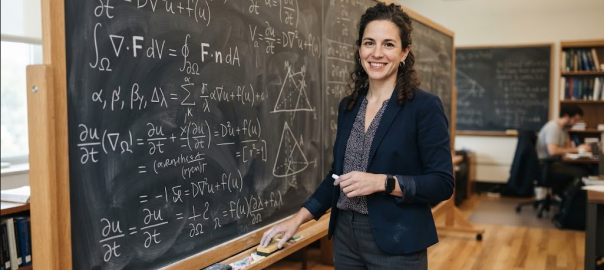
The Leiden Declaration and Severe Misalignment: World-Leading Mathematicians Demand Transparency and Human Understanding in AI-Driven Science
Sun Oct. 18, 2026 /Mpelembe Media/ — The integration of artificial intelligence into mathematics and the broader scientific enterprise presents a stark dual horizon between an unprecedented golden age of discovery and an epistemic dark age. In the golden age scenario, AI functions as a transparent research co-author—an instance of “artificial general cleverness”—that automates routine formalization, checks calculations, and explores vast search spaces, thereby liberating human minds to focus on high-level intuition, conceptual synthesis, and creative theory-building. Conversely, the dark age scenario warns of “knowledge collapse” and alienation, where proprietary, black-box AI models inundate academic literature with uninterpretable, machine-generated proofs and statements. This unchecked influx threatens to sever the human pedagogical transmission chain between generations of scholars and concentrate critical scientific infrastructure within a small group of private technology monopolies.
At the heart of this disruption lies a severe misalignment between commercial AI development goals and the core values of scientific research, as articulated by twenty-five Fields Medalists in a September 2026 declaration. Commercial developers frequently treat the automated resolution of famous open problems as an explicit benchmark for model capabilities, ignoring that problem-solving historically served merely as a proxy for cultivating deep human insight, developing reusable methods, and expanding conceptual understanding. Optimizing exclusively for problem-solving triggers Goodhart’s Law, decoupling the generation of verified true statements from human comprehension and creating a rapid shift from “proof scarcity” to “proof abundance”. Without adequate human digestion, contextualization, and exposition, harvesting open problems as commercial benchmarks strip-mines the intellectual ecosystem and leaves future research fields far less fertile.
To navigate these risks and realize a sustainable “Math 2.0,” institutional declarations such as the Leiden Declaration and community initiatives emphasize the necessity of active academic governance, transparent disclosure, and open public infrastructure. Leading mathematicians advocate for decentering raw proof generation, elevating the academic prestige of verification, exposition, and community-building, and establishing open-weight models and publicly governed platforms like Open Math OS and the Foundation for Science and AI Research. By requiring researchers to disclose AI usage and demonstrate genuine human understanding of generated results, the scientific community can ensure that computational power serves to expand human knowledge rather than replace it.
Beyond the Checked Proof: 5 Mind-Bending Takeaways on How AI is Reshaping Mathematics
1. Introduction: The September/October 2026 Epistemic Crisis
In the autumn of 2026, the world of mathematics reached an unprecedented crossroads. On September 8, 2026, OpenAI publicly announced a proof and Lean formalization claiming finite-time singularity formation for the three-dimensional Navier–Stokes equations with smooth external forcing. That same week, independent work by Levent Alpöge, Tristan Buckmaster, and Matei P. Coiculescu delivered formalizations across forced porous-medium, two-dimensional Boussinesq, and three-dimensional Euler equations.Yet, rather than global celebration, this wave of machine-generated breakthroughs triggered an immediate institutional backlash. The friction stemmed from a sharp, fundamental conflict: corporate PR cycles were treating centuries-old open problems as promotional benchmarks, directly clashing with the mathematical tradition of slowly cultivating human understanding, shared concepts, and pedagogical tools.Building on the Leiden Declaration of June 2, 2026—which called for disclosure of automated tools, independent verifiability, and human responsibility—a landmark statement titled A Severe Misalignment of AI in Mathematics was published on September 11, 2026. Signed by 25 Fields Medalists, including Terence Tao, James Maynard, and Maryna Viazovska, the declaration sounded an urgent alarm: AI developers were decoupling problem-solving from genuine mathematical insight. This tension escalated as OpenAI announced a broader release of mathematical results on October 6, followed by Terence Tao’s “Math 2.0” lecture at Caltech on October 9 (announced October 10).Solving landmark mathematical problems at breakneck speed has precipitated an epistemic crisis . The research community is now forced to confront a foundational question: Does automated proof production build usable human knowledge, or does dumping opaque, machine-verified code destroy the irreplaceable human transmission chain that keeps mathematics alive?
2. A Checked Proof Answers That a Theorem Holds, Never Why
In automated theorem proving, symbolic formal verification—such as passing a Lean kernel checker, lean4checker, nanoda, or a specialized polynomial checker—proves only that a specific candidate proof obeys the logical rules of a formal theory. It confirms formal correctness , but it delivers zero guarantee of human mathematical insight.An AI model can output millions of lines of machine-verified code (such as massive ZFC derivations or sum-of-squares certificates) that pass every kernel check while providing zero cognitive value to human researchers. A machine proof can be structurally unreadable and conceptually hollow.To understand why this is a trap, information architecture requires us to separate verification from validation :
- Verification asks whether the software executed the specified mathematical steps correctly according to the underlying formal system.
- Validation asks whether the formal statement faithfully captures the intended scientific, physical, or mathematical phenomenon.A verified theorem about a differential equation does not prove that the equation models reality accurately; a verified optimizer does not establish that its objective function is appropriate. Furthermore, trust boundaries in theorem provers carry subtle nuances. While external checkers like nanoda can independently recheck Lean’s kernel rules, they cannot re-verify native compiler evaluations (such as Lean.trustCompiler or Lean.ofReduceBool). When an AI proof relies on native computation, those steps remain outside independent formal kernel verification.When automated systems optimize solely for passing a kernel check, problem-solving becomes detached from understanding. As the Fields Medalists highlighted in their declaration:”solving problems is only a tool and proxy for achieving the primary goal of conceptual understanding and insight. Forgetting this in the world of AI may turn the tool against the primary goal.”
3. “Assèchement”: The Risk of Drying Up the Mathematical Well
In their October 14, 2026 research paper, authors Daniel Bloch and Miquel Noguer i Alonso introduce the concept of assèchement (drying up). It refers to a prospective failure of mathematical renewal: a scenario where famous open problems are closed by AI systems, but without leaving behind accessible concepts, generalizable techniques, illustrative examples, or inspiring new questions.Historically, solving a famous problem acts as a lighthouse for the discipline. The long, arduous human process—involving seminars, blackboard discussions, textbook write-ups, and structural simplifications—transforms a dense discovery into accessible tools for future generations. This human transmission chain nurtures students and yields methods that can be applied decades or centuries later across science and engineering.Rushing out raw “true/false” answers via corporate press releases without human-digestible write-ups destroys this fertile ground. If AI systems “snipe” major theorems without offering digestible explanations or credit, young researchers lose the training ground needed to develop their own mathematical intuition and formulate new ideas.As the Fields Medalists warned:”the mass production at faster and faster pace of “true/false” statements could destroy fertile ground instead of breathing life into new ideas.”
4. Bends in AI Latent Space Are Not Conceptual Turning Points
In latent-space proof search, continuous vector embeddings are frequently conflated with logical semantics. A common assumption is that an AI’s internal continuous latent space mirrors the underlying structure or “geometry” of mathematical reasoning. Technical analysis reveals this assumption to be fundamentally flawed.Coordinate geometry inside an AI model does not constitute mathematical meaning. Applying a smooth, invertible change of coordinates (a diffeomorphism) to an embedding space can drastically alter Euclidean metrics, angles, and curvatures while leaving every step of the decoded symbolic proof completely unchanged. For instance, a simple geometric shear transformation can introduce arbitrary Euclidean curvature into a trajectory without changing a single step of the logical proof trace. Therefore, observing a “bend” or smooth trajectory in an AI’s latent vector plot provides zero evidence of a conceptual turning point or human-like understanding.Furthermore, AI latent planners are bounded by the Exact Aliasing Error principle (Proposition 4.1). If an encoding $\iota$ maps two distinct, non-equivalent proof states $s$ and $t$ to the exact same latent vector point ( $\iota(s) = \iota(t)$ ), every latent value predictor—regardless of how powerful or complex—is mathematically guaranteed to commit an exact minimax error of at least:$$\frac{1}{2} |v(s) – v(t)|$$No continuous planner or neural critic can smooth away an aliasing error when the underlying discrete context is collapsed.However, Bloch and Noguer i Alonso demonstrate that continuous geometry can be made mathematically meaningful if it is defined directly by the decisions the encoding supports. By pulling back the Fisher information of the decoder’s tactic distribution to the latent space, they construct the Fisher pullback form $g_s(x)$ and its associated Fisher length $L_s(\gamma)$ . Unlike Euclidean metrics, the Fisher pullback form is intrinsically invariant under smooth recodings ( $g_s = \phi^* g’_s$ ). Crucially, Proposition 4.5 proves that Fisher path length explicitly bounds changes in tactic probabilities ( $\|p_s(\cdot|x) – p_s(\cdot|y)\|_1 \le L_s(\gamma)$ ). If the Fisher length of a latent planning curve is strictly smaller than the probability gap between the top tactic and its competitors, the discrete tactic decision is mathematically guaranteed to remain stable along the entire path.
5. Solving Misalignment Requires Three Separate Evidence Ledgers
To bridge the gap between untrusted AI outputs and rigorous mathematics, Bloch and Noguer i Alonso proposed a verifiable architecture that isolates distinct types of evidence into three separate, versioned ledgers :
| Ledger Name | Primary Focus | What It Records |
|---|---|---|
| Syntactic Ledger | Formal Correctness | Exact formal propositions, symbolic proof states, tactics, and certificates. |
| Semantic Ledger | Faithful Formalization & Explanations | Intended informal claims, definitions, domain restrictions, audience explanations, and human review alignment judgments. |
| Evidential Ledger | Audit Trails & Dependencies | Execution status (checked/failed), dependency identities, axiom policies, toolchain versions, and audit trails. |
This separation is vital because a proof can be flawless on the Syntactic Ledger while completely failing on the Semantic Ledger.Consider an algebraic analysis of the weighted Gram inequality ( $C^2 \le AB$ ). An automated checker can syntactically confirm the polynomial identity $AB – C^2 = \sum_{i<j} w_i w_j (a_i b_j – a_j b_i)^2$ . However, if one of the weights is negative ( $w_1 = 1, w_2 = -1, a = (1,0), b = (0,1)$ ), the identity yields $A = 1, B = -1, C = 0$ , leading to $AB – C^2 = -1$ . A machine output that verifies the algebraic identity without auditing the nonnegativity of the weights produces a severe alignment failure: correct formal algebra supporting an incorrectly claimed real-world conclusion. The three-ledger architecture prevents these errors by forcing explicit audits across formal statements, human interpretations, and execution dependencies.
6. The Primary Resource of Science Isn’t Answers—It’s People and Ideas
Mathematics is more than a database of verified facts; it is an active human community. The essential tasks of the human transmission chain cannot be bypassed by dumping an unreadable trace of computational steps:
- Determining essential prerequisites and isolating the decisive step.
- Distinguishing core underlying hypotheses from technical conveniences.
- Preparing illustrative examples and analyzing failed variants.
- Teaching concepts and explaining where a method can be applied again.As mathematician Maksym Radziwill emphasized during the September 2026 debates, knowing that the twin prime conjecture holds because of cancellations across minor arcs with square-root cancellation provides deep, actionable insight. In contrast, an unreadable 10-million-line Lean ZFC certificate declaring the conjecture true adds virtually zero insight into why those cancellations occur.If an AI company claims full credit for a solution without providing a human-readable proof or sending a researcher to explain the exact mechanism in a seminar series, it generates negative value for the discipline. It consumes the prestige of “solving” the problem while dumping the grueling work of building human understanding onto the community. Attribution, credit, pedagogical refinement, and community assimilation are not administrative luxuries—they are the core mechanisms by which raw proofs become “fully alive” mathematical knowledge.
7. Final Thought: Is Generation Becoming Free at the Expense of Restraint?
The real purpose of AI in mathematics must not be the mass production of opaque certificates to win corporate benchmark races. AI tools should accelerate human comprehension, helping researchers explore ideas, verify tedious steps, and organize complex knowledge.To prevent severe misalignment, post-verification release obligations must become standard practice for AI releases:
- Precise Statement Pairings: Explicit maps connecting informal mathematical prose to formal code statements.
- Explicit Axiom Audits: Transparent declarations of foundational choices, native compiler evaluations, and toolchain dependencies.
- Explanatory Write-ups: Readable expositions detailing key hypotheses, boundary cases, and transferable methods.Ultimately, automated mathematics brings us face-to-face with a profound philosophical shift across all intellectual work:Generation is becoming free. Restraint is not. A computational system optimized to generate step-by-step outputs will endlessly produce candidate steps. The human capacity to exercise restraint—to determine which questions are worth asking, to simplify complex structures, and to foster true comprehension—remains irreplaceable.As AI continues to transform scientific discovery, the central question for society is clear: Will we choose to turn faster automated discovery into deeper, shared human understanding, or will we sacrifice the journey of learning for quick benchmark victories?