
Nov. 2, 2025 /Mpelembe Media/ — This is an Open Access research article from BMC Psychology by Wang and Wang, published in 2025, titled “Exploring pathways to academic engagement: a SEM analysis of self-compassion, social support, and stress management among Chinese university students.” This study employs Structural Equation Modeling (SEM) to investigate how self-compassion and social support relate to academic engagement among 389 Chinese university students. The core findings indicate that both self-compassion and social support have significant positive direct effects on engagement. Crucially, the research also establishes that stress management acts as a mediator, meaning that self-compassion and social support indirectly enhance academic engagement by fostering better stress coping skills. Grounded in Conservation of Resources (COR) Theory and Self-Determination Theory (SDT), the authors suggest these findings support interventions aimed at improving student well-being to boost academic success.
The collective influence of personal and social resources on academic engagement among university students is demonstrated through both significant positive direct effects and crucial indirect effects mediated by stress management.
This understanding is grounded in the Conservation of Resources (COR) Theory and Self-Determination Theory (SDT), which view self-compassion and social support as vital resources that help students navigate the demanding academic environment.
1. Direct Influence on Academic Engagement
Both self-compassion (a personal resource) and social support (a social resource) are directly associated with increased academic engagement.
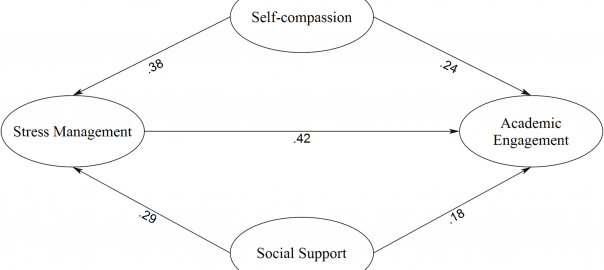
- Self-Compassion (Personal Resource): Self-compassion, defined as treating oneself with kindness during challenges, shows a significant positive direct effect on academic engagement (β = 0.24).
- Mechanism: Self-compassion functions as an internal resource that fosters emotional resilience and helps buffer against academic stress. By fostering a supportive inner attitude, it aligns with SDT’s needs for autonomy and competence, enhancing self-efficacy and intrinsic motivation. Self-kindness, in particular, may conserve psychological resources by reducing self-criticism, allowing energy to be redirected towards academic efforts.
- Social Support (Social Resource): Social support, encompassing assistance, care, and empathy from a social network, also demonstrates a significant positive direct effect on academic engagement (β = 0.18).
- Mechanism: Social support fulfills the SDT need for relatedness, providing students with a crucial sense of connection, community, and belonging. This external assistance (instrumental and emotional) alleviates isolation and promotes a more motivated learning approach.
2. Indirect Influence via Stress Management (Collective Pathway)
The key finding regarding the collective influence is that stress management mediates the relationships between both self-compassion and social support with academic engagement. This highlights that a major pathway through which these resources enhance engagement is by improving a student’s capacity to cope with stressors effectively.
Stress Management as a Mediator:
| Path (Resource $\rightarrow$ Engagement) | Direct Effect on Stress Management | Indirect Effect on Academic Engagement (via Stress Management) | Theoretical Alignment |
|---|---|---|---|
| Self-Compassion | Positive direct effect (β = 0.38) | Significant indirect effect (β = 0.16) | COR Theory: Self-compassion serves as an internal coping resource that preserves emotional energy and resilience by mitigating self-criticism and fostering adaptive strategies like mindfulness. |
| Social Support | Positive direct effect (β = 0.29) | Significant indirect effect (β = 0.12) | COR Theory: Social support provides external assistance and stability, offering emotional and instrumental resources that buffer the effects of stress, promoting resilience, and preventing disengagement. |
In summary of the collective influence:
The study indicates that students with higher self-compassion and stronger social support networks tend to be more academically engaged, with the total effects being statistically significant for self-compassion (β = 0.40) and social support (β = 0.30). These resources collectively influence engagement by:
- Providing Direct Motivation and Resilience: By meeting intrinsic needs (relatedness, autonomy, competence).
- Facilitating Effective Stress Management: By strengthening students’ ability to cope, allowing them to conserve vital personal and psychological resources necessary for sustained focus and motivation in their studies.
The relationship between these resources and engagement suggests that supporting students requires fostering both internal coping skills (like self-compassion training) and external support structures (like strong community bonds) to enhance their stress management capabilities, ultimately promoting success in higher education.
The study is grounded in two main theories: the Conservation of Resources (COR) Theory and Self-Determination Theory (SDT).
- Conservation of Resources (COR) Theory:
- This theory posits that individuals strive to acquire, protect, and maintain valuable resources (including personal characteristics, energies, and social connections) to withstand stress and minimize resource loss in demanding environments, strive to acquire, protect, and maintain valuable resources (including personal characteristics, energies, and social connections) to withstand stress and minimize resource loss in demanding environments, such as academia.
- Within this framework, the resources examined—self-compassion, social support, and stress management—are viewed as acting as buffers against stress, preserving the energy and motivation necessary for sustained academic engagement.
- Self-Determination Theory (SDT):
- This theory provides a perspective on the motivational drives that underpin well-being and academic engagement.
- SDT emphasizes that intrinsic motivation and engagement are achieved through the fulfillment of three fundamental psychological needs: autonomy, competence, and relatedness.
- The constructs explored in the study align with SDT: self-compassion aligns with the needs for autonomy and competence by fostering a supportive inner attitude and enhancing self-efficacy, while social support fulfills the need for relatedness, promoting a sense of connection and belonging.
The research uses these two theories collectively to create a robust framework for understanding how self-compassion (a personal resource) and social support (a social resource) influence academic engagement, both directly and indirectly through stress management.
Analogy to solidify understanding:
The way personal and social resources collectively influence academic engagement is similar to a student navigating a difficult mountain climb. Self-compassion is like having excellent hiking boots and inner motivation (personal resources): they provide internal resilience and confidence, making the footing surer and helping the climber get back up after a slip. Social support is like having a reliable team and well-placed ropes (social resources): they provide external assistance, encouragement, and a safety net. Both these resources strengthen the stress management system, which acts as the climber’s ability to pace themselves, plan for weather changes, and avoid exhaustion. Without effective stress management, even the best boots or strongest ropes won’t prevent burnout and disengagement (falling off the climb).