
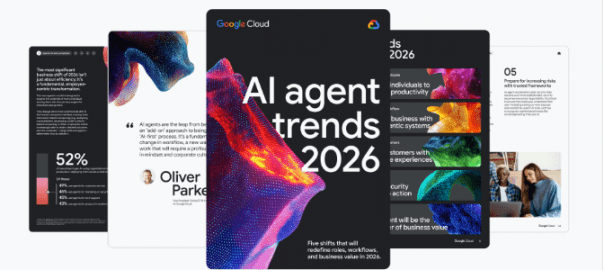
Dec. 20, 2025 /Mpelembe Media/ — The Google Cloud 2026 report describes a major transition from basic automated assistants to agentic AI, which can plan and execute complex tasks with human oversight. This shift moves technology from simple instruction-based computing to intent-based systems that understand and achieve specific goals. Key trends highlight how these agents will soon be integrated into every employee’s workflow, acting as specialized digital team members that handle repetitive duties. Beyond individual productivity, the report explores how integrated agent networks will manage entire business processes, such as customer service, security, and supply chain logistics. Human roles are expected to evolve into strategic orchestration, where people focus on high-level decision-making while AI agents manage the underlying data. Ultimately, the document serves as a strategic guide for business leaders to prepare for a future where AI is a fundamental, always-on collaborator.
By 2026, agentic AI is expected to drive a fundamental shift from “add-on” AI to “AI-first” processes, necessitating a profound change in corporate culture and mindset. This transition will redefine the relationship between humans and computers, moving from instruction-based tasks to intent-based computing, where employees state a desired outcome and AI agents determine the plan and actions required to achieve it.
Redefining Human Roles: From Doer to Orchestrator
The primary role of the employee will shift from performing mundane, repetitive tasks to becoming a strategic supervisor and orchestrator of AI agents. This applies to all levels of an organisation, from entry-level analysts to senior executives. Human responsibilities will be redefined around four core functions:
Delegation: Identifying which tasks are best suited for agents.
Goal Setting: Clearly defining the desired outcomes for the agentic systems.
Strategic Direction: Guiding agents using human judgment and making the final, nuanced decisions that AI cannot.
Quality Verification: Acting as the final checkpoint for accuracy, tone, and quality.
In specific fields, such as marketing, a manager will no longer scramble to draft posts or pull data; instead, they will orchestrate a system of specialized agents—including data, analyst, content, and creative agents—to multiply their output and focus on high-impact storytelling. Similarly, security analysts will move away from “alert fatigue” to become strategic defenders, using their intuition to lead proactive threat hunting while agents handle automated triage.
Redefining Corporate Workflows: The Digital Assembly Line
Workflows will be reimagined as “digital assembly lines”—human-guided, multi-step processes where multiple agents work together to run a business end-to-end. These agentic systems will be powered by new standa
Agent2Agent (A2A) Protocol: An open standard allowing agents from different developers or frameworks to work together seamlessly.
Model Context Protocol (MCP): A standardized connection that allows AI “brains” to access real-time data and interact with external tools and databases.rds:
These workflows will integrate previously siloed functions. For instance, in telecommunications, an agent could autonomously detect a network anomaly, open a ticket for field services, and notify customers through the contact centre in one integrated sequence. In customer service, the workflow moves from reactionary chatbots to proactive concierge-like agents that resolve issues—such as rescheduling a failed delivery and applying a service credit—before a customer even complains.
The Skills Gap and Organizational Value
The ultimate driver of business value in 2026 will be upskilling talent. Because the “half-life” of professional skills is shrinking to roughly four years, organisations must invest in building an AI-ready workforce. New roles, such as “Agent Orchestrator” or “Chief of Staff for AI,” will emerge to fill the gap where current market expertise does not yet exist. This shift is intended to free teams from low-value work, allowing them to focus on the creative, empathetic, and strategic efforts that remain uniquely human.
Analogy: Transitioning to agentic AI is like moving from driving a car to commanding a fleet. Instead of focusing on every gear shift and steering adjustment (instruction-based tasks), the human acts as the fleet commander, setting the destination and strategy while the individual vehicles (agents) navigate the terrain and communicate with one another to reach the goal efficiently.
Agentic AI represents a transition from “add-on” tools to “AI-first” processes. It is defined as AI that moves beyond simply answering questions to understanding a goal, formulating a plan, and taking actions across various applications to achieve that goal under human oversight. These systems combine advanced model intelligence with access to specific tools to act on a user’s behalf.
For business, the core capabilities of agentic AI are defined by several transformative features:
Intent-Based Computing
Agentic AI marks a shift in the human-computer interface from instruction-based tasks (like manually editing a spreadsheet) to intent-based computing. In this model, employees state a desired outcome, and the AI agents determine the specific plan and actions required to deliver it.
Enterprise Grounding
Unlike general AI, business agents are “grounded” in an organisation’s internal “ground truth”. This means their responses and actions are anchored to a verifiable set of facts, such as internal knowledge bases, customer data, and historical work context.
Digital Assembly Lines
Workflows in 2026 are envisioned as “digital assembly lines”—human-guided, multi-step processes where multiple specialized agents are orchestrated to run a business process end-to-end. This is made possible by new standards:
Agent2Agent (A2A) Protocol: An open standard that allows agents from different developers or frameworks to work together seamlessly.
Model Context Protocol (MCP): A connection that allows AI “brains” to overcome their training limitations by interacting with real-time data and external tools like managed databases.
Specialized Functional Capabilities
Across various departments, agentic AI provides distinct operational advantages:
Marketing: Specialized agents can sift through millions of data points, monitor competitors 24/7, and draft content or generate creative assets based on a provided strategy.
Customer Service: Agents act as “concierges” that offer one-to-one experiences by remembering past conversations and proactively resolving issues—such as rescheduling a failed delivery and applying a service credit—before a customer complains.
Security: Agentic systems identify and respond to threats in real time, moving beyond “alert fatigue” to assist with vulnerability discovery and active threat hunting.
Commerce: New protocols (like AP2) allow agents to make secure, autonomous purchase decisions based on human pre-approval, such as buying an item only when it reaches a certain price point.
Analogy: Using traditional AI is like using a high-tech GPS that tells you exactly where to turn, but you still have to drive the car yourself (instruction-based). Agentic AI is like a self-driving delivery service: you simply tell the system “get this package to the client by noon,” and the system plans the route, handles the driving, and manages the logistics to ensure the goal is met (intent-based).
Grounding is the essential process of anchoring an AI model’s responses to a specific, verifiable set of facts, which serves as its “ground truth”. In an enterprise context, this ground truth is the organisation’s own internal data. This capability allows agentic systems to move beyond generic answers and operate with a deep understanding of a company’s unique context, including its internal systems, knowledge bases, customer data, and records of past work.
Grounding is critical because standard Large Language Models (LLMs) have two major limitations: their knowledge is frozen at the time of their training, and they cannot naturally interact with the outside world to access real-time data. Grounding bridges this gap by connecting these AI “brains” to external tools and live data platforms. A key technology enabling this is the Model Context Protocol (MCP), which creates a standardized, two-way connection for AI applications to access managed databases—such as Cloud SQL or Spanner—and data platforms like BigQuery.
The business value of grounding manifests in several ways:
Personalization at Scale: Grounding allows an “agentic concierge” to succeed where standard chatbots fail; instead of asking for an order number, the agent can access a CRM to see purchase history or a logistics database to track a delivery in real time.
Operational Precision: In manufacturing, grounded systems can inspect specific machine criteria to suggest solutions for underperformance.
Security Operations: Multiple security agents can share a common enterprise context, such as security telemetry data, allowing them to detect and respond to risks more effectively.
Efficiency: Grounded agents can translate natural language questions into code to query complex internal data, such as SAP Materials, drastically reducing the time required for data retrieval.
Analogy: Grounding is like giving a brilliant but isolated scholar access to your company’s private, up-to-the-minute archives. Without it, the scholar can only give general advice based on the old books they read before they were locked away; with grounding, they can provide precise, actionable guidance because they have a direct view of your specific records and current reality.
In the agentic AI era of 2026, the primary role of an employee shifts from being a “doer” of mundane tasks to a strategic supervisor and orchestrator. This responsibility applies across all levels of an organisation, requiring every individual to manage a “digital assembly line” of specialized agents to achieve complex business goals.
According to the sources, the core responsibilities of a human supervisor are defined by four primary functions:
Delegation: Supervisors must identify which repetitive or mundane tasks are best suited for AI and assign them to the appropriate specialized agents.
Goal Setting: Humans are responsible for defining the intent and desired outcomes. Rather than providing step-by-step instructions, the supervisor states the goal, and the agentic system determines the plan to achieve it.
Strategic Outlining: Supervisors use human judgment to guide agents and make the “final, nuanced decisions” that AI cannot. This includes determining high-level strategy, such as deciding how to monetize stories or identifying which areas are not worth an investment of time and effort.
Quality Verification: The human acts as the final checkpoint for accuracy, tone, and quality, ensuring that the agent’s output meets the organisation’s standards before it is finalized.
Advanced Oversight and Ethical Governance
Beyond daily task management, human supervisors bear the responsibility for the governance and ethical application of AI. This includes:
Defining Rules of Engagement: Supervisors must fine-tune the parameters under which agents operate and “performance-review” their automated responses to ensure they remain aligned with business values.
Ethical Judgment: In high-stakes environments like banking or healthcare, supervisors must apply critical thinking and ethical judgment to ensure secure and fair outcomes.
Strategic Defense and Hunting: In specialized roles like security, humans move from reactive “alert-watching” to proactive strategic defense, using their intuition to lead “threat hunts” while agents handle automated triage.
Ultimately, the supervisor’s role is to ensure that AI agents function as powerful assistants that augment human-centric workflows rather than operating without control.
Analogy: A human supervisor of agents is like a film director. The director does not operate every camera, set every light, or act out every part; instead, they provide the creative vision (goal setting), coordinate specialized crews (delegation), and review every scene (quality verification) to ensure the final production matches their original intent.
The shift from instruction-based to intent-based computing represents a fundamental change in the human-computer interface expected by 2026. While traditional computing requires humans to manage the “how” of a task, agentic models allow humans to focus solely on the “what”.
Instruction-Based Computing: The Manual Approach
In the traditional instruction-based model, the human is the primary “doer” who must personally perform or direct every granular step of a process.
Manual Execution: Tasks such as analyzing a spreadsheet, developing code, or drafting social media posts are performed personally by the employee.
Step-by-Step Guidance: The computer acts as a reactive tool, following specific commands but requiring constant human intervention to progress through a workflow.
Limited Autonomy: Systems like standard chatbots are pre-programmed to answer simple questions or deflect tickets but cannot reason or take independent action.
Intent-Based Computing: The Strategic Approach
Intent-based computing, the hallmark of agentic AI, allows an employee to simply state a desired outcome. The AI system then determines the necessary plan and takes actions across various applications to achieve it.
Goal-Oriented Action: AI agents move beyond mere “add-ons” to become the engine of “AI-first” processes, understanding a goal and reasoning through the steps to reach it.
Human as Orchestrator: The employee’s role shifts from performing mundane tasks to being a supervisor of agents. Their core responsibilities become delegation, goal setting, strategic direction, and quality verification.
Digital Assembly Lines: Rather than siloed manual tasks, work becomes a “digital assembly line”—a multi-step workflow where specialized agents are orchestrated to run a business process end-to-end.
Proactive Problem Solving: Unlike reactive instruction-based tools, intent-based agents can monitor systems for triggers and resolve problems proactively—such as rescheduling a failed delivery—without waiting for a human to initiate a complaint.
Summary of Key Differences
| Feature | Instruction-Based Computing | Intent-Based Computing (Agentic) |
|---|---|---|
| Human Role | Personal execution of mundane tasks | Strategic orchestrator and supervisor |
| Computer Role | Reactive tool following granular commands | Proactive assistant formulating and executing plans |
| Input Type | Step-by-step instructions (e.g., writing code) | Statement of desired outcome (intent) |
| Workflow | Manual, often siloed processes | Digital assembly lines (multi-step, multi-agent) |
Analogy: Instruction-based computing is like following a recipe where you must personally chop every vegetable, stir every pot, and monitor the temperature at every minute. Intent-based computing is like hiring a head chef: you simply state, “I need a healthy three-course dinner for six people by 8 PM,” and the chef handles the planning, shopping, and cooking, while you provide the final taste test to ensure it meets your standards.
Download the full report here