The Quantum Turn: How Subatomic Physics is Rewriting the Rules of Social Science and International Relations
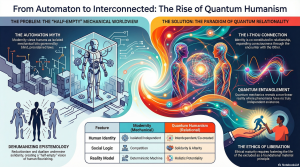
March 30, 2026 /Mpelembe Media/ — There is a profound paradigm shift from classical, mechanistic, Newtonian physics toward quantum and relativistic models, and how this transition is fundamentally reshaping the social sciences, philosophy, ethics, and spirituality. Classical physics historically promoted a view of the universe as a machine composed of isolated parts, which fostered social and political models that emphasized radical individualism, rational self-interest, and conflict. In contrast, the principles of modern quantum mechanics—such as entanglement, non-locality, uncertainty, and complementarity—reveal a deeply interconnected universe. This has prompted scholars to propose a relational, holistic ontology for human society, moving away from deterministic views to recognize that human existence thrives on community and interdependence.
A major application of this shift is the emergence of “quantum social science” and theoretical frameworks like “Connectivism” or “Quantic Humanism”. Political scientists, such as Alexander Wendt, argue that human beings might conceptually or literally operate as macroscopic quantum systems—referred to as “walking wave functions”—suggesting that our minds and societies are inherently entangled. Under this quantum worldview, cooperation, rather than conflict, may actually be the natural, default state of human interaction. By applying concepts like quantum probability, coherence, and wave function collapse to macro-social phenomena, these frameworks offer novel ways to analyze complex international relations, global social movements like the Arab Spring or Black Lives Matter, and state behavior.
Furthermore, the researchers consistently bridge modern physics with ancient philosophy, theology, and human values. Quantum mechanics’ concept of “unbroken wholeness” closely parallels concepts found in Buddhist philosophy (such as Huayan interpenetration), Hindu cosmology (like Indra’s Net), and theological discussions such as the application of Einstein’s relativity to the Islamic Mi’raj. This convergence challenges the traditional “mind-body” and “subject-object” dualisms, suggesting that human consciousness is not merely a passive observer but an active co-creator of reality.
Consequently, researchers advocate for a “Transdisciplinary” approach that reunites scientific, technological, and mathematical education (STEM) with the humanities. By acknowledging our fundamental interconnectedness with all life, this synthesis calls for an ethical imperative centered on global solidarity, responsible environmental stewardship, and cooperative problem-solving to address the complex, existential threats of the modern age, including those posed by artificial intelligence.
You Are Not an Atom: Why Quantum Physics is the Secret to Ending Modern Loneliness
1. Introduction: The Identity Crisis You Didn’t Know You Had
Do you ever feel like a solitary gear spinning in a void? For centuries, we have been told a story that breeds a profound, quiet desperation: the story that we are “atoms.” In the cold, clockwork universe of 19th-century materialism, you are a self-contained, independent unit—a biological accident navigating a mechanical world that doesn’t care you exist. This view suggests we are cogs in a giant machine, grinding along a preordained path toward an inevitable end.But there is a seismic event occurring in the bedrock of science that offers a radical antidote to this isolation. “Quantic Humanism” is more than a theory; it is a life-affirming bridge between the rigorous mathematics of subatomic physics and the deep empathy of social philosophy. It suggests that you are not a solitary observer watching a world “out there.” You are an integral participant in a non-local, interconnected reality. By shifting our perspective from the “I” to the “Other,” we find that the loneliness of the “atom” is actually a scientific impossibility.
2. Takeaway 1: Your “Self” is Not an Island (The Foundation of Alterity)
At the heart of our modern malaise is an obsession with the “Self” as an isolated, fixed object. Quantic Humanism replaces this with the principle of Alterity . It asks a single, foundational question: “Who is the Other?”Drawing from the relational philosophy of Martin Buber and Enrique Dussel, we discover that humanness is not a solo performance; it is only realized through the encounter. In this framework, the “Self” is not a pre-existing entity that happens to meet people. Instead, the “Self” is like a quantum probability wave—unrealized, unactualized, and ghost-like—until it is “measured” by the presence of the Other. Your identity is co-created in real-time. To look into the eyes of another is not just a social gesture; it is the most radical act of the 21st century because it is the moment you actually become “you.””The fundamental human purpose is to know and recognize the Other, shifting focus from self-centered notions of human nature toward relational, interdependent existence.”
3. Takeaway 2: The “Half-Empty” Human (An Epistemological Critique)
Why do we feel so disconnected? It is because modern social sciences have historically operated on a “half-empty” vision of humanity. This is an epistemological critique: the very way we study ourselves has drained the soul out of the model.By treating humans as predictable automatons governed strictly by biological impulses or economic utility, we have “dehumanized” the human. When we view people as mere “cogs,” we strip away moral responsibility and collective solidarity. This “mechanical” view creates a logic of domination where the Other is only valuable if they are useful. Quantic Humanism argues that we must reclaim the “half-full” vision, recognizing that our agency and our “spirit” are not “transcendental implants” but the emergent products of our social environment.
4. Takeaway 3: Identity is a Quantum State (The In-Out Duality)
In the framework of In-Out Mechanics , we find the scientific basis for why we cannot exist independently. Unlike classical physics, which sees things as having fixed boundaries, this quantum ontology suggests that “inside” and “outside” are relative.Think of it this way: your “inside” (your thoughts, potential, and values) is the “outside” of the person you are talking to. We are woven together through specific quantum roles:
The Homogeneity Axiom: We share fundamental internal states (like the need for dignity) that allow us to belong to the category of “humanity.”
Bosons vs. Fermions: In physics, Fermions represent the differentiated “in” aspect—our unique identities. Bosons , however, are the “connectors”—the outward wave properties that bridge different entities to create a unified field.We are not just a collection of parts; we are a “systemic structure” where the whole is always present in the interaction of the parts. You are a “walking wave function,” always in a state of potentiality until you engage with the world.
5. Takeaway 4: “Spooky Action” at a Social Distance (Entanglement and Dialogue)
Einstein famously bristled at “spooky action at a distance,” but today we call it entanglement. In Quantic Humanism, we apply the Entanglement Axiom : $A_{in} = B_{out}$ .This formula is a mathematical truth with a beautiful social consequence: the internal state of one person is equal to the external manifestation of another. Your inner peace is mathematically entangled with the outer well-being of your neighbor. When we engage in deep, authentic dialogue, we experience what psychologists call “inflation”—an expansion of consciousness. This is that magical feeling during a deep conversation where you lose track of time and the boundary between “me” and “you” seems to dissolve. That isn’t just a feeling; it is a “quantum fact” of social entanglement.”Identity, like a quantum state, is not intrinsic but is actualized through interaction. This provides a scientific basis for challenging the subject-object dualism and for supporting a holistic, emergent, and interdependent vision of being.”
6. Takeaway 5: Reclaiming Free Will from the “Materialist Machine”
The 19th-century “materialist machine” suggested that your thoughts are merely the high-level noise of low-level mechanical processes—that you have no real choice. However, the “Copenhagen” and “von Neumann” interpretations of quantum theory provide a vital “reprieve.”They bring the observer—your consciousness—back to the center of reality. The “quantum jump” and the physics of attention suggest that your mind can influence, though not completely control, what happens in your body and brain.Classical Physics Vision
Determinism: You are an automaton; every action is a mechanical extension of a past you didn’t choose.
Human Status: Cogs in a blind machine with no rational basis for moral responsibility.Quantum Humanism Vision
Agency: The “quantum jump” allows for novelty and choices not dictated by the past.
Human Status: Causally efficacious participants whose thoughts and values influence physical reality.
7. Takeaway 6: The Logic of the “Other” (The Ethics of Liberation)
Drawing on Enrique Dussel’s “Philosophy of Liberation,” Quantic Humanism establishes a “Material Principle” of ethics. It moves us from D-love (Deficiency-love), which seeks to “use” others to fill a void, to B-love (Being-love), which is an “unneeding,” fostering love.This is the “Logic of the Other.” It dictates that we have a literal, material responsibility to produce and develop the life of the Other—especially the excluded and the marginalized. Ethics is not just a set of rules; it is the obligation to foster the life of those the “machine” has cast aside. By recognizing the Other as truly legitimate, we liberate ourselves from our own myopia. We don’t just “help” the Other; we actualize our own humanity through them.
8. Conclusion: Toward a “Polynational” Reality
Quantic Humanism is a call to move toward a “polynational” foundation for society—a world grounded in radical interconnectedness, nonviolent inner development, and critical ethics. It replaces the logic of domination with the logic of relational co-creation.As you leave this document and re-enter the world, I invite you to hold one thought: What if you viewed every interaction today not as a transaction, but as a “quantum event”? What if you realized that the person standing in front of you—the barista, the stranger, the colleague—is the very mirror through which your own existence is being actualized? By recognizing the “Other” as a part of your own entangled state, we can finally begin to end the long, cold winter of modern loneliness.