
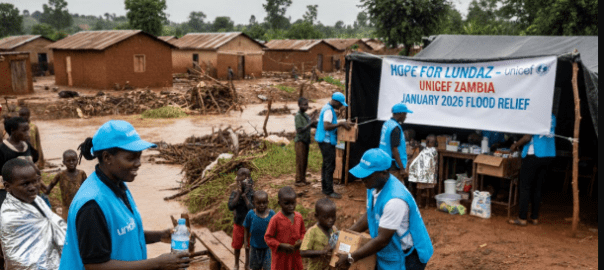
Jan. 29, 2026 /Mpelembe Media/ — Since late December 2025, devastating floods triggered by heavy rains have ravaged the Lundazi and Lumezi districts in Zambia’s Eastern Province. The disaster submerged dams, swept away homes, and destroyed critical infrastructure, leaving more than 40,000 people without access to safe drinking water after the main treatment plant was compromised. This has created a severe health crisis for children, who face heightened risks of cholera, diarrhea, and malaria, while also suffering from extreme food insecurity due to the destruction of stored maize and agricultural livelihoods.
In response, UNICEF, in collaboration with the Zambian government and partners like the Zambia Red Cross, has implemented a multi-pronged relief strategy:
Immediate Life-Saving Aid: UNICEF has distributed chlorine and essential hygiene supplies, which have already begun reducing the frequency of stomach illnesses in children. They have also provided educational materials in English and Nyanja to teach families how to prevent waterborne diseases.
Infrastructure and Health Support: To restore water access, UNICEF is installing hand pumps and boreholes in clinics and communities while providing water testing kits to monitor safety.
Capacity Building: More than 75 Community-Based Volunteers have been trained across 15 health facilities (including 11 through virtual orientations) to lead local response efforts and promote future flood preparedness.
Long-Term Climate Resilience: The goal of these interventions is to strengthen local systems and reduce vulnerability to future climate-related shocks.
Despite these rapid efforts, the situation remains critical as continued rains threaten further flooding and place ongoing strain on children’s nutrition, education, and protection. The collective response from the government and international partners remains focused on ensuring that every affected family remains safe and supported throughout the recovery process.
The main health risks identified in the sources include:
Waterborne Diseases: The destruction of water systems and the submerging of the main treatment plant have left over 40,000 people without safe drinking water, significantly increasing the risk of cholera and diarrhea among children. Families have reported that children are frequently sick with stomach problems due to these compromised conditions.
Vector-borne Diseases: Displaced children are at high risk for malaria. This is largely due to families living in small, fragile, temporary wooden shelters that are exposed to continued rains and lack mosquito nets to protect them from insects.
Nutritional Strain and Hunger: The floods have caused severe food insecurity by damaging stored food supplies—such as bags of maize and mealie meal—and disrupting agricultural livelihoods. As a result, some children have gone from eating properly to having only one meal a day, putting their nutritional status under growing strain.
Hygiene-Related Illnesses: Poor sanitation and hygiene are major concerns because safe spaces for children have disappeared. In some cases, families are forced to use a single bucket for fetching water, bathing, and washing plates simultaneously, which facilitates the spread of germs.
Overall Wellbeing and Protection: Beyond physical illness, children’s health is affected by the loss of their homes and the inability to attend school, which places their overall wellbeing and safety under significant pressure.
To mitigate these risks, the sources highlight that chlorine distribution and hygiene promotion are being used to clean water and reduce the frequency of stomach illnesses among children.
Beyond providing immediate humanitarian relief, UNICEF is focused on strengthening local systems to reduce vulnerability to future climate-related shocks and ensure communities can withstand recurring environmental challenges.
UNICEF’s approach to building long-term climate resilience includes the following strategies:
System Strengthening and Capacity Building: UNICEF has oriented more than 75 Community-Based Volunteers (CBVs) across four health facilities directly impacted by floods, while providing virtual orientations to 11 additional facilities. This training focuses on future flood preparedness and anticipatory actions, ensuring that local responders are equipped to act before a disaster strikes.
Resilient Water Infrastructure: To ensure long-term access to safe water, UNICEF is providing three hand pumps for flood-affected communities and providing technical support for the installation of three boreholes in urban clinics. These permanent structures help mitigate the impact of future water system destructions like the ones seen in the Lundazi and Lumezi districts.
Enhanced Water Quality Monitoring: UNICEF provided four water testing kits, which allow for ongoing water quality monitoring. This strengthens the local capacity to detect and prevent waterborne disease outbreaks long after the initial flood emergency has passed.
Empowering Communities through Education: By distributing over 7,000 educational leaflets and training volunteers to spread preparedness messaging, UNICEF is fostering a culture of safety. These efforts allow community members to listen to local concerns and support their neighbors independently during climate events.
Collaborative Coordination: UNICEF works in partnership with the Zambia Ministry of Health, the Zambia Red Cross Society, and other international partners to coordinate a unified response that integrates local government priorities with global humanitarian standards.
These investments are designed to move communities away from a cycle of emergency response and toward a model of sustained resilience, where local systems are robust enough to protect children’s health, nutrition, and education despite the increasing frequency of heavy rains and floods.
The floods in the Lundazi and Lumezi districts have severely compromised local livelihoods and food security, primarily through the destruction of agricultural resources and stored food supplies.
The specific impacts identified in the sources include:
Disruption of Agricultural Livelihoods: The local economy is heavily dependent on agriculture, and the floods have directly disrupted these livelihoods because crops have been flooded and destroyed.
Destruction of Stored Food: Families have lost critical food reserves that were stored in their homes. One resident, Mary Nyirenda, reported that when her house collapsed, her entire stock of 17 bags of maize and mealie meal was damaged.
Increased Hunger and Reduced Meal Frequency: The loss of food supplies has led to immediate hunger. Families who previously “ate properly” have been forced to cut back significantly, with some now only able to provide their children one meal a day.
Nutritional Strain on Children: Because of the damage to food supplies and the disruption of agricultural production, the nutrition and overall wellbeing of children are under growing and high strain.
Despite rapid response efforts, the sources note that significant needs remain as continued rains threaten further flooding and persistent risks to child nutrition.
Community-based volunteers are playing a vital role in flood recovery by providing immediate health interventions, essential education, and long-term preparedness support to families in the Lundazi and Lumezi districts.
Their contributions include:
Distributing Life-Saving Supplies: Volunteers are actively distributing chlorine and essential hygiene supplies to families, ensuring they can keep their water clean despite the destruction of local water systems. This direct delivery has led to a visible reduction in stomach illnesses among children.
Spreading Health Education: Trained by UNICEF, these volunteers share easy-to-understand information regarding the prevention of cholera, diarrhea, and other waterborne diseases. They utilize over 7,000 leaflets and posters printed in English and Nyanja to ensure families understand how to stay safe during the emergency.
Providing Community Support: Beyond physical supplies, volunteers are trained to listen to people’s concerns and offer neighborly support to those who have lost their homes and livelihoods.
Scaling Up Local Response: The involvement of volunteers has enabled health systems to scale up their response and sustain the distribution of life-saving messaging within communities even as the rains continue.
Building Long-Term Resilience: More than 75 Community-Based Volunteers (CBVs) have received orientations at local health facilities specifically focused on future flood preparedness and anticipatory actions. This training ensures they can continue to deliver life-saving messages and lead community responses to future climate-related shocks.
According to the sources, flood preparedness training and orientations are being conducted across a total of 15 health facilities in the affected regions of Lundazi and Lumezi:
Direct Impacted Facilities: More than 75 Community-Based Volunteers (CBVs) have received orientations across four health facilities that were directly impacted by the floods.
Virtual Orientations: Training was extended to 11 additional facilities through virtual orientations to promote future flood preparedness and anticipatory actions.
While the sources do not list the specific names of these individual clinics or hospitals, they confirm that these efforts involve both Health Care Workers and Community-Based Volunteers. These individuals are trained to scale up their response by delivering life-saving messages and distributing essential supplies like chlorine within their communities.
Additionally, the sources mention that technical support is being provided for the installation of boreholes in urban clinics to further strengthen local health infrastructure.
Virtual orientations are a key component of UNICEF’s strategy to build long-term resilience by reaching health facilities beyond those immediately devastated by the disaster,. According to the sources, these sessions prepare health facilities for future floods in the following ways:
Promoting Anticipatory Action: The primary focus of providing virtual orientations to 11 additional health facilities is to promote future flood preparedness and anticipatory actions,. This ensures that facilities not currently at the center of the crisis are ready to act proactively if floodwaters spread or if future seasons bring similar challenges,.
Scaling Up Local Response: These orientations empower Health Care Workers and Community-Based Volunteers to scale up their response efforts,. This includes training them to sustain the distribution of life-saving supplies, such as chlorine, which is essential for preventing waterborne diseases during floods,.
Sustaining Preparedness Messaging: By orienting staff virtually, UNICEF ensures that flood preparedness messaging continues to circulate within communities,. This helps maintain a level of awareness and readiness among the population even after the immediate emergency subsides.
Reducing Long-Term Vulnerability: These virtual sessions are part of a broader investment aimed at reducing vulnerability to future climate-related shocks,. By strengthening the knowledge base of health systems across a wider geographic area, the community is better positioned to withstand recurring environmental threats,.
While the sources highlight that orientations were provided to 15 facilities in total—4 through direct contact and 11 through virtual means—the goal for all remains ensuring that every family stays safe, protected, and supported throughout the rainy season and beyond,.