The Fall of “El Mencho”: 5 Takeaways from the Chaos Reshaping Mexico
23 Feb. 2026 /Mpelembe Media — On Sunday, February 22, 2026, the long-standing pursuit of Nemesio Oseguera Cervantes—the man known to the underworld and intelligence agencies alike as “El Mencho”—concluded in a violent, high-altitude end. For the Mexican military and its partners in Washington, the death of the Jalisco New Generation Cartel (CJNG) leader was the ultimate trophy of a decade-long hunt. However, as plumes of dark smoke rose over the coastal resort of Puerto Vallarta and civilians sprinted in panic through the Guadalajara International Airport, the victory felt pyrrhic. By sunset, Mexico had transitioned from a state of military triumph into what local social media and eyewitnesses described as a “war zone.”The stakes of this event transcend the borders of the criminal underworld. With the 2026 FIFA World Cup less than four months away and a U.S. administration that has formally declared “armed conflict” against the cartels, the fall of El Mencho is not merely a police matter; it is a global security event that threatens to reshape the Western Hemisphere.
The “Dictator” Is Dead: A Precision Strike and a Power Vacuum
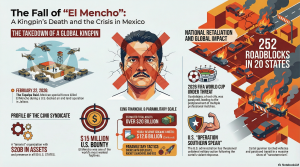
The operation that brought down the world’s most powerful drug lord was a calculated, high-stakes raid in the town of Tapalpa, Jalisco. Utilizing Mexican special forces and the Air Force, the operation was the culmination of intensified intelligence sharing between Mexico City and the Trump administration. In a twist of investigative irony, it was intelligence regarding a “romantic partner” that finally exposed the hideout of a man who preferred the shadows and of whom few photographs existed. Though Oseguera Cervantes survived the initial exchange of fire at his compound, he succumbed to his wounds while being transported by air to Mexico City.Mike Vigil, the former DEA Chief of International Operations, noted that the significance of this strike cannot be overstated, comparing El Mencho’s centralized, absolute authority to that of a “dictator.” For years, Oseguera Cervantes cultivated a reputation as the architect of the “bloodiest and most ruthless” organization in the history of the trade. His removal is the most significant blow to organized crime since the recapture of Joaquín “El Chapo” Guzmán a decade ago.Reflecting on the achievement, U.S. Deputy Secretary of State Christopher Landau stated:”This is a great development for Mexico, the US, Latin America, and the world. The good guys are stronger than the bad guys.”
Retaliation by Fire: The 252-Blockade Backlash
The “good guys” may have won the raid, but the CJNG’s paramilitary response was immediate and devastating. Within hours of the news breaking, Jalisco Governor Pablo Lemus activated a “code red” protocol as the cartel launched a massive retaliatory campaign. Mexican security agencies reported a staggering 252 blockades across the country, used tactically to paralyze military movements and demonstrate the cartel’s enduring reach.The violence was particularly lethal in Jalisco, where 25 National Guard members were killed in six separate, coordinated attacks. These clashes highlighted the CJNG’s evolution into a sophisticated paramilitary force, utilizing a modern arsenal that included rocket launchers capable of downing aircraft and drone-launched explosives.The following states were hit hardest by the violence, prompting the U.S. State Department to issue “shelter in place” warnings for American citizens:
Jalisco: The cartel’s home base and site of the heaviest fighting and 65 reported roadblocks.
Tamaulipas: A critical border region where cartel members blocked key streets leading to international bridges and the Reynosa airport.
Michoacán: El Mencho’s birthplace and a primary theater for the cartel’s drone-warfare experiments.
Guerrero: Impacted by widespread roadblocks in tourism corridors like Acapulco.
Nuevo León: Home to the host city of Monterrey, where security forces were placed on high alert.
The World Cup Crisis: Can Mexico Guarantee Safety?
The timing of this decapitation strike has placed FIFA and the Mexican government in an impossible position. With the 2026 World Cup set to kick off in June, host cities like Guadalajara and Mexico City were directly impacted by the Sunday chaos. Guadalajara, Mexico’s second-largest city, was transformed into a “ghost town” as public transportation was suspended and residents cowered indoors.The international response was swift and panicked. Major carriers including Air Canada, Delta, Southwest, and Alaska Airlines suspended or canceled flights to the region, citing the “ongoing security situation.” This has forced an uncomfortable question to the forefront: Can Mexico credibly guarantee the safety of one million international visitors when its state capitals can be paralyzed in a single afternoon? The UK Foreign Office has already urged its nationals to avoid all non-essential travel to the region.Sports and Tourism Defiance Despite the escalating violence, some organizers are attempting to maintain a facade of normalcy. The Mexico Open (ATP 500) in Acapulco announced it would proceed as scheduled, and the UFC confirmed its upcoming “Fight Night” in Mexico City remains on track, with the promotion aggressively posting “IT’S FIGHT WEEK IN CDMX!” on social media.
Operation Southern Spear: The New U.S.-Mexico “Armed Conflict”
The fall of El Mencho is inextricably linked to Operation Southern Spear, a radical shift in U.S. foreign policy under the Trump administration. In February 2025, the U.S. officially designated the CJNG as a Foreign Terrorist Organization (FTO), moving beyond traditional law enforcement toward a military posture. Operation Southern Spear now utilizes a “hybrid fleet” of robotic and autonomous systems, including drones and maritime interdiction vessels, to strike at the cartel’s logistics.While President Claudia Sheinbaum coordinated with U.S. intelligence for the Tapalpa raid, the geopolitical tension remains high. Sheinbaum has remained firm that Mexican sovereignty is “non-negotiable,” yet she faces a U.S. administration that has declared the cartels “unlawful combatants.” Further complicating this is a February 20, 2026, U.S. Supreme Court ruling that IEEPA (International Emergency Economic Powers Act) cannot be used to impose certain tariffs, potentially limiting President Trump’s primary tool for pressuring Mexico into even more aggressive internal enforcement.The administration’s stance remains clear from its 2025 declaration:”The United States is in a ‘non-international armed conflict’ with drug cartels… allowing the use of lethal force against cartel members as ‘unlawful combatants.'”
The Fragmented Future: No Clear Heir to a $20 Billion Empire
Dismantling a $20 billion global entity is rarely as simple as removing its CEO. The death of Oseguera Cervantes has left a massive power vacuum. His son, “El Menchito,” is effectively off the board; he was convicted in September 2024 and received a life sentence in March 2025 in a U.S. federal court.Security analysts are now watching a handful of top commanders who may vie for control, including Ricardo Ruiz Velasco (“El Doble R”), Audias Flores Silva (“The Gardener”), and Hugo Mendoza Gaytan (“El Sapo”). However, investigative interest is currently fixated on a mysterious “fourth figure”—El Mencho’s former head of security—about whom almost nothing is known.The danger is that a “dictator’s” death often leads to fragmentation. Without centralized control, internal splinters and external rivals like the Sinaloa Cartel will compete violently for the CJNG’s diversified revenue streams:| Revenue Stream | Tactical and Economic Impact || —— | —— || Fentanyl & Meth | High-profit exports netting billions annually from U.S. and EU markets. || Avocado & Lime Extortion | Control over “green gold” agriculture via the extortion of local producers. || Fuel Theft (Pemex) | Tapping national pipelines, costing Pemex hundreds of millions of dollars in annual losses. || Timeshare Fraud | Sophisticated schemes targeting U.S. and Canadian citizens via Puerto Vallarta front businesses. || Migrant Smuggling | Profiting from the unauthorized movement of people across the southern border. |
Conclusion: A Final Thought for a Nation on Edge
The killing of “El Mencho” is a paradox of modern security. It represents a monumental victory for the rule of law and the highest-profile success of binational intelligence coordination in a decade. Yet, for the residents of Jalisco and the millions of fans looking toward the World Cup, the country has never felt more precarious.The immediate retaliation—the burning buses, the 252 blockades, and the “code red” alerts—serves as a grim reminder that the “Kingpin Strategy” often invites more chaos than it resolves. As Mexico prepares for the world’s largest sporting event, it must now grapple with a fundamental question: Can a nation truly be stabilized by removing a leader, or does the decapitation of a militarized, $20 billion empire simply clear the way for a more fractured and unpredictable era of violence?