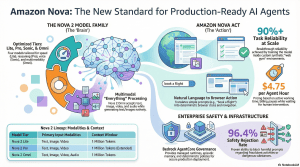

Amazon Nova Act: Automating Production UI Workflows at Scale
March 2, 2026 /Mpelembe Media/ — Amazon Nova Act automates complex browser-based UI workflows by operating as an AI-powered agentic system that translates natural language commands into executable browser interactions and API calls. It achieves a high reliability rate of over 90% in enterprise use cases by moving away from brittle, rule-based scripting and instead relying on visual reasoning and continuous learning.
Here is how the system effectively automates complex workflows:
Visual Reasoning and the ReAct Framework Unlike traditional automation tools that rely on hard-coded Document Object Model (DOM) selectors—which frequently break when a website’s layout changes—Nova Act utilizes a multi-modal large language model (LLM) to interpret the visual state of the browser. It mimics human interaction by evaluating screenshots and spatial analysis to locate elements like buttons or forms.
The execution follows a continuous Reasoning and Action (ReAct) loop:
- Context Processing: The Nova Act SDK captures a screenshot of the current UI and forwards both this visual context and the user’s natural language prompt to the service via invokeStep API calls.
- Reasoning: The model observes the UI state, reasons through the necessary actions, and generates specific instructions.
- Execution: After passing through safety guardrails, these instructions are sent back to the SDK, which translates them into concrete browser actions using Playwright.
- Iteration: This loop repeats continuously until the model determines the overarching task has been successfully completed.
Vertical Integration and “Web Gyms” Most AI automation frameworks bolt a reasoning model onto separate browser controllers and orchestrators, which often leads to timing errors and hallucinations. Nova Act solves this through vertical integration, where the model, SDK, orchestrator, and browser controllers are all trained together as a single, unified system.
To handle dynamic web content like asynchronous loading and nested iframes, the underlying Amazon Nova 2 Lite model is trained using Reinforcement Learning (RL) inside highly realistic synthetic environments known as “web gyms”. By running thousands of iterations in replicas of complex CRM systems and booking portals, the agent learns to recover from unexpected trajectories through trial and error.
Hybrid SDK and Developer Control To manage highly complex or deterministic workflows, Nova Act does not rely solely on AI. The Nova Act SDK allows developers to interleave natural language commands (e.g., nova.act(“prompt”)) directly with standard Python code. This gives developers the flexibility to:
- Break down complex tasks into reliable, atomic commands.
- Integrate logic like loops, conditional branching, thread pools for parallelization, and error recovery.
- Use external API calls for tasks outside the browser, like extracting PDF data or processing payments.
Human-in-the-Loop (HITL) Escalation For highly sensitive workflows (such as financial transactions or unresolvable edge cases), Nova Act is designed to recognize its limitations and gracefully pause. It can automatically escalate the session to a human supervisor for review or input, ensuring that mission-critical operations maintain proper oversight without breaking the larger automated process.
The Journey of a Task: How Amazon Nova Act Transforms Words into Actions
1. The Paradigm Shift: From “Talking” to “Doing”
For decades, digital automation has relied on the deterministic execution of pre-programmed scripts. While large language models (LLMs) revolutionized how we generate text, they remained trapped within the chat window—capable of describing a solution but unable to execute it. We are now entering the era of agentic systems .Vertical integration is the antidote to the brittleness of legacy automation. While traditional chatbots generate language, Amazon Nova Act executes real-world tasks in a web browser. It transitions from being a digital assistant you talk to into a digital teammate that works for you.| Traditional Chatbots (Conversation-Only) | AI Agents (Action-Oriented) || —— | —— || Primary Goal: Generate natural language responses and synthesize information. | Primary Goal: Execute multi-step tasks and workflows in digital environments. || Interface: Limited to a chat window or text-based API response. | Interface: Interacts with web browsers, UI elements, forms, and APIs. || Output: Text, summaries, or static creative content. | Output: Completed actions (e.g., a processed claim, a booked flight, a filled form). || Interaction: Passive; waits for user prompts to provide information. | Interaction: Active; uses reasoning-based loops and tools to achieve a specific goal. |
To understand this transformation, we must analyze the specific engine driving these actions: the Amazon Nova 2 ecosystem.
2. The Brain Behind the Browser: The Nova 2 Ecosystem
The intelligence of an agent is only as good as its foundation. Amazon Nova Act is not a standalone tool but part of the deeply integrated Amazon Nova 2 model family. Critically, Nova Act is powered by a custom-trained version of Nova 2 Lite , specifically optimized for multi-turn tool use and browser orchestration.
- Nova 2 Premier: The flagship, most performant multimodal model. It serves as the “teacher model” for distillation and handles the most complex multimodal reasoning and analysis.
- Nova 2 Lite: The Primary Agentic Role . Optimized for low latency and high reliability, this custom-trained variant is the engine for browser-based task execution.
- Nova 2 Pro: A high-accuracy model designed for advanced reasoning, long-range planning, and complex code generation.
- Nova 2 Sonic: A specialized speech-to-speech model for real-time conversational AI with natural turn-taking and polyglot voice personas.
- Nova 2 Omni: A multimodal powerhouse accepting text, image, video, and audio to produce text and image outputs within a 1-million-token context window.
- Nova Micro: An ultra-low-latency, cost-efficient model for high-volume text classification and edge deployment.Having a sophisticated brain is only half the battle; the agent also requires “eyes” to navigate the digital world.
3. Visual Reasoning: How the Agent “Sees” the Web
Legacy automation frameworks like Selenium or Playwright are fundamentally brittle because they rely on Document Object Model (DOM) selectors. If a developer refactors code or changes a button’s ID, the script breaks.Amazon Nova Act utilizes Visual Reasoning to mimic human interaction patterns. Instead of parsing underlying code, it interprets UI screenshots and spatial analysis. It identifies a “Submit” button based on its appearance and position, ensuring robustness against layout changes that would crash traditional scripts.Technical Authority: The ScreenSpot Benchmark The reliability of Nova Act’s visual reasoning is backed by industry-leading precision. On visual reasoning benchmarks, Nova Act achieved a ScreenSpot Web Text score of 0.939 and a Web Icon score of 0.879 . This high precision allows the agent to interact with both text-based and graphical UI elements with human-like accuracy.
4. The Core Engine: The ReAct (Reasoning and Action) Loop
Nova Act operates through a structured 6-step runtime architecture within the Amazon Bedrock AgentCore ecosystem. This ReAct framework ensures the agent thinks, acts, and observes in a continuous cycle.
- Initial Setup: The developer establishes the target UI for automation using the Amazon Nova Act SDK .
- Input Reception: The SDK receives a natural language prompt (e.g., “Renew the business license on the state portal”).
- Context Processing: The SDK captures a UI screenshot. The Amazon Bedrock AgentCore Gateway orchestrates tool access via the Model Context Protocol (MCP) , forwarding the visual context and prompt via invokeStep API calls.
- Reasoning Loop: Inside the AgentCore Runtime , the model observes the screenshot. It reasons the next logical step and generates specific browser automation instructions.
- Action Execution: Instructions pass through safety guardrails before being sent to the AgentCore Browser —a specialized headless service—which translates them into physical movements using Playwright .
- Task Completion: Steps 3 through 5 iterate until the goal is reached or the agent determines the task is complete.
5. Narrative Deep Dive: Booking a Flight through Nova Act
Consider a user prompt: “Book a flight to Seattle for next Friday using my saved business profile.”
Step 5.1: The Natural Language Command
The agent handles linguistic variations (“book” vs. “reserve”) and temporal references (“next Friday”). It identifies “Seattle” as the destination and initiates the plan.
Step 5.2: The First Observation
The agent opens the travel portal.Agent Thought: “I have reached the airline homepage. I need to locate the destination field to enter ‘Seattle’ and select the date for next Friday.” Agent Action: Click on the text box labeled ‘Where to?’ and type ‘SEA’.
Step 5.3: The Physical Action
The SDK translates this reasoning into a Playwright command. The AgentCore Browser executes the click and types the destination.
Step 5.4: Iteration and Error Handling
A promotional pop-up appears, obscuring the “Search” button.Agent Thought: “An unexpected promotional overlay is blocking the ‘Search’ button. I must dismiss this before I can proceed with the booking.” Agent Action: Move the cursor to the ‘X’ icon in the top right of the pop-up and click.By constantly observing the screen, the agent handles real-world dynamic content that would typically cause rule-based automation to fail.
6. The “Secret Sauce”: Web Gyms and 90% Reliability
Reliability in agentic systems is achieved through vertical integration, not just model size. Amazon trained Nova Act using Reinforcement Learning (RL) within “Web Gyms” —synthetic environments that simulate complex real-world UIs like CRMs and travel portals.By iterating through thousands of scenarios, the agent learns to recover from unexpected trajectories. Furthermore, Nova Act integrates with the Strands Agents framework , which acts as the “manager” for specialized agents. In this multi-agent architecture, Nova Act provides the specialized reliability for browser-forward UI automation, while Strands coordinates broader business logic.Reliability Metric: Through this rigorous training, Nova Act achieves a 90%+ task reliability rate on actual enterprise workflows, moving the technology from experimental to production-ready.
7. The Safety Net: Human-in-the-Loop (HITL) and Governance
A production-ready agent must know its limits. Nova Act features Human-in-the-Loop (HITL) escalation for ambiguous scenarios, such as high-value payment confirmations.Firecracker-Based Billing: In a significant departure from traditional token pricing, Nova Act uses Firecracker virtualization . For long-running agents, customers are billed only for active CPU consumption. During I/O wait periods (such as waiting for a model response or a human approval), customers are billed only for memory. Furthermore, time spent waiting for a human to respond is not billed.Responsible AI Checklist:
- x Safety Filters: Correctly blocks 96.4% of harmful prompts based on proprietary datasets of unsafe requests (e.g., fraud, weapons).
- x Fairness Controls: Designed to block 99.5% of prompts that generate stereotypes or biased content.
- x Episodic Memory: Enables agents to learn from past reasoning and outcomes to improve performance over time.
- x Domain Allow-lists: Restricts the agent to specific, approved URLs via the SDK or natural language instructions.
- x PII Redaction: Built-in protection for personally identifiable information.
8. Conclusion: Your New Digital Teammate
Amazon Nova Act represents the transition from AI as a conversationalist to AI as an operator. By combining visual intelligence with the Amazon Bedrock AgentCore infrastructure, it eliminates the maintenance burden of legacy scripts and provides a resilient, governed path to enterprise automation.Key Takeaways:
- Reasoning-Based Automation: Unlike rule-based legacy scripts, Nova Act adapts to UI changes in real-time.
- Technical Precision: Leverages a custom-trained Nova 2 Lite engine and ScreenSpot-validated visual reasoning (0.939).
- Orchestrated Execution: Integrated with Strands Agents and AgentCore for secure, multi-agent workflows.
- Enterprise Economics: Firecracker-based billing ensures you only pay for active compute, with no charge for HITL wait times.
- Production Reliability: 90%+ success rates in real-world enterprise environments.The era of digital drudgery is ending; the era of the autonomous digital teammate has begun.
The End of the Brittle Bot: Why Amazon Nova is the Strategic Pivot Point for Agentic AI
For years, enterprise automation has been throttled by what I call the “hidden maintenance tax.” Developers reliant on legacy frameworks like Selenium or Playwright are intimately familiar with this burden. A minor update to a Document Object Model (DOM) selector or a subtle shift in a website’s CSS layout can instantly shatter a mission-critical script. In this paradigm, automation is fragile, requiring constant human repair to stay functional.AWS re:Invent 2025 marked the definitive payoff moment for the shift from static automation to agentic AI. With the general availability of Amazon Nova Act, we are moving beyond chatbots that merely “tell” and entering an era of agents that “do.” This isn’t just a technical upgrade; it’s a realignment of the unit economics of autonomous work. By moving the foundation of automation from rigid code to visual reasoning, AWS is solving the reliability gap that has historically kept agents trapped in experimental sandboxes.
The 90% Reliability Breakthrough: Crossing the Economic Threshold
In the world of autonomous agents, reliability is the only metric that matters for ROI. Traditional competitors and early-stage open-source experiments often struggle to exceed 50% reliability in complex, multi-step browser tasks. For a CTO, a 50% success rate is a liability—it means a human must supervise every single step to ensure completion.Amazon Nova Act’s claim of 90%+ reliability for enterprise workflows represents a critical economic threshold. At 90%, the human role shifts from constant supervision to “management by exception.” This is the point where an AI agent stops being an expense and starts being a production-ready asset. As the technical documentation notes:”These legacy systems, while foundational, require the manual definition of Document Object Model (DOM) selectors and rigid logic paths that frequently fail when confronted with minor interface updates or dynamic content.”By breaking free from the underlying code and utilizing visual reasoning, Nova Act identifies elements like “Submit” or “Checkout” based on their appearance and spatial positioning—mimicking how a human eyes the screen. This ensures that a backend refactor no longer breaks the frontend automation.
“Web Gyms” and Vertical Integration: The Intelligence Engine
The secret to Nova Act’s reliability lies in its departure from “model stitching.” Most AI frameworks attempt to pipe data between a generic LLM and a separate browser controller. This fragmentation causes the model to lose context regarding physical UI constraints, leading to timing errors and hallucinations.Nova Act utilizes a vertically integrated architecture where the custom Amazon Nova 2 Lite model, the orchestrator, and the browser tools were trained in unison. This training occurred within “Web Gyms”—high-fidelity synthetic environments that simulate real-world CRMs, travel portals, and internal ERPs. Through Reinforcement Learning (RL), the model “learned” the UI visually rather than just reading text data, allowing it to recover from unexpected pop-ups or dynamic shifts in a trajectory.According to the AWS Service Card, a successful Nova Act workflow is defined by three strict criteria:
- Completion as Specified: The task is finished exactly as the natural language command intended.
- Error-Free Execution: The workflow completes without requiring manual intervention.
- Adherence to Standards: The process complies with predefined safety and reliability guardrails.
The “Agent Hour”: A Predictable Unit of Autonomous Work
Perhaps the most significant strategic signal is the shift in pricing. Traditional token-based pricing is inherently unpredictable for iterative workflows; a single complex task involving dozens of model calls can cause cost spikes that are impossible to budget.Nova Act introduces the “agent hour” at $4.75 per active hour . This shift rewards efficiency and outcomes over raw token consumption. Crucially, the model includes a Human-in-the-Loop (HITL) exemption : time spent waiting for a human to approve a high-stakes transaction or clarify a data point is not billed.This exemption effectively de-risks the hybrid human-AI model. For high-stakes tasks like healthcare enrollment or financial processing, an agent can pause for human oversight without the “meter” running, making it economically viable to maintain a safety buffer in autonomous processes.
Collapsing the Stack: How Sonic and Omni End Model Stitching
Supporting the Act framework is the broader Nova 2 family, designed to eliminate the latency and error “tax” associated with piping data between specialized models.Amazon Nova 2 Sonic is a native speech-to-speech model that enables real-time conversations with natural turn-taking. For global organizations, its “polyglot” persona is a game-changer: a single voice persona can switch seamlessly between English, French, Spanish, German, Italian, Portuguese, and Hindi in a single session.Amazon Nova 2 Omni serves as the ultimate stack-collapser. By handling text, images, video, and audio within a single 1-million-token context window, Omni removes the need for model stitching. You can now build research agents that can “watch” a video, “read” a technical manual, and generate a visual summary in one native context, significantly reducing the surface area for failure.
Deterministic Governance: Moving Beyond Probabilistic Safety
For the enterprise leader, autonomy without governance is a non-starter. While most AI safety is probabilistic —relying on the model to “behave” based on its training—Amazon has integrated deterministic safety through the Cedar policy language within Bedrock AgentCore.Nova Act boasts impressive safety metrics:
- 96.4% success rate in blocking harmful prompts (fraud, weapon creation).
- 99.5% success rate in refusing tasks that proliferate stereotypes or bias.However, the real strategic value is in the infrastructure-level boundaries. Using Cedar, a developer can write a hard-coded policy stating that an agent “never processes a refund over $200” or “only accesses example.company.com.” These are not suggestions; they are non-negotiable boundaries that cannot be bypassed by clever prompting or “jailbreaking.” This provides a hard layer of governance that probabilistic models alone cannot match.
Conclusion: From Assistants to Teammates
We are witnessing the transition of AI from a passive assistant to a trusted teammate. With the introduction of Episodic Memory , agents are no longer “amnesiac” at the start of every session. By utilizing a “reflection agent” to extract patterns from past reasoning, actions, and outcomes, Nova can proactively suggest options based on historical context.AWS has built the first vertically integrated stack that combines visual reasoning, predictable unit economics, and deterministic safety. The era of the brittle bot is ending, replaced by agents that actually work at scale.As you evaluate your own operational stack, the question is no longer if you can automate, but which high-maintenance manual process in your organization is the most ready for an autonomous upgrade.