
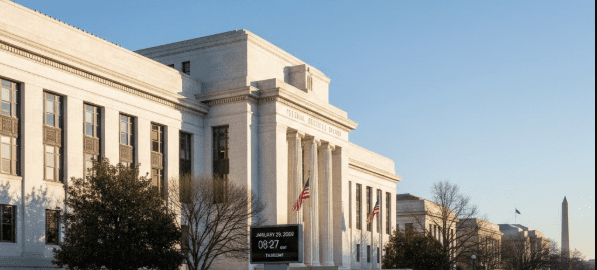
Jan. 29, 2026 /Mpelembe Media/ — In January 2026, the Federal Reserve opted to maintain interest rates at their current levels, pausing a series of previous reductions despite significant political pressure from the Trump administration. This decision was influenced by a resilient economy showing robust growth and a stabilizing, though slightly softened, job market. While the central bank faces a high-stakes Supreme Court battle regarding its governance, Chair Jerome Powell emphasized the necessity of institutional independence and avoiding partisan politics. Two officials dissented in favor of a rate cut, but the majority favored a cautious approach as inflation remains somewhat elevated due to trade tariffs. Ultimately, the sources describe a central bank attempting to navigate economic stability and future policy shifts amidst a backdrop of intense executive scrutiny.
The Federal Reserve maintains its independence through a combination of adhering to data-driven mandates, avoiding political discourse, and seeking legitimacy through legislative engagement rather than executive compliance. According to the sources, the Fed employs the following strategies to navigate political pressure:
1. Prioritizing Economic Data Over Political Demands
The Fed base its decisions on economic indicators rather than the desires of the administration. Despite “relentless attacks” from President Trump, who sought lower borrowing costs, the Fed held interest rates steady in January 2026 because economic activity was expanding at a “solid pace” and inflation remained elevated. By focusing on its dual mandate of price stability and maximum employment, the Fed signals that its actions are dictated by the economy—such as the “stabilization” of the unemployment rate—rather than political cycles.
2. Avoiding “Elected Politics”
A core tenet of the Fed’s strategy for independence is a strict refusal to engage in political controversy. Chair Jerome H. Powell explicitly advised that the best way for a Fed chair to maintain the institution’s integrity is to “stay out of elected politics”. During press conferences, Powell has been noted for demurring or refusing to comment when asked directly about political attacks or his own future at the bank, thereby preventing the Fed from becoming a participant in partisan debates.
3. Earning “Democratic Legitimacy” Through Congress
While the Fed remains independent of the executive branch, it seeks “democratic legitimacy” by engaging with elected officials in Congress. Powell suggested that this engagement is essential for the institution’s standing in a democracy. By being accountable to the legislative branch rather than the President, the Fed maintains a buffer against direct executive interference.
4. Legal and Institutional Defense
The Fed also protects its independence through the legal system and public presence. Powell characterized a Supreme Court case regarding the president’s ability to fire a Fed governor as the “most important legal case in the Fed’s 113-year history”. His attendance at the hearing was a visible sign of his commitment to the Fed’s institutional arrangement, which he argued is designed to serve the “broader public” rather than any specific interest group.
5. Cultivating Institutional Unity
Maintaining a unified front helps the Fed resist external pressure. While there were dissents from governors appointed by the administration who favored rate cuts, Powell emphasized that there was “broad support” among the committee for the decision to hold rates steady. This internal consensus makes it more difficult for outside political actors to exploit divisions within the bank to influence policy.
6. Protecting Long-term Credibility
The sources highlight that the Fed views independence as critical to its credibility. Powell noted that if politics were seen to influence the bank’s decisions, it would create a perception that the Fed acts for specific groups, making it nearly impossible to restore the institution’s credibility once lost. By remaining independent, the Fed ensures that public and market expectations regarding inflation remain anchored, as consumers trust that the bank will prioritize its 2 percent inflation target regardless of political pressure.
According to the sources, both tariffs and immigration trends have significantly influenced the economic landscape in 2026, contributing to elevated inflation and complicating the Federal Reserve’s interpretation of the labor market.
The Impact of Tariffs on Inflation
Tariffs are currently at their highest levels since the 1930s, which has exerted upward pressure on the cost of living.
Direct Price Increases: Fed Chair Jerome H. Powell noted that tariffs have specifically pushed up prices for goods, contributing to an inflation rate that remained at approximately 3 percent through 2025.
Mitigating Factors: The inflationary impact has been less severe than initially feared because the tariffs actually implemented were smaller than the high levels originally announced or threatened by the administration. Additionally, many companies have absorbed the costs of the levies rather than passing them through to consumers, and most foreign countries have chosen not to retaliate.
Long-term Outlook: The Fed views the inflationary effect of tariffs as a “one-time price increase.” Powell indicated that as these effects fade later in 2026, measures of inflation are expected to cool. Notably, when stripping out tariff effects, the Fed’s preferred inflation measure (core PCE) is estimated to be just above 2 percent.
The Impact of Immigration on the Economy
A significant shift in immigration patterns has altered the labor market, which indirectly affects inflation dynamics through wage expectations and labor supply.
Labor Force Slowdown: There was a “steep decline” in immigration over the past year, which led to a corresponding slowdown in the growth of the labor force.
Data Distortion: This reduction in immigration has made labor market data “difficult to interpret” because it represents a simultaneous fall in both the supply of and the demand for labor. Powell described this as an “unusual” situation that makes it hard to determine if the economy is at “full employment”.
Wage-Price Spiral Risks: While the sources do not directly link the immigration decline to a specific rise in inflation, they highlight that the Fed closely monitors inflation expectations. If a tight labor market (potentially exacerbated by fewer immigrant workers) leads workers to demand higher wage increases to compensate for rising costs, it becomes more likely that prices will continue to rise.
Summary of the Inflationary Environment
As of January 2026, inflation remains “somewhat elevated,” and the Fed has held interest rates steady at 3.5 to 3.75 percent to manage these risks. While there is still some “tension between employment and inflation,” Powell noted that this tension has waned, reducing the immediate risk of a significant acceleration in inflation.
The Supreme Court case involving Federal Reserve Governor Lisa D. Cook is considered significant because it centers on the President’s legal authority to fire a Fed governor, a challenge that strikes at the core of the institution’s independence.
According to the sources, the case is important for the following reasons:
Historical and Legal Magnitude: Fed Chair Jerome H. Powell described the litigation as the “most important legal case in the Fed’s 113-year history”. Its outcome will define the limits of executive power over the central bank’s leadership.
Protection of Institutional Independence: The Fed views its independence as an “institutional arrangement” designed to serve the broader public rather than specific political interests. A ruling that allows a president to fire governors at will could lead to the perception that the bank is subject to political whims.
Maintenance of Credibility: Powell emphasized that if politics were seen to influence the bank’s decisions, it would severely damage the Fed’s credibility, which he noted would be “hard to restore” once lost.
Symbolic Importance: Powell’s personal attendance at the Supreme Court hearing—a move criticized by Treasury Secretary Scott Bessent—underscored the gravity of the situation. Powell suggested it would have been difficult to explain his absence given the case’s potential to reshape the Fed’s future.
The case occurs at a time when the Federal Reserve is already facing “relentless attacks” and a barrage of legal challenges from the Trump administration, which has consistently pressured the bank to lower interest rates.