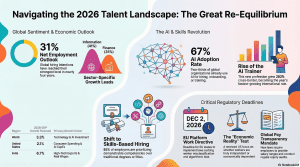

The AI Paradigm and Pipeline Risks: AI is acting as a massive job creator rather than just a labor displacer. The “AI trainer” is the fastest-growing cross-border profession, expanding by 283%. Furthermore, companies are integrating autonomous AI agents as “digital teammates”. However, a significant risk is emerging: by replacing entry-level and back-office roles with AI, organizations risk destroying their future leadership pipelines, creating a looming talent crisis for experienced managers by 2030.
The “Urban Boomerang” and Geographic Shifts: The pandemic-era exodus from cities is reversing, with remote workers migrating back toward major urban hubs. The hybrid work model has largely stabilized into a “3-2” schedule (three days in-office, two days remote. Meanwhile, top-funded startups are shattering the cost-arbitrage myth by prioritizing high-income talent hubs (like the UK, Canada, and Germany) for specialized skills. Nearshoring and the use of Global Capability Centers (GCCs)—particularly in India—are also accelerating to handle high-end technical work.
Compensation and “Currency Hopping”: Pay transparency is transforming from a cultural expectation into a strict legal mandate, driven by new laws like the EU Pay Transparency Directive. In response to global inflation and financial vulnerability, contractors in volatile markets are increasingly “currency hopping” by requesting payment in US dollars or stablecoins to protect their purchasing power.
A Fragmented Regulatory Frontier: Governments are tightening labor frameworks, making global compliance highly complex. The U.S. Department of Labor is pushing the “economic reality” test to crack down on independent contractor misclassification, while the EU’s Platform Work Directive is introducing a presumption of employment for gig workers and heavily regulating algorithmic management.
The Skills-First Imperative: With 39% of current skills expected to become obsolete by 2030, the market is shifting toward “skills-first” hiring rather than relying on degrees. Ironically, as AI automates technical tasks, distinctly “human skills”—such as critical thinking, adaptability, and problem-solving—have become the most highly prized assets by talent acquisition leaders.
The 2026 Re-Equilibrium: 5 Counter-Intuitive Truths Redefining the Global Workforce
- Introduction: The End of Reactive WorkThe early 2020s will be remembered as an era of reactive, crisis-driven chaos. From the sudden pivot to remote work to the volatile “Great Resignation,” organizations spent years simply trying to keep pace with a shifting floor. However, as we move through 2026, we have entered the “Great Re-Equilibrium”—a period defined by intentional, strategic reorganization. The global economy is no longer merely surviving; it is teetering on a unique form of resilience, with global GDP growth projected by Morgan Stanley to reach 3.2% in 2026 as inflation gradually cools and investment cycles stabilize.This re-equilibrium is not a return to the status quo. It is a fundamental shift in how, where, and why talent is engaged across borders. While growth remains steady, it is increasingly concentrated in sectors driven by artificial intelligence (AI) and high-density expertise. For business leaders, navigating this landscape requires moving past outdated myths of cost-cutting and embracing a more sophisticated, human-centric model of operational efficiency.
- The AI Paradox: Augmentation vs. the Leadership Pipeline CrisisWe are witnessing the death of the “task” and the birth of the “orchestrator.” The narrative surrounding AI has matured from labor displacement to a complex model of augmentation where AI creates roles as fast as it automates them. The most prominent example is the rise of the “AI Trainer”—a distinct profession that has seen a cross-border growth rate of 283%. These specialists, ranging from data annotators to high-level subject matter experts commanding over $100 per hour, illustrate that AI development is a human-intensive endeavor.By “saving” on entry-level wages today, companies are effectively liquidating their future intellectual capital. According to Korn Ferry, 43% of companies are targeting entry-level roles for AI replacement to drive short-term efficiency. By eliminating these foundational positions, organizations are inadvertently destroying the training grounds for the next decade of leadership. The short-term productivity gains highlighted by Morgan Stanley are real, but they come with a hidden cost: a talent vacuum in the manager pool of 2030.”The exact path depends on the strength of the consumer amid a slowing labor market and when AI adoption increases productivity gains meaningfully.” — Morgan Stanley, 2026 Economic Outlook
- The Urban Boomerang: The Death of the Rural Nomad?The dream of the permanent rural nomad has collided with the gravity of the metropolitan hub. While the early 2020s saw talent flee to the periphery, 2026 is defined by the “Urban Boomerang.” Synthesis of the Deel 2025 State of Global Hiring indicates that the distance between cross-border workers and major metropolitan centers has decreased consistently since 2022. Talent is returning to the orbit of cities like New York, London, and San Francisco to recapture the density of collaboration and career acceleration that remote isolation cannot replicate.The “3-2” hybrid model has solidified not as a compromise, but as the global standard for organizational energy. This stabilization—where employees spend three days in a collaborative office core and two days working remotely—is the direct result of this urban migration. Organizations are no longer debating if employees should return to the office, but are instead focused on optimizing those three days for “Technological Synergy” and spontaneous innovation.
- Expertise over Arbitrage: The New Map of Startup HiringGlobal hiring is no longer about finding the cheapest talent; it is about securing the fastest execution. Top-funded startups are shattering the cost-arbitrage myth by prioritizing high-income, high-skill hubs over traditional low-cost destinations. In 2026, “Execution Speed” has replaced “Cost Containment” as the primary driver of international recruitment.The new map of startup hiring reveals a concentrated preference for specialized talent in specific high-income regions:
- United Kingdom: 12.2% of cross-border hires
- Canada: 11.9% of cross-border hires
Germany: 8.8% of cross-border hiresThis trend underscores a shift in recruitment strategy: global hiring is now about finding the best talent, not the cheapest . Startups are increasingly focused on roles that support scaling and product development, such as software engineers (28% of international hires), recognizing that the proximity premium of tech ecosystems outweighs the benefits of wage arbitrage.
5 The End of Salary Secrecy: The Global Transparency MandateThe era of salary secrecy has been ended by a global transparency mandate that is as much psychological as it is regulatory. The most significant catalyst is the EU Pay Transparency Directive, which requires full implementation by June 2026. This mandate forces employers to include salary ranges in job listings and conduct rigorous pay equity audits.Workers are now managing their cross-border pay with the precision of a central bank through “Currency Hopping.” To preserve purchasing power against local inflation, workers in volatile markets are increasingly demanding payment in USD-backed stablecoins. However, this creates a sophisticated economic risk: PwC reports that 99% of stablecoins are currently pegged to the dollar. At a time when the USD is projected to soften further through 2026, this concentration risk makes global payroll a strategic high-wire act.”90% of employees now view open communication regarding pay, raises, and benefits as essential to their engagement.” — Korn Ferry, Talent Acquisition Trends 2026
6. The Legal Re-Equilibrium: The “Economic Reality” CheckRegulators have replaced “contractual labels” with the uncompromising “Economic Reality Test” as the benchmark for global liability. In the United States, enforcement now centers on whether a worker is truly in business for themselves or is economically dependent on the employer, based strictly on the factors of “control vs. opportunity for profit or loss.”In this high-enforcement era, fragmented HR and payroll systems have transitioned from a mere inconvenience to a catastrophic operational liability. The clock is ticking toward the December 2, 2026, deadline for the EU Platform Work Directive, which introduces a “rebuttable presumption” of employment. As noted by EmployeeConnect, fragmented systems are now viewed as “risk centers” because they cannot provide the audit-ready data required to survive the increased scrutiny of regulators in the EU or under Australia’s “Payday Super” mandates
.7. Conclusion: Leading with Humanity in a Machine-Augmented WorldThe “Great Re-Equilibrium” of 2026 marks a turning point where value is defined by specialized expertise, transparency, and regulatory precision. We have moved away from the era of cost-arbitrage and reactive hiring toward a future where efficiency is a machine-driven baseline, but resilience is a human-led differentiator.The ultimate question for leadership in 2027 is not how much work can be offloaded to an algorithm, but whether your organization is investing enough in the “Human-Machine Equation.” Efficiency may be driven by machines, but the durability of your growth depends entirely on the humans who guide them. Are you merely chasing short-term margins, or are you building a foundation for the next decade of work?Resilience is no longer an accident of the market; it is an intentional design.