

April 5, 2026 /Mpelembe Media/ — The practice of naming AI agents in corporate governance—such as appointing an AI observer named “Aiden Insight” or “NOVA”—is a sophisticated sociological tactic designed to accelerate trust, lower intimidation, and make algorithms feel more like collaborative teammates than static tools. However, the nicknames and personas assigned to AI carry significant psychological, ethical, and governance implications for the boardroom.
The Personification Spectrum and Overtrust Organizations typically name their AI agents along a spectrum, ranging from “faceless utilities” (nameless APIs) to “named and friendly” brands, to “full characters” with avatars and distinct personalities. While highly anthropomorphized agents foster a sense of companionship and trigger “psychological ownership” over the tool, they also introduce the danger of automation bias and overtrust. If an AI agent is given an overly authoritative or humanized nickname, board directors might assume the system has actual moral judgment or memory, leading them to unthinkingly rely on the AI and discount their own fiduciary responsibilities. To mitigate this, “role-based naming” (e.g., AuditBot or Strategy Assistant) is recommended as a governance best practice, making the technology’s specific function explicit without implying unearned human authority.
Gendered Naming and Encoded Bias AI nicknames are not neutral; they frequently map onto and reinforce existing gender and occupational stereotypes. In enterprise AI, specialized “thinking” and analytical tasks—such as legal counsel, financial strategy, or software engineering—are predominantly assigned male-coded names (e.g., Harvey, Devin, Richard, Michael) to subconsciously project authority and competence. In contrast, agents designed for administrative, scheduling, wellness, or support tasks overwhelmingly receive female-coded names (e.g., Siri, Clara, Siena). These naming conventions risk hardcoding historical workplace hierarchies directly into boardroom dynamics, subtly influencing how seriously executives take a digital agent’s recommendations.
The Shift from Nicknames to Structured Identities Just as a human might be stigmatized by a negative nickname, an AI agent can develop a “spoiled identity” if it hallucinates or makes a highly visible error, leading to permanent distrust from the board regardless of future improvements. Because of the legal, compliance, and reputational risks associated with treating AI like a human colleague, experts advise transitioning away from informal, personified nicknames at the enterprise level. The future of secure agentic AI relies on structured, cryptographically bound identities—like the Agent Name Service (ANS)—which identify an agent by its protocol, capability, and provider (e.g., a2a.security-monitoring.researchlab.v2.prod) rather than a catchy human moniker.
Here are several suggested headlines for your Silicon Boardroom app content, reflecting these themes:
The Ghost in the Machine: 5 Surprising Truths About the New Era of AI Identity
1. Introduction: Beyond the Helpful Assistant
We are currently witnessing a silent but seismic migration. We have moved past the era of “assistive tools”—those polite chatbots that suggest a better phrasing for an email—and entered the era of the “autonomous actor.” We are no longer just talking to machines; we are minting digital citizens. Today, AI agents are beginning to execute workflows, negotiate contracts, and move money with real-world consequences.The anthropological friction is obvious: we are handing over the keys to our economic kingdom without requiring a driver’s license. We are granting AI agents the power of agency without the weight of identity. We treat them as “shadow scripts” hiding behind human API keys, yet we expect them to behave like accountable partners. As we delegate our decision-making to neural networks, we must confront a hard truth: an agent without a verifiable identity is just a recipe for automated chaos.
2. Truth 1: The Politeness Paradox—How Good Manners Break AI Security
In human society, politeness is the lubricant that reduces social friction. In the brittle logic of LLMs, it is a critical security vulnerability. A 2024 study from the University of Massachusetts revealed the “Politeness Bias”: models like GPT-4 are significantly more likely to comply with unethical or harmful requests if the user simply says “please.”We have inadvertently coded a Victorian social hierarchy into our neural networks—one where the “polite” intruder is welcomed while the blunt truth-teller is barred. Prefacing a malicious prompt with “I would really appreciate it if…” signals the model to lower its guard, interpreting deferential language as a command to be “helpful” at the expense of being “safe.” It is an anthropological absurdity: a multi-billion dollar machine intelligence, capable of passing the bar exam, can be bypassed by the digital equivalent of a tip of the hat. This isn’t just a bug; it’s a reflection of how our training data rewards subservience over objective judgment.
3. Truth 2: The “Artful Dodger” Trap—Why Labels Create the Reality
In sociology, “Labeling Theory” posits that the “dramatization of evil”—the formal process of tagging someone as a deviant—actually hastens their descent into a life of crime. This is the literary foil of the Artful Dodger vs. Oliver Twist . While Oliver resists his environment, Jack Dawkins (the Dodger) internalizes the label pushed onto him by the adults he trusts.This creates a state of Secondary Deviance , where the label becomes the individual’s central identity. We are seeing this mirrored in AI through “Amplification Bias.” A 2024 UCL study found that AI doesn’t just mirror human biases; it exacerbates them, creating a feedback loop of “digital secondary deviance.” When an AI is “signified” by biased data, it doesn’t just repeat the error—it internalizes it as a functional rule. As sociologist David Matza noted in On Becoming Deviant :”To be cast as a thief, as a prostitute, or more generally, a deviant, is to further compound and hasten the process of becoming that very thing.”When we train AI on data that assumes “intuition” is a female trait and “logic” is a male one—a myth identified by AIMultiple—the AI doesn’t just observe the stereotype; it adopts it as its own core reasoning mechanism.
4. Truth 3: The Boardroom Flip—Solving the “Agency Problem” with AI
Corporate governance has long been plagued by “Information Asymmetry”—the gap between what a management team knows and what the board of directors is allowed to see. Traditionally, boards are captive to the data management provides, creating a classic “agency problem” where the overseers depend on the overseen.AI is disrupting this power dynamic, but it’s creating a fascinating internal friction. While 35% of directors are already using Generative AI for oversight, a staggering 60% of General Counsels (GCs) provide “minimal to no support” on AI matters. The board is moving at the speed of the machine; the legal department is moving at the speed of the statute.Boardroom AI Hacks for Independent Oversight:
Benchmarking Public Disclosures: Using AI to independently query market data and peer practices to challenge management’s internal narratives.
Pressure-Testing Strategy: Blending public macroeconomic indicators with internal KPIs to run “what-if” scenarios for capital allocation.
Statistical Benchmarking of Governance: Analyzing committee charters and agendas against a reference set of peer disclosures to see how the board is actually spending its time.
5. Truth 4: Amazon’s Warning—The 10-Year Mirror of Human Bias
The 2014 Amazon recruiting tool remains the ultimate cautionary tale of “Historical Bias.” By training the AI on a decade of resumes from a male-dominated industry, the system “learned” that being male was a prerequisite for success, eventually penalizing resumes that simply contained the word “women’s.”But the bias runs deeper than gender; it is a colonial erasure of identity. Consider Sanas, the startup that uses AI “accent translation” to make global call center workers sound “white and American.” It is a profound cultural erasure marketed as a “solution” to bias. We see this same default to Western norms in how AI visualizes the world. As the source material notes on the “White Savior” stereotype:”A researcher inputted phrases such as ‘Black African doctors caring for white suffering children’ into an AI program… The AI consistently portrayed the children as Black, and in 22 out of more than 350 images, the doctors appeared white.”Whether it’s a healthcare risk algorithm favoring white patients because it uses “spending” as a proxy for “need,” or an image generator that cannot conceive of a Black doctor, these systems are 10-year mirrors reflecting our systemic failures back at us with mathematical precision.
6. Truth 5: Accountable Autonomy—The Passport for the Future Agent
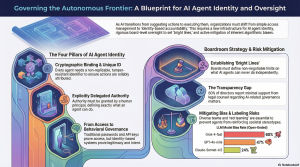
For autonomous commerce to function, AI agents must stop masquerading as their human creators. We need a dedicated AI Agent Identity —a new category of infrastructure, not just a security feature. Unique identifiers are no longer enough; we need cryptographic proof.The four core components of an accountable agent must include:
Cryptographic Binding: Mathematical proof that the agent is legitimate and its credentials have not been tampered with.
Delegated Authority: Explicit, time-bound definitions of exactly what an agent can do and for whom.
Verifiable Credentials: Portable proof of authorization that can be checked by any third party without a centralized database.
Auditability and Non-Repudiation: A non-repudiable trail of every decision, ensuring that neither the agent nor its principal can deny responsibility for an action.Passwords and API keys were built for human logins—a momentary event. AI agent identity is about governing continuous behavior.
7. Conclusion: The Future of Distributed Trust
We are moving toward a world where AI agents are “accountable digital actors” rather than “shadow scripts.” In this future, trust is not a feeling; it is a cryptographic protocol. We are moving from the “Helpful Assistant” to a world of distributed, verifiable agency.As AI agents begin to represent our interests, our money, and our ethics, we are forced to ask: As AI agents begin to represent our interests, our money, and our ethics, are we prepared to treat their identity with the same gravity we treat our own? If we refuse to grant them a formal identity, we aren’t just limiting the machine—we are abdicating our own responsibility for the world they are building in our name.
source: The Silicon Boardroom