March 23, 2026 /Mpelembe Media/ — MoneyPrinterV2 is an advanced Python-based automation framework designed to help users generate online revenue through AI-driven content creation and social media management. The software utilizes a modular architecture to automate the production of YouTube Shorts, manage Twitter bots, and execute affiliate marketing campaigns. By integrating technologies like Ollama for script generation and KittenTTS for voiceovers, the tool can independently create and schedule videos with subtitles and background music. Beyond social media, the platform includes features for scraping local business data to facilitate automated email outreach and lead generation. This open-source project aims to eliminate the manual labor typically required for consistent digital engagement by providing a centralized command-line interface for various income streams. While offering powerful capabilities for creators and marketers, the author emphasizes that the tool is intended for educational purposes and requires user compliance with platform terms.
The Complex Legal Landscape of AI Copyright
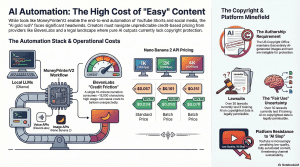
The legal status of AI-generated content is currently a massive gray area. The U.S. Copyright Office has established that purely machine-generated works without human authorship cannot be copyrighted. This means if a user relies entirely on automated tools to generate a video or image, the output effectively belongs to the public domain and can be legally copied by competitors. Copyright protection is only granted if a human exercises “meaningful creative control,” such as extensively editing or arranging the AI output. Furthermore, whether AI companies are legally permitted to train their models on copyrighted materials without permission is still heavily debated in courts, though some tech companies are fighting for a “fair use” exception. Due to this lack of legal protection, terms of service from AI companies (like Recraft) claiming to “own” the copyright of generated images are widely considered to be unenforceable contractual overreach.
Nano Banana 2 (Image Generation): Google’s newer image model is highlighted for its aggressive pricing and high performance. It costs between $0.045 for a 512px image and $0.151 for 4K resolution, making it roughly 37% cheaper than its “Pro” predecessor. Developers can also cut costs by an additional 50% by using Google’s Batch API for non-urgent requests.
ElevenLabs (Text-to-Speech): While ElevenLabs offers top-tier voice cloning, its character-based credit system creates hidden complexities and budget unpredictability for businesses. Because the pricing penalizes growth, businesses are warned about surprise bills when their content volume scales, leading many automation frameworks to explore cheaper or local TTS alternatives like KittenTTS.
The Ghost in the Machine: Why Your AI “Empire” Has Zero Legal Walls
Welcome to the AI Wild West, where the promise of “easy money” fuels a gold rush of automated channels and generated assets. It is an attention arbitrage play marketed as a frictionless frontier, but beneath the hood, creators are producing what critics call “industrial-scale slop.” We are currently barreling toward a “copyright catastrophe” that threatens to leave the most prolific automators with nothing to show for their efforts.If an algorithm builds your entire business, who actually owns the keys to the kingdom? This is the relatable curiosity driving a wave of over 30 lawsuits, such as The New York Times v. OpenAI , where publishers allege their “fixed expression” was used without permission. Understanding the gap between marketing hype and legal reality is the only way to survive the coming shakeout.
1. You are Already a Copyright Owner (and a Data Source)
Under the Copyright Act of 1976, you are already a copyright mogul. Every smartphone photo, mid-rant blog post, or original video is “fixed in a tangible medium,” granting you automatic ownership from the moment of creation. You don’t need to file paperwork to own the rights to your original expressions; the law recognizes your human authorship by default.The supreme irony of the generative era is that AI companies are harvesting this very data to train models that mimic your human personality and style. These systems require high-quality, human-generated data to function, yet they are being trained to compete with the very creators they rely on. You are essentially providing the raw material for the machine that aims to automate your creative output.”Once you create an original work and fix it, like taking a photograph, writing a poem or blog or recording a new song, you are the author and the owner.” — US Copyright Office
2. The “Ownership” Illusion in Terms of Service
Contractual Overreach and the Federal Reality. Platforms like Recraft often leverage their Terms of Service (ToS) to imply ownership structures that simply do not exist under federal law. On Reddit, users have flagged terms claiming that images created on free plans are “owned by the company” or that rights are revoked upon cancellation. This is little more than a misleading intimidation tactic designed to keep users subscribed; while a contract can restrict your usage , it cannot conjure a copyright where the law says none exists. Per the precedent in Thaler v. Perlmutter , the U.S. legal system maintains that copyright requires human authorship—you cannot “lose” a legal title to an AI output that was never protectable in the first place.
3. The Hidden “Token Tax” of AI Production
The “easy money” narrative frequently ignores the “friction disguised as flexibility” inherent in AI credit systems. In ElevenLabs, for example, a single 10-minute narration consumes roughly 15,000 characters, meaning the 100,000-character limit on a Starter plan vanishes almost instantly. These usage-based models create a hidden “token tax” that makes ROI unpredictable for anyone trying to scale production.The true cost of your “automation empire” includes several gritty overhead factors:
Input Token Costs: You are billed for every character in your text prompts, meaning complex instructions for models like Nano Banana 2 add up before you even see an output.
Failed Retry Costs: Real-world API failure rates—stemming from safety filters or network timeouts—range from 3% to 8%, and users typically pay for these failed attempts.
Resolution Premiums: Strategic decisions matter; generating a 4K image with Nano Banana 2 costs $0.151 per request, a massive jump from the $0.045 charged for 0.5K resolution.
4. Why “100% AI” is a Legal Dead End
Building a business on content that is entirely generated by AI is a strategic dead end because you are essentially dumping your assets into the public domain. The U.S. Copyright Office is clear: images and videos generated entirely by prompts lack human authorship and are ineligible for protection. This introduces a catastrophic business risk; competitors could legally “take your thing” and extract all the value from your automated channel, re-uploading your content with zero legal recourse.To move beyond the public domain waiting room, creators must adopt a “Human-in-the-Loop” approach. Legal protection is only available if you can prove “meaningful creative control,” such as significant human manipulation or AI-assisted editing. Without this human flourish, your automated output is free for any large corporation or rival to seize and monetize.”Do these laws exist primarily as an issue of industrial economic policy, or do they exist as part of a humanistic approach that values and encourages human flourishing by rewarding human creators?” — Christian Mammen, Intellectual Property Lawyer
5. The “Easy Money” Automation Trap
Projects like “MoneyPrinter” are marketed as a “YouTuber’s wet dream,” promising 10-word prompts that churn out hour-long videos effortlessly. The technical reality is a gritty maze of environment dependencies, requiring Python 3.12 (it fails on 3.13 due to torch compatibility) and a Postgres database in Docker for “restart-safe processing.” Setting up ImageMagick and FFmpeg binaries is only the first hurdle in a complex production pipeline.Beyond the setup, you face the very real threat of platform penalties. Algorithms on sites like YouTube are increasingly adept at “pegging” industrial-scale, low-effort content as “AI slop,” which can cause your reach to vanish overnight. The dream of mindless passive income ignores the reality that platforms value original engagement over the raw output of an automated script.
Conclusion: The Future of Creative Value
We are shifting from a production economy to one of “strategic orchestration.” In this new landscape, value is not found in the raw output of a machine, but in the human curation that transforms AI fragments into a protected, cohesive work. Curation is emerging as a protected manner of speech, allowing creators to “collage” AI assets into a greater whole that clears the bar for copyright.As we navigate this transition, we must ask ourselves: In an era where a machine can generate infinite content for pennies, will we continue to value the “human flourish” that makes a work unique, or will we settle for the mechanical output of the automation era?