The Center of Gravity Just Shifted: 5 Surprising Lessons from the India AI Impact Summit 2026
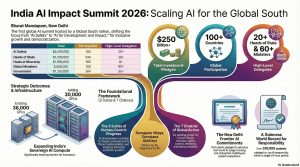
Feb 21, 2026 /Mpelembe media/ — For the past three years, the global conversation surrounding Artificial Intelligence has been dominated by a single, narrow theme: safety. From the Bletchley Park AI Safety Summit (2023) to high-level gatherings in Seoul (2024) and Paris (2025) , the focus remained fixed on “existential risk” and theoretical doomsday scenarios. While the West remained paralyzed by the “Alignment Problem,” the Global South has been focused on the “Access Problem.”The India AI Impact Summit 2026 , held from February 16–21 at Bharat Mandapam in New Delhi, decisively shifted the center of gravity. As the first global AI summit hosted in the Global South, the event pivoted from speculative risks to “Applied AI” —technology deployed today to solve real-world problems. Anchored in the philosophical foundation of the “Three Sutras” (People, Planet, and Progress) , the summit presented a human-centric alternative to the Silicon Valley narrative, prioritizing inclusive development over elite safety debates.
Takeaway 1: Infrastructure for the Masses (The GPU Democratization)
While Silicon Valley treats high-end computing power as a gatekept resource for Big Tech, India is pursuing a “frugal and scalable” model of democratization. This strategy is backed by the ₹10,371 crore IndiaAI Mission budget, providing the fiscal weight necessary to challenge centralized AI models.During the summit, Union Minister Ashwini Vaishnaw announced a massive expansion of India’s compute capacity. The government is adding 20,000 Graphics Processing Units (GPUs) —specialized chips designed for the parallel processing and high-throughput training required for AI—to its existing 38,000-unit base. This brings the total to exactly 58,000 GPUs .More disruptive than the quantity is the accessibility. Under the IndiaAI Mission , this sovereign compute is available at just ₹65 per hour , representing a 40% reduction in cost compared to standard market rates. Minister Vaishnaw emphasized that this reflects a strategic “democratization of technology,” ensuring that the “fifth industrial revolution” is accessible to every student and innovator rather than just those with the deepest pockets.
Takeaway 2: Breaking the “English Barrier” (Linguistic Inclusion at Scale)
Linguistic barriers have historically limited AI adoption in the Global South, as most Large Language Models (LLMs) —AI systems trained on massive datasets to generate human-like text—are optimized for English. The New Delhi summit marked the unveiling of indigenous models designed to bridge this gap:
- BharatGen Param2: A government-funded, 17-billion parameter multimodal model supporting 22 official Indian languages .
- Sarvam AI: Unveiled a new generation of models (30B and 105B parameters) using Mixture-of-Experts (MoE) architecture. MoE is a technical design that improves efficiency by only activating a specific fraction of the model’s parameters for any given task.
- Gnani.ai: Launched Vachana TTS , capable of cloning a human voice across 12 Indian languages using less than 10 seconds of reference audio.These innovations power the BHASHINI platform, which enables “voice-first” digital governance . By shifting AI from an elite tool to a grassroots utility, a farmer can now access government services via a voice chatbot in their native dialect, bypassing the need for English literacy.
Takeaway 3: A Guinness World Record for Responsibility
In a move that contrasted with traditional top-down regulation, India engaged the public directly in AI governance. Between February 16 and 17, the summit set a Guinness World Record after 250,946 students pledged to use AI responsibly within a 24-hour period, shattering the initial target of 5,000.This massive public engagement effort, coordinated by the Ministry of Electronics and Information Technology (MeitY) , reflects a unique approach to governance. Rather than relying solely on restrictive laws, the summit emphasized building a “Safe and Trusted AI” culture from the ground up. This aligns with the summit’s core theme: “Sarvajana Hitaya, Sarvajana Sukhaya” (Welfare for all, happiness for all), suggesting that ethical AI is a communal responsibility.
Takeaway 4: The Geopolitical Friction (The “Delhi Declaration” vs. The White House)
The summit highlighted a growing divide in global AI governance. Over 80 signatories , including 70+ nations , joined the “Delhi Declaration,” a framework pushing for shared standards and inclusive benefits for the Global South.However, tension emerged as the United States delegation signaled a preference for a market-driven approach over international oversight. White House official Michael Kratsios stated, “We totally reject global governance of AI,” arguing instead for voluntary, market-led frameworks.Despite this friction, India continues to act as a “bridge power” between the West and the Global South. This “multi-aligned” strategy was evidenced by India joining the “Pax Silica” initiative—a US-led alliance focused on shifting the semiconductor and electronics supply chain to trusted, peace-aligned partners—while simultaneously leading the impact-focused agenda of the “Delhi Declaration” for developing nations.
Takeaway 5: Real-World Use Cases over Prototypes
Perhaps the most significant insight for a technology analyst was the move from speculative prototypes to “Outcome-based AI.” The government, in collaboration with NITI Aayog , released 6 Sectoral AI Impact Casebooks featuring over 170 deployed innovations .High-impact examples included:
- Agriculture: Tools like Kisan E-Mitra (an AI chatbot) have led to 30-50% productivity gains in states like Andhra Pradesh.
- Disaster Management: BrahmaSATARK uses AI-integrated physics modeling to provide impact-based flood forecasts for the Brahmaputra and Ganga basins.
- Fraud Detection: MuleHunter.AI identifies “mule accounts” in banking to prevent large-scale financial fraud.These examples prove that the most important metric for the next decade is not the “intelligence” of a model, but the measurable social and economic value it creates.
Conclusion: The Future of Sovereignty
The India AI Impact Summit 2026 concluded with a staggering $270 billion in total commitments, including ****$ 250 billion for the infrastructure layer and $20 billion in venture capital for the innovation ecosystem. The summit also saw the announcement of “IndiaAI Mission 2.0,” which aims to address the global talent gap by training 2 million people in AI skills.As the conversation moves toward the 2027 summit in Geneva, the New Delhi event has left the world with a critical question: Will the “Global South model” of AI—sovereign, frugal, and impact-driven—eventually become the global standard? By treating AI as a public utility rather than a corporate luxury, India has provided a blueprint for a future where technology serves the many, not just the few.