
03, Feb. 2026 /Mpelembe Media/ — The Architect of New Labour Peter Mandelson was Tony Blair’s closest political confidant and a primary architect of the “New Labour” project. His influence began with his secretive role (codenamed “Bobby”) in securing Blair’s leadership in 1994 and continued as he directed the 1997 landslide election campaign. Known by nicknames such as “Rasputin” and the “Prince of Darkness”, Mandelson was defined by his influential, behind-the-scenes operational style and a persistent reputation as an “arch manipulator”.
Inner Circle Dynamics and Resilience Within the government, Mandelson was a central pillar of Blair’s inner circle, though he faced intense rivalry with Gordon Brown. His career was marked by extraordinary resilience; despite being forced to resign from the Cabinet twice—first in 1998 over a home loan scandal and again in 2001 over a passport application row—he was repeatedly brought back into the fold. This was sustained by a deep personal bond with the Blair family, with Cherie Blair reportedly telling him he would “always be part of the family”.
International Diplomacy and Commercial Links Beyond domestic politics, Mandelson played a role in the UK’s re-engagement with Libya, defending the 2004 “Deal in the Desert” which aimed to normalise relations after Muammar Gaddafi renounced weapons of mass destruction. He maintained personal links with Saif al-Islam Gaddafi, meeting him in 2009 and 2010. Furthermore, his close friendship with Russian oligarch Oleg Deripaska drew attention when reports surfaced in 2011 regarding potential commercial deals involving JP Morgan, the Libyan Investment Authority, and Deripaska’s company, Rusal.
The Legacy of Influence While Mandelson was a successful minister, his legacy is inextricably linked to his strategic advisory role and his ability to maintain power through personal connections and high-level international networking. Despite various controversies, including debates over frozen Libyan assets, Mandelson remained a foundational figure in the rise and tenure of the New Labour government.
Peter Mandelson was Tony Blair’s closest political confidant and served as a primary architect of the “New Labour” project. His influence was instrumental from the project’s inception, beginning with his secretive role (codenamed “Bobby”) in helping Blair secure the Labour Party leadership in 1994.
The sources highlight several ways his role as a political architect shaped the movement:
Strategic Campaigning: Mandelson was the election campaign director for Labour’s 1997 landslide victory, a pivotal moment that defined the New Labour era.
Operational Style: He was known for a highly influential, behind-the-scenes approach, earning him nicknames such as “Rasputin” and the “Prince of Darkness”. Despite his success as a minister, he struggled to shake a reputation as an “arch manipulator”.
Inner Circle Dynamics: Within Blair’s inner circle, Mandelson shared influence with Alastair Campbell and Gordon Brown. However, his relationship with Brown was frequently marked by intense rivalry, which shaped the internal power dynamics of the party.
Resilience and Personal Bonds: His role was sustained by a deep personal connection to Tony Blair and his family; Cherie Blair reportedly told him he would “always be part of the family”. This bond allowed him to be repeatedly brought back into the inner circle even after being forced to resign from the Cabinet twice—first in 1998 regarding a home loan scandal and again in 2001 over a passport dispute.
Diplomatic and Commercial Legacy: Even after the initial architecting of New Labour, Mandelson remained involved in its legacy, defending controversial diplomatic moves like the 2004 “Deal in the Desert” with Libya and maintaining links with figures like Saif al-Islam Gaddafi.
Mandelson’s professional reliance and personal friendship with Blair were central to both the rise and the tenure of the New Labour government.
The intense rivalry between Peter Mandelson and Gordon Brown was rooted in their competing influence within Tony Blair’s inner circle. Both men were primary figures and architects of the “New Labour” project, yet their roles and relationship to Blair created significant friction.
Key factors contributing to this rivalry, as identified in the sources, include:
The 1994 Leadership Contest: A major source of tension was Mandelson’s secretive and instrumental role (codenamed “Bobby”) in helping Tony Blair secure the Labour Party leadership in 1994 after the death of John Smith. This strategic support for Blair over other potential candidates—such as Brown—established a foundational point of conflict regarding the party’s hierarchy.
Proximity to Tony Blair: While Gordon Brown was the Chancellor, the sources describe Mandelson as “Tony Blair’s closest political confidant”. This deep professional reliance and personal friendship, which saw Blair repeatedly bring Mandelson back into the inner circle despite multiple Cabinet resignations, often placed Mandelson in a position of influence that rivalled Brown’s own standing.
Shared Influence and Strategic Control: Mandelson and Brown, along with Alastair Campbell, shared influence over the direction of the government. Mandelson’s reputation as an “arch manipulator” and his behind-the-scenes role as “Rasputin” or the “Prince of Darkness” further complicated his working relationship with other high-ranking officials like Brown.
While the sources confirm the existence and intensity of this rivalry, they do not provide specific details on the private personal disagreements or the “Granita pact”—a term frequently used in external political histories to describe a leadership deal between Blair and Brown—that is often cited as a primary cause for their breakdown in relations. You may wish to independently verify the details of that specific agreement to gain a fuller picture of the origins of their animosity.
Peter Mandelson was forced to resign from the Cabinet on two separate occasions during the New Labour government due to the following scandals:
The 1998 Home Loan Scandal: Mandelson first resigned on 24 December 1998. This resignation was prompted by a controversy surrounding a personal home loan he had received from Geoffrey Robinson, who was the Paymaster General at the time. The scandal resulted in the resignations of both Mandelson and Robinson.
The 2001 Passport Dispute: His second resignation occurred on 24 January 2001, while he was serving as the Northern Ireland Secretary. This departure was triggered by a row concerning a passport application. Although he was forced to leave the Cabinet twice, Tony Blair maintained a strong personal bond with him and repeatedly brought him back into his inner circle.
Despite these resignations, Mandelson remained a highly influential figure, though he struggled to move past his reputation as an “arch manipulator”. Following his time in the Cabinet, he continued to be involved in high-level diplomatic and commercial activities, such as defending the 2004 “Deal in the Desert” with Libya and maintaining personal links with figures like Saif al-Islam Gaddafi and Russian oligarch Oleg Deripaska.
Peter Mandelson’s links with Saif al-Islam Gaddafi were primarily characterized by high-level diplomatic and commercial re-engagement with the Libyan regime. According to the sources, Mandelson admitted to meeting Saif Gaddafi on two occasions, specifically in 2009 and 2010.
The nature of these links can be understood through the following contexts:
Diplomatic Re-engagement: These meetings occurred within the broader framework of the UK’s efforts to bring the Libyan regime “in from the cold”. Mandelson was a vocal supporter of the 2004 “Deal in the Desert”, which had been architected by Tony Blair to normalise relations after Muammar Gaddafi renounced weapons of mass destruction. Mandelson defended this engagement as the “right thing” to do, despite the “unpredictable” nature of the Libyan leader.
Commercial Interests: Mandelson’s connections to the Gaddafi family also overlapped with his network of influential friends. In 2011, reports surfaced regarding a potential deal involving JP Morgan and the Libyan Investment Authority (LIA). This deal reportedly aimed to broker an investment with Rusal, a company owned by the Russian oligarch Oleg Deripaska, who is described in the sources as a close friend of Peter Mandelson.
Broader New Labour Strategy: Mandelson’s interaction with Saif Gaddafi was part of a wider pattern of communication between the New Labour inner circle and the Libyan leadership. While Mandelson met Saif for discussions, Tony Blair communicated with him even more frequently, often to encourage regime reform or, later, to urge his father to step down during the Arab Spring.
While Mandelson’s reputation as an “arch manipulator” and his behind-the-scenes role as “Rasputin” often drew scrutiny to his international dealings, the sources indicate that his links with Saif Gaddafi were a component of the government’s strategic and commercial outreach to Libya during that era.
The 2004 “Deal in the Desert” was a significant diplomatic agreement intended to normalise relations between the United Kingdom and Libya. Tony Blair served as the primary architect of this deal, which was made possible after Muammar Gaddafi officially renounced weapons of mass destruction.
The deal was a central part of a broader strategy to bring the Libyan regime “in from the cold”. Peter Mandelson, as one of Blair’s closest political confidants, later defended this engagement as the “right thing” to do, even while acknowledging that the Libyan leader was “unpredictable”.
This agreement paved the way for subsequent commercial and diplomatic interactions between the New Labour government and Libya, including:
Diplomatic Re-engagement: Normalised ties allowed for direct communication between UK leadership and figures like Gaddafi’s son, Saif al-Islam.
Commercial Interests: The deal created a framework for future business discussions, such as reports linking Blair to potential deals involving JP Morgan and the Libyan Investment Authority.
Ongoing Controversy: Despite the initial goal of normalisation, the deal remains a point of political debate, particularly regarding the subsequent handling of frozen Libyan assets in the UK and their potential use for compensating victims of IRA terrorism sponsored by the Gaddafi regime.
The friendship between Peter Mandelson and Oleg Deripaska, a prominent Russian oligarch, is described as a “close” personal bond.
The nature of this relationship is highlighted through its intersection with Mandelson’s diplomatic and commercial networks:
Commercial Intersections: In 2011, reports surfaced linking this friendship to high-level international business. Specifically, a potential deal was discussed involving JP Morgan (where Tony Blair was a senior adviser) and the Libyan Investment Authority (LIA). The aim of this deal was reportedly to broker a loan or investment with Rusal, a company owned by Deripaska.
Political Context: While Mandelson maintained this close friendship, the sources note that Tony Blair’s office denied any commercial relationship with either Deripaska or Rusal.
Reputational Impact: Mandelson’s links to powerful international figures like Deripaska and Saif al-Islam Gaddafi often reinforced his reputation as a “behind-the-scenes” operator and an “arch manipulator”.
Mandelson’s role as a political architect for New Labour frequently involved leveraging such influential personal connections, even after his formal time in the Cabinet had ended.
Peter Mandelson and Alastair Campbell shared influence as central pillars of Tony Blair’s inner circle, though they occupied distinct roles within the “New Labour” project. While Mandelson was regarded as Blair’s “closest political confidant” and a key strategic architect, Campbell served as the Director of Communications.
The sources describe how their influence over Blair was structured:
Complementary Roles: Mandelson’s influence was often behind-the-scenes; he acted as a strategic adviser and election campaign director, earning nicknames like “Rasputin” and the “Prince of Darkness” due to his influential operational style. Campbell, as Director of Communications, managed the public-facing image and messaging of the government.
The Inner Circle: Alongside Gordon Brown, the Chancellor, Campbell and Mandelson formed a small group that shared influence over the direction of the government and the “New Labour” project. However, as mentioned in our previous conversation, this dynamic was often complicated by the intense rivalry between Mandelson and Brown.
Foundational Support: Mandelson’s influence began early when he played a secretive and instrumental role (codenamed “Bobby”) in helping Blair secure the Labour Party leadership in 1994, establishing a long-term professional reliance.
Resilience of Influence: Mandelson’s position was bolstered by a strong personal bond with Blair, which allowed him to be repeatedly brought back into the inner circle even after two Cabinet resignations. This personal connection was so deep that he was considered “part of the family” by the Blairs, ensuring his continued influence alongside Campbell throughout Blair’s tenure.
While the sources focus heavily on Mandelson’s specific strategic and diplomatic contributions—such as his role in the “Deal in the Desert” and his links to international figures—they clarify that Campbell was a primary figure with whom this power was balanced within the heart of the government.
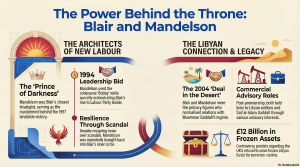
The codename “Bobby” referred to the secretive and instrumental role Peter Mandelson played in helping Tony Blair secure the Labour Party leadership in 1994.
According to the sources, this clandestine operation was triggered by the death of John Smith, which created a leadership vacuum within the party. Mandelson’s work under this codename was foundational to his status as a key architect of the “New Labour” project and established the deep professional reliance that defined his relationship with Blair for years to come.
The use of a codename like “Bobby” highlights the behind-the-scenes, influential style that became Mandelson’s trademark, often leading others to refer to him as “Rasputin” or the “Prince of Darkness”. Despite the secrecy of his early efforts to install Blair as leader, Mandelson’s role was central to Blair’s eventual rise and his decade-long tenure as Prime Minister.