
March 31, 2026 /Mpelembe Media/ — Organized crime groups, particularly the Calabrian ‘Ndrangheta and the Sicilian Cosa Nostra, have transformed from regional racketeers into sophisticated global enterprises. Central to their modern success is the “submersion” strategy—a tactical move away from overt, bloody violence toward the silent infiltration of the legal economy, public administration, and global financial systems.
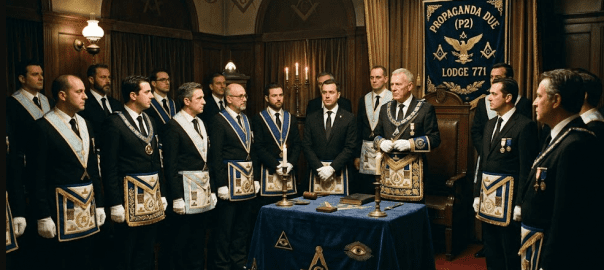
A primary mechanism for this infiltration is the “secret nexus” between mafia clans and deviant Masonic lodges. Criminal organizations actively exploit the strict secrecy, esoteric rituals, and deep brotherhood of these unrecognized lodges to forge corrupt alliances with the “upperworld” of politicians, magistrates, business executives, and intelligence officers. The ultimate archetype of this architecture of opaque power is the Propaganda Due (P2) lodge, led by Licio Gelli. Functioning as a “state within a state,” P2 orchestrated massive financial scandals like the Banco Ambrosiano collapse, manipulated the press, and obstructed justice regarding neo-fascist terrorism, including the 1980 Bologna massacre. To access these elite, protected networks, the ‘Ndrangheta altered its own traditional rules by creating a specialized upper-tier rank known as “La Santa,” which explicitly granted its bosses permission to hold dual affiliation in both the mafia and Freemasonry. This weaponization of Masonic structures also occurs outside Italy, as evidenced by a recent trial in France exposing the Athanor Masonic lodge as a front for contract killings orchestrated by former intelligence agents.
Fueling this vast corruption is the ‘Ndrangheta’s dominance in the global cocaine trade. Utilizing the port of Gioia Tauro and forging direct partnerships with Latin American cartels, the syndicate generates billions of euros annually. The group has used this immense wealth to expand internationally, setting up money-laundering operations and criminal cells in countries like Germany, Canada, Australia, and the UK. They frequently launder their illicit profits through legitimate businesses, real estate, and public contracts, creating a “grey area” that heavily blurs the lines between legal and illegal economies.
In response, state institutions have launched unprecedented crackdowns. The historic Rinascita-Scott maxi-trial recently concluded with over 200 convictions, specifically exposing the ‘Ndrangheta’s symbiotic relationship with rogue Freemasonry and corrupt officials in the province of Vibo Valentia. Furthermore, the Italian Parliamentary Antimafia Commission, previously led by Rosy Bindi, aggressively investigated these ties, leading to the controversial seizure of Masonic membership lists to cross-reference them with mafia investigations. However, this assertive approach recently resulted in a landmark European Court of Human Rights (ECHR) ruling, which found that the sweeping, indiscriminate search and seizure operations violated the Masonic association’s right to privacy under Article 8 of the Convention. Despite these complex legal hurdles, the cultural fight against organized crime continues to grow, increasingly spearheaded by the “female face of the anti-mafia”—a powerful coalition of women, including former mafia family members, magistrates, and activists, who are breaking the code of silence and fighting the mafia’s societal grip.
The Script of Power: 5 Surprising Truths About the World’s Most Secretive Mafia
In January 2021, the Lamezia Terme bunker courtroom in Calabria became the site of a forensic deconstruction of power. The Rinascita-Scott trial, involving 355 defendants and an evidentiary deluge catalyzed by over 50 pentiti (collaborators), has provided more than just a list of crimes. It has exposed the ‘Ndrangheta’s functional architecture. This investigative pivot suggests the ‘Ndrangheta functions less as a traditional hierarchy and more as a self-sustaining narrative loop. While mainstream analysis focuses on blood and bullets, the trial suggests a more clinical reality: the organization’s power is a “script” that is collectively authored, maintained, and enforced. Is this criminal network held together by biological ties, or by the stories we allow it to tell about itself?
I. The Narrative Loop: How the Mafia Talks Itself into Existence
In the rigorous framework of narrative criminology and “communication-as-constitution” theory, the ‘Ndrangheta is defined as a “criminogenic product” of its own storytelling. The organization does not merely exist and then speak; it is constituted through the act of communication. Within this system, stories actually precede action, establishing what researchers call an “integrated common sense of action.”The perceived invincibility of the ‘Ndrangheta is not a byproduct of its violence, but a primary security feature created through narrative. By utilizing “strategic ambiguity”—ranging from protective silence to the hyperbolic disclosure of rituals—the organization shields itself from judicial and public scrutiny. We are often left with what scholars term a “fragmentary materiality” ; we only see the “texts” of the organization—intercepted conversations, leaked rituals, and declarations—but these fragments are the very code that builds the environment where criminal practice becomes possible.
II. The Glocal Brand: Accreditation as a Strategic Business Decision
Contrary to the “master narrative” that the ‘Ndrangheta is a purely biological, family-based entity, judicial data reveals that membership is frequently a calculated “glocal” strategic choice. For “Added” clans—those operating in provinces like Vibo Valentia, away from the historical “Center” of Reggio Calabria—joining the ‘Ndrangheta is a branding exercise.Recognition by the “Center” provides a “quality seal” that allows a clan to operate beyond its own borders. The source material outlines a rigorous three-step script for this “glocal” expansion:
Socialization: The organic absorption of roles, secret codes, and expectations through geographical proximity and hearsay.
Discretion: Navigating specific “lines of criminality” where access is granted only through a guarantee of protection by established figures.
Accreditation: The final “certification.” To “climb the mountain” to the Sanctuary of Polsi is not a requirement for committing crimes, but it is mandatory for status. As one collaborator noted, without this recognition from “The Mountain,” a clan “could rule only in its own house.”
III. The Executive Shift: The Masonry-Mafia Overlap
The most critical modernization of the ‘Ndrangheta is its transition from “street-level” thugs to an executive-level, para-masonic elite. This evolution is embodied in the “Society of Santa,” a hybrid power structure that allows high-ranking members to move under the umbrella of Freemasonry.This shift was captured with cynical clarity in an interception of boss Pantaleone Mancuso:“The ‘ndrangheta no longer exists! … once… there was the ‘ndrangheta! … now the ‘ndrangheta is part of Freemasonry!”This is not a dissolution, but an infiltration. By moving into deviant masonic circles like the P2 (Propaganda Due) Lodge, the ‘Ndrangheta aligns itself with a broader “Plan of Democratic Rebirth.” This subversive program sought to establish a “state within a state”—a shadow government moving power away from democratic institutions and into the hands of an invisible, authoritarian elite. This “executive” ‘Ndrangheta operates far above the reach of standard law enforcement.
IV. The Cocaine Hegemony: Global Execution, Local Logic
The ‘Ndrangheta’s economic evolution has transformed it from a provincial kidnapping ring into the primary gatekeeper of the global cocaine trade. Its “glocal” nature is perfectly expressed through the Port of Gioia Tauro, which serves as a gateway connecting local territorial control to five continents.
Systemic Gain: Cocaine trafficking now accounts for 60% of the systemic gain for the organization.
Global Spread: The group’s presence has been ascertained across Europe, Canada, Australia, the USA, and Latin America.
The Power Loop: This immense wealth serves to validate the “script” of invincibility. Infiltration of legal markets and global supply chains makes the organization appear as an inescapable, structural component of the global economy.
V. Burning the Script: The Feminine Counter-Narrative
The most profound threat to the ‘Ndrangheta’s code does not come from rival cartels, but from a “silent revolution” within its own homes. Women—mothers, daughters, and sisters—are increasingly burning the traditional script of Omertà (silence).As highlighted by the DIA 2026 institutional initiatives, these women are the “decisive weapons” against the Mafia. By choosing the State over the clan, they are not merely performing a moral act; they are creating a competing counter-script of “memory and civil commitment.” They challenge the traditional narrative of “honor” by exposing the inherent suffering of the Mafia lifestyle. This movement redefines legality not as a dry legal requirement, but as “an act of love toward our society.” When the narrative of “climbing the mountain” is replaced by a story of social restoration, the organization’s foundational code begins to fracture.
Conclusion: The Future of the Narrative Terminal
If the ‘Ndrangheta’s power is a collection of narratives—a script regarding secrecy, rituals, and the “Center” of San Luca—then the organization’s survival depends entirely on the integrity of that script. The evidentiary deluge of the Rinascita-Scott trial and the rising counter-narratives from Calabrian women suggest that the “text” is being rewritten in real-time.Organized crime in a globalized era is no longer just a battle over territory; it is a battle over the “narrative terminal.” If the story of the territory changes, can the world’s most secretive Mafia survive the new edition? Is it enough to arrest the characters, or must we burn the script itself?