
Artemis II Launch Day: NASA Ready to Send First Crew to the Moon in Over 50 Years
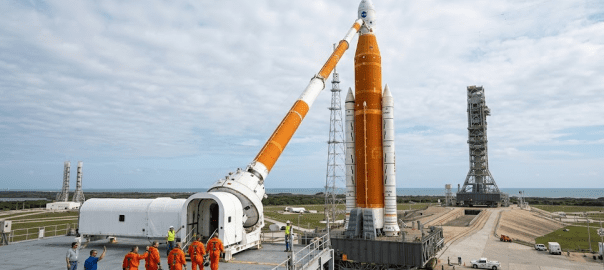
April 1, 2026 /Mpelembe Media/ — NASA is currently in the final countdown for the historic launch of the Artemis II mission, scheduled to lift off today, April 1, 2026, at 6:24 p.m. EDT from the Kennedy Space Center in Florida. This 10-day mission will send four astronauts around the Moon, marking the first time humans have left low-Earth orbit since the Apollo 17 mission in 1972.
Fueling of the Space Launch System (SLS) rocket has been successfully completed. NASA launch teams have fully loaded the rocket’s core stage and Interim Cryogenic Propulsion Stage (upper stage) with over 700,000 gallons of super-chilled liquid hydrogen and liquid oxygen. The fueling process went smoothly without any of the major leaks that caused delays during previous wet dress rehearsals. The rocket is currently in “replenish mode,” meaning systems are continuously trickling in small amounts of fuel to replace the cryogenic propellant that naturally boils off while sitting on the pad.
The Artemis II crew is suited up and on the move. Following a 9:25 a.m. wake-up call and a final weather briefing, astronauts Reid Wiseman, Victor Glover, Christina Koch, and Jeremy Hansen donned their bright orange Orion Crew Survival System pressure suits. After completing leak checks and participating in traditional pre-launch activities—such as a card game with NASA’s chief astronaut—the crew waved to cheering crowds and boarded the Astrovan for the 9-mile trip to Launch Pad 39B.
Weather conditions remain 80% favorable for the two-hour launch window. While the overall forecast is promising, launch weather officers are closely monitoring isolated offshore rain showers and thick cumulus clouds drifting over the spaceport. NASA enforces a strict “No Rain” policy and Cumulus Cloud Rules to ensure the rocket has a dry ascent and is not at risk of triggering lightning. Space weather is also currently quiet, meaning there is no immediate threat of solar flares interfering with the rocket’s electronics or exposing the astronauts to dangerous radiation during their flight.
The Human Heart of Artemis II: A Guide to the Lunar Crew
1. The Bridge to Deep Space: Mission Objectives and Context
The Artemis II mission represents a definitive historical pivot, marking the first time a human crew will venture beyond the orbital plane of Earth since the departure of Apollo 17 in December 1972. Scheduled for liftoff on April 1, 2026, at 6:24 p.m. EDT , this 10-day flight test is designed to validate the Space Launch System (SLS) Block 1 rocket and the Orion spacecraft—recently christened Integrity —in the harsh environment of deep space. Unlike the uncrewed Artemis I, which tested structural resilience, Artemis II is the ultimate proof-of-concept for the life-support, communication, and manual navigation systems required for a sustainable human presence on the Moon.
| Apollo Legacy (1960s-70s) | Artemis Vision (Present Day) || —— | —— ||
Technology: Powered by the Saturn V (7.6 million lbs of thrust). |Technology: Powered by the SLS (8.8 million lbs of thrust) and the European Service Module (ESM). ||
Mission Duration: Measured in days; limited by consumable life-support.| Mission Duration: Extended stays; 10-day flyby as a bridge to a permanent lunar base. ||
Strategic Goal: A “flags and footprints” geopolitical race during the Cold War. |Strategic Goal: Sustainability and international collaboration through the Artemis Accords. ||
Landing Target: Equatorial regions of the lunar near-side. | Landing Target: The lunar South Pole (beginning with Artemis IV). |
The “So What?” of the Free-Return Trajectory
Artemis II utilizes a free-return trajectory , a specific orbital path that leverages the Moon’s gravity as a natural “slingshot.” For a crewed test flight, this path is a masterclass in safety engineering: it ensures that once Orion loops around the lunar far side, the laws of physics will pull the capsule back to Earth even if primary propulsion systems fail. This mission serves as a critical testbed for the spacecraft’s heat shield. Due to unexpected char loss on Artemis I, NASA has instituted a steeper entry profile for Artemis II, eliminating the “skip reentry” maneuver to reduce thermal exposure and ensure the structural integrity of the crew cabin remains uncompromised.This technical bridge to the Moon is supported by a crew specifically selected to serve as the modern parallels to the pioneers of the Apollo era.
2. Defining the Roles: Who Does What in Orion?
Operating the Orion spacecraft requires a synthesis of test-pilot precision and complex systems engineering. The crew fills three distinct roles:
Commander: The ultimate authority on the flight deck. The Commander holds responsibility for the crew’s safety, the Integrity ’s mission success, and the strategic leadership of the team in deep space.
Pilot: Beyond traditional flight controls, the Pilot manages “proximity operations” (Prox Ops), which involve high-stakes manual maneuvering during the mission’s early phases.
Mission Specialist: These roles are the “enablers” for future lunar operations. They monitor the ESM and life-support systems, conduct science like the O2O Laser Communication demonstration (targeting data rates of 260 Mbps), and evaluate hardware readiness.
Insight: Proximity Operations (Prox Ops)
A hallmark of this mission is the proximity operations demonstration. Pilot Victor Glover will take manual control of Orion to fly within 30 feet of the spent ICPS (Interim Cryogenic Propulsion Stage). The “So What” of this maneuver is the evaluation of handling qualities using the Cooper-Harper rating scale . By manually flying near the ICPS, the crew validates that Orion can safely dock with future lunar landers or the Lunar Gateway station if automated systems fail.While these roles provide the technical structure for the mission, the individual path of the Commander sets the tone for the journey ahead.
3. The Commander: Reid Wiseman
In the lineage of lunar exploration, Reid Wiseman serves as a modern successor to Frank Borman (Apollo 8), acting as the bridge between Earth-orbit testing and lunar-vicinity operations. A native of Baltimore, Captain Wiseman’s leadership is defined by a “team-first” philosophy forged in the U.S. Navy.
The Military Path: Wiseman earned his commission through Navy ROTC. He flew F-14 Tomcats during combat operations in the Middle East and later served as a Test Pilot for advanced airframes, including the F-35C Lightning II.
NASA Experience: Selected in 2009 as part of “The Chumps” (Group 20), Wiseman spent 165 days on the ISS during Expedition 40. He later served as the Chief of the Astronaut Office, advocating for the needs of the entire corps during the transition to the Artemis program.
Insight: The Commander’s Perspective on Risk
Wiseman frequently notes that the crew has the “easiest job” on launch day. From his perspective, the astronauts follow a scripted, highly trained schedule with a global team supporting them. He asserts that the true weight of the mission’s risk is carried by the families on the ground, who must navigate the emotional burden of watching their loved ones ascend atop 8.8 million pounds of thrust.Wiseman’s strategic oversight of the mission’s trajectory is balanced by the tactical execution of the pilot at the controls.
4. The Pilot: Victor Glover
Captain Victor “Ike” Glover brings an analytical, test-pilot approach to the cockpit. Known for his mastery of complex systems—earning him the nickname “I Know Everything”—Glover represents a historic milestone as the first Black astronaut to leave low-Earth orbit.”We see this as a relay race… it’s not about us. It’s about landing on the Moon and eventually landing on Mars.”
Insight: The Transition to Orion
Glover’s prior experience as the pilot of the SpaceX Crew-1 Dragon is vital to Artemis II. While the Dragon utilizes highly automated, digital-first interfaces for commercial Earth-orbit transit, Orion requires a pilot capable of shifting to manual deep-space handling. Glover’s role is to bridge these two worlds, ensuring the transition from automated commercial tech to the manual requirements of lunar navigation is seamless and safe.Glover’s flight deck operations are supported by the scientific and international expertise of the two mission specialists.
5. The Mission Specialists: Christina Koch & Jeremy Hansen
The Mission Specialists represent the dual pillars of the Artemis program: civilian engineering excellence and the expansion of international partnerships.Christina Koch: The Civilian Engineer
Background: An electrical engineer who developed science instruments at NASA Goddard before transitioning to the U.S. Antarctic Program.
Remote Expertise: Her experience in extreme, isolated environments like the South Pole prepared her for the psychological rigors of deep space.
Legacy: Koch holds the record for the longest continuous spaceflight by a woman (328 days) and participated in the first all-female spacewalk.Jeremy Hansen: The International Partner
Background: A Colonel in the Royal Canadian Air Force and the first Canadian ever selected for a lunar mission.
Analogue Specialist: Hansen’s training includes living undersea in the Aquarius station and exploring deep caves with the ESA to simulate the isolation of lunar flight.
Role: He represents the first non-American to leave low-Earth orbit, a direct result of the Canadian Space Agency’s commitment to the mission.
Insight: The Global Importance of the Artemis Accords
Hansen’s inclusion marks a historical shift from the U.S.-centric Cold War era to a multi-national framework governed by the Artemis Accords . His presence signifies that Artemis is a global endeavor, shifting the narrative from a single-nation race to a collaborative pursuit of lunar sustainability. This international synergy ensures that the knowledge gained from Artemis II belongs to all of humanity.The individual paths of these specialists converge into a unified unit through the psychological and emotional demands of training.
6. The Human Element: Teamwork and Family Readiness
The “unseen training” for Artemis II focuses on the reality of four people living in a space the size of a camper van for ten days.
Mission-Critical Preparation:
The 36-Hour Nap Strategy: Because Flight Day One is a highly orchestrated 36-hour period of intense technical activity, “nap strategies” are literal mission-critical requirements to ensure the crew is rested enough to safely execute proximity operations.
Estate Planning: Candid “what if” conversations with families to address the inherent risks of deep-space flight.
Psychological Synergy: Working with coaches to move beyond their “military” or “civilian” sub-cultures into a singular “NASA culture” —a unified identity dedicated to the mission’s specific operational needs.This collective synergy ensures the crew is ready to represent the hopes of the broader “Artemis Generation.”
7. Conclusion: The Legacy of Artemis II
Artemis II is the essential stepping stone for the decades of exploration to follow. By validating the SLS and Orion systems with a human crew, this mission clears the path for Artemis III—a secondary test mission—and the historic Artemis IV mission in 2028 , which will return humans to the lunar surface.The mission’s success transforms the Moon from a distant object of observation into a reachable destination for international science.The crew’s ultimate hope is that future historians do not view Artemis II as a standalone accomplishment, but as the foundational moment that enabled a permanent lunar presence and the eventual journey to Mars. Artemis II is not just a return to the Moon; it is the moment humanity began to stay.