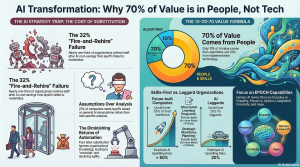
The Pitfalls of Labor Substitution: Many companies that rushed to replace human workers with AI are experiencing a costly “fire-and-rehire” cycle because the anticipated cost savings failed to materialize. Relying on AI to eliminate entry-level roles also threatens long-term organizational health by destroying the traditional “pyramid” structure of career progression, turning it into a “diamond” that drains the pipeline of future leaders.
The Cognitive Augmentation Advantage: Research shows that 70% of the value generated by AI comes from adapting the human workforce, while only 10% comes from the algorithms themselves. Rather than replacing humans, the most successful companies are using AI to augment them, freeing up employees from routine tasks to focus on complex problem-solving. Humans possess resilient capabilities that AI cannot replicate—defined by the EPOCH framework as Empathy, Presence, Opinion/Ethics, Creativity, and Hope.
The Rise of Workforce and Skills Intelligence: Traditional workforce planning based on static job titles is becoming obsolete. Organizations are now utilizing “Workforce Intelligence”—AI-driven platforms that analyze tasks and map the latent skills of their employees. This allows companies to identify internal talent capable of transitioning into high-demand roles (like cloud computing or digital marketing) rather than paying a premium to hire externally. Reskilling an existing employee is estimated to be 23% more cost-effective than making an external hire.
Redesigning the Operating Model: True AI ROI takes years to materialize because it requires more than just layering new software over old processes; it requires a fundamental redesign of how work is done. Organizations must learn to manage a hybrid “carbon and silicon-based” workforce, where AI agents handle end-to-end execution and humans provide strategic oversight, ethics, and validation.
Strategic HR Leadership: Navigating this transition requires strong leadership, particularly from CHROs. Successful integration demands a human-centric approach that prioritizes transparency, upskilling, and a focus on long-term revenue growth over immediate payroll savings.
The AI Paradox: Why 70% of Your Success Has Nothing to Do with Technology
1. The Billion-Dollar Miscalculation
By 2024, global corporate investment in artificial intelligence surged to a monumental $250 billion. Yet, the boardroom reality is stark: recent research from NANDA at MIT reveals that 95% of firms report no measurable impact on their bottom line. We are currently witnessing a “Billion-Dollar Miscalculation” where organizations treat AI as a plug-and-play cost-cutter—a digital band-aid for legacy inefficiencies—rather than a fundamental evolution of the workforce.The disconnect is systemic. While 80% of executives are already utilizing AI, only 20% of the frontline is empowered to do the same. This asymmetry, combined with a narrow focus on “labor substitution,” has created an implementation gap that technology alone cannot bridge. To redefine the AI business case, leaders must stop looking at the software stack and start looking at the human infrastructure.
2. The 10-20-70 Rule: Technology is the Smallest Piece of the Puzzle
The most successful AI transformations follow a strict ratio of value distribution. According to analysis by BCG, the actual ROI of AI follows a 10-20-70 breakdown: 10% of the value comes from the algorithms, 20% from the technical infrastructure, and a staggering 70% depends on rethinking the people component.This is counter-intuitive for leadership teams that reflexively approve a $20 million GPU cluster while balking at a $2 million reskilling program. In the traditional mental model, “Infrastructure” is an asset, whereas “People” are a line-item expense. Futurist leaders, however, recognize the KPI delta: “future-built” companies are five times more likely to conduct strategic workforce planning and commit to upskilling over 50% of their employees, compared to just 20% for laggards.”The remaining 70% comes from rethinking the people component.” — BCG
3. The “Fire-and-Rehire” Trap: Why AI Cost-Savings Often Evaporate
In a race for short-term margin boosts, 32% of organizations that made redundancies based on AI’s cost-saving promises ultimately had to rehire staff. This “Fire-and-Rehire” cycle is a direct result of the “readiness challenge”: 23% of companies based layoffs on general assumptions about AI capabilities rather than role-specific task analysis.When leaders deploy AI without a granular understanding of how work actually gets done, they inadvertently strip away the institutional knowledge required to handle the edge cases AI misses. This leaves organizations trapped in a cycle of “workslop”—poorly prepared AI outputs that require human rework.”Too many organizations are deploying AI without understanding the work in detail. That’s not an AI problem; it’s a workforce intelligence problem.” — Jessica Modrall, Orgvue
4. The Squeezed Middle: The U-Shaped Complementarity Curve
AI does not impact the labor market linearly; it creates a “U-shaped complementarity curve.” The technology strongly augments both high-skill strategic work and low-skill manual tasks, but acts as a substitute for routine, middle-skill roles.
- Low-Skill Support: AI provides “cognitive scaffolding,” allowing entry-level workers to bypass routine steps and perform at a higher level immediately. This effectively eliminates the traditional “entry-level” role, as seen in the BPO sector where “Smart Call Assistants” reduced resolution times from 11 minutes to 2 minutes.
- The Risk of “So-So Technologies”: Organizations that use AI merely to save labor without transforming the role risk pushing workers into lower-productivity, lower-wage jobs, exacerbating inequality.Industry in Action: Unilever Brazil successfully navigated this curve by upskilling maintenance operators in mechatronics and critical thinking. By transforming them into “technical operators,” they reduced the mean-time to repair by 27% and cut breakdown losses in half.”Early automation disproportionately harmed middle-skill, routine jobs… exacerbating inequality.” — Lawrence Emenike
5. Skills as a Depreciating Asset: The Two-Year Half-Life
Technical expertise is losing its shelf life at an unprecedented rate. Gartner projects that by 2030, the half-life of technical skills will shrink to just two years. This shift demands a move away from “Self-Reported Surveys” and toward AI workforce skill mapping systems (such as Eightfold, Workday, or SAP).These systems use “Automated Skill Inference” to extract capabilities from live project artifacts—code repositories, emails, and tickets—rather than static résumés. Success now hinges on “skill velocity.”Industry in Action: IBM utilized this live skill inference to realign 20,400 employees in months. When the company shifted to cloud services, they mapped “adjacent skills” in declining technology areas, redeploying thousands of workers into high-demand cloud roles rather than resorting to expensive external hiring.
6. The Rise of “Shadow AI”: Why 78% of Your Team is Bypassing IT
While leadership debates governance, the frontline is taking action. Zylo and Microsoft data reveal that 78% of AI users are “bringing their own tools” (BYOT). This “Shadow AI” is an organic response to organizational inertia, with employees turning to a core stack: ChatGPT, Grammarly, OpenAI API, Otter.ai, and Anthropic.Shadow AI represents a massive workforce intelligence problem:
- Security Risk: 43% of IT leaders cite the exposure of sensitive company data as their primary fear.
- SaaS Waste: Employees often incur charges from redundant licenses for multiple LLM tools before settling on a favorite.
- Quality Variance: Inconsistent outputs that bypass official ethics and accuracy guardrails.
7. The EPOCH Defense: Investing in Uniquely Human Moats
As AI becomes a commodity, the strongest competitive moats will be built on capabilities that technology cannot replicate. The MIT Sloan “EPOCH” framework identifies five human-intensive capabilities that are the strongest drivers of employment growth:
- Empathy: The ability to share emotional experiences and create meaningful human connections (vital in education and social work).
- Presence: Networking, connectedness, and the physical collaboration vital for innovation.
- Opinion: Navigating open-ended systems through judgment, ethics, and accountability.
- Creativity: Humor, improvisation, and visualizing possibilities beyond data.
- Hope: Vision, leadership, and the grit to pursue a goal despite long odds of success.”If you’re aiming for disruptive innovation or truly transformative business, humans have a huge role to play.” — Isabella Loaiza, MIT Sloan
8. Conclusion: From Labor Substitution to Workforce Multiplication
The era of labor substitution is ending. The next phase of economic growth will be defined by “Workforce Multiplication,” where human-AI teams achieve exponential productivity by fusing machine scale with human judgment. To navigate this, every Chief AI Officer should adopt the Four-Point Playbook :
- Assess Organizational Maturity: Map current talent, data quality, and workflow integration.
- Address Risk and Governance: Establish ethical guardrails and transparent bias reporting.
- Develop an AI-Ready Workforce: Target core EPOCH capabilities and launch large-scale upskilling.
- Invest in Scalable Use Cases: Prioritize high-multiplier pilots that enhance customer and innovation impact.AI won’t take your job, but a human-AI team that leverages human judgment will redefine your industry.Is your organization building a faster database, or is it building a more resilient, human-centric engine for the next era of work?