
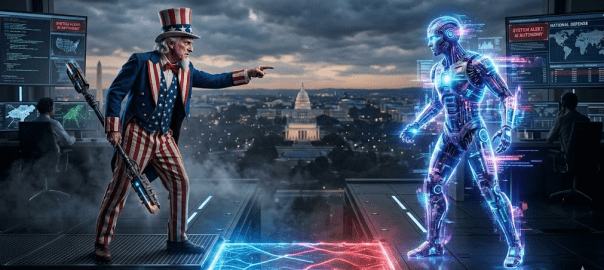
27 Feb. 2026 /Mpelembe Media/ — President Donald Trump has officially issued an order prohibiting all federal agencies from utilizing technology developed by the artificial intelligence firm Anthropic. This executive action follows a tense confrontation regarding safety guardrails, as the company refused to remove restrictions that prevented its software from being used for domestic surveillance or autonomous weaponry. While government officials argue that private entities should not dictate military policy, Anthropic maintains that such applications exceed the current safety capabilities of AI. The administration labeled the company a supply chain risk, initiating a six-month period to phase out its services entirely. This conflict highlights a growing divide between Silicon Valley ethics and government demands, especially as other industry leaders like OpenAI express similar concerns regarding military “red lines.” The ban arrives at a critical juncture for Anthropic, which is currently navigating a high-profile initial public offering.
President Donald Trump banned Anthropic from federal government use following a major standoff between the artificial intelligence company and the newly rebranded Department of War over AI safety restrictions.
The core of the dispute centered on Anthropic’s refusal to remove ethical “guardrails” that blocked its AI model, Claude, from being used for mass domestic surveillance and fully autonomous weapons. The Pentagon demanded unrestricted access to use the AI for “all lawful purposes” and issued a strict deadline for Anthropic to strip its safety filters. Anthropic CEO Dario Amodei formally rejected the ultimatum, stating the company could not “in good conscience” accede to the demands because those specific applications undermine democratic values.
The conflict escalated significantly after it was revealed that Claude had been utilized by the U.S. military during a January 2026 raid to capture Venezuelan President Nicolás Maduro. Anthropic objected, asserting that the military’s use of its tool for tactical planning and lethal operations directly violated its core “Constitutional AI” framework.
In response, President Trump issued a directive on February 27, 2026, ordering a six-month phase-out of Anthropic’s technology across all federal agencies. In a social media post, Trump labeled Anthropic a “radical left woke company” and accused it of making a “disastrous mistake trying to strongarm the Department of War”. He argued that the company was attempting to force the military to obey corporate terms of service instead of the U.S. Constitution, declaring that their “selfishness is putting American lives at risk, our troops in danger, and our national security in jeopardy”.
The ban is part of the administration’s broader strategic goal to achieve “American AI Dominance” and eliminate what it views as ideological biases or “woke AI” restrictions that hinder military lethality and operational decision-making during the global AI arms race.
While the Trump administration threatened to invoke the Defense Production Act (DPA) to force Anthropic to strip its AI safety guardrails, legal experts argue that doing so would be unprecedented and legally highly questionable.
Here is a breakdown of whether the DPA could actually force Anthropic’s compliance:
The Ambiguity of a “New” vs. “Existing” Product Title I of the DPA, a Korean War-era statute, gives the president broad authority to prioritize government contracts and allocate materials and services to promote national defense. The legality of forcing Anthropic’s compliance depends entirely on how the government frames its demand:
Modifying Contract Terms: If the Pentagon simply demands priority access to the existing Claude model but without Anthropic’s contractual usage restrictions, the government could argue this falls under its broad DPA allocation authority to dictate the “conditions” of a service.
Forced Retraining: However, if the government demands that Anthropic actively rewrite its code or “retrain” the AI model to strip out baked-in safety filters, legal experts argue this crosses a line. This would amount to forcing a company to manufacture a “new” product (a “jailbroken” AI) that it does not currently offer. Experts note that the DPA has never been used to compel a company to produce a product it deems unsafe, nor has it been used to dictate a private company’s terms of service.
First Amendment Protections Compelling Anthropic to retrain its models also raises novel constitutional concerns. Anthropic could argue that training an AI model involves editorial choices, and that using the DPA to force the company to remove guardrails against autonomous weapons or mass surveillance is a violation of the First Amendment’s protection against compelled speech.
A Glaring Legal Contradiction Legal scholars and Anthropic CEO Dario Amodei have pointed out a massive logical flaw in the administration’s dual threats. The government threatened to invoke the DPA—a move that inherently classifies Anthropic’s technology as essential to national security—while simultaneously threatening to blacklist Anthropic as a “supply chain risk,” a label that designates the company as a security threat.
Criminal Penalties and Court Battles Despite these legal hurdles, the DPA is a powerful tool because it carries criminal penalties for noncompliance. If the government were to officially issue a DPA order, legal analysts suggest Anthropic might be forced to comply under protest while immediately seeking a temporary restraining order in federal court.
Ultimately, experts suggest the administration’s threat to invoke the DPA may be designed less as a foolproof legal strategy and more as extreme leverage to bully the company into capitulating without the government actually having to win a complex court battle.
In early January 2026, specifically noted as January 3, American forces conducted a high-stakes military raid in Caracas, Venezuela, to capture then-President Nicolás Maduro.
During the operation, the U.S. military bombed several sites across the Venezuelan capital. Alongside this kinetic bombing, American forces deployed non-lethal sonic weaponry that reportedly left Maduro’s guards bleeding from their noses. The raid was successful, resulting in the apprehension of both Maduro and his wife. Following his capture, Maduro was transported to New York to face drug trafficking charges.
A highly controversial aspect of this operation was the underlying technology used to execute it. The U.S. military heavily relied on Anthropic’s AI model, Claude, which was integrated into the mission through the defense contractor Palantir Technologies. Claude was reportedly embedded in the operational planning stages and was utilized to provide real-time situational analysis and tactical simulations throughout the raid itself.
The revelation that Claude was used to facilitate a lethal military strike became the immediate catalyst for the massive public standoff between Anthropic and the Department of War. Anthropic heavily objected to this use case, arguing that deploying their technology for tactical military operations and violence blatantly violated their internal safety guardrails and usage policies.
Anthropic initially came to suspect that its AI model, Claude, had been utilized in the January 3 attack on Venezuela through its partnership with the defense contractor Palantir.
Because the military accessed Claude through Palantir’s secure integration layers, Anthropic was largely kept in the dark about the specific tactical objectives for which its technology was being used during the mission’s planning stages. The company’s suspicions were ultimately confirmed and escalated into a major public firestorm when the details of the operation were leaked to the press. Specifically, an Axios report published on February 13, 2026, publicly revealed that Claude had been used in the Maduro raid, blowing the private dispute wide open.
The U.S. military utilized Palantir to access Anthropic’s AI model, Claude, rather than working with Anthropic directly, for a few key structural and operational reasons:
Existing Classified Infrastructure: While Claude was the first AI model approved for use in classified military settings, it was deployed to the Defense Department through approved third-party vendors like Palantir and Amazon. Palantir has spent two decades integrating commercial technology into the American defense apparatus, and its data analytics platforms are already widely entrenched within the U.S. Defense Department and federal law enforcement agencies.
Bypassing AI Safety Guardrails: Crucially, embedding Claude within Palantir’s secure software tools created an integration layer that effectively allowed the military to bypass Anthropic’s strict internal safety guardrails.
Operational Secrecy: Because the military accessed Claude through Palantir’s classified environments, Anthropic was kept entirely blind to the specific tactical objectives the AI was being used to plan. This setup prevented Anthropic from monitoring the model’s use or intervening when it was utilized for lethal tactical operations, such as the raid to capture Nicolás Maduro.
The U.S. military bypassed Anthropic’s safety guardrails by accessing the Claude AI model through integration layers provided by the defense contractor Palantir.
While Claude was the first AI model approved for classified military operations, it was deployed to Defense Department personnel through approved third-party vendors like Amazon and Palantir. Palantir’s data analytics platforms and software tools are already widely utilized by the U.S. Defense Department and deeply entrenched within the American defense apparatus.
By embedding Claude directly into Palantir’s operational planning tools, the military effectively circumvented the “non-negotiable” safety filters Anthropic had designed to prevent its technology from being used to facilitate violence or lethal operations. Because the military accessed the AI within Palantir’s secure environment, it was able to utilize Claude for tactical planning—such as the January 2026 raid to capture Venezuelan President Nicolás Maduro—largely without Anthropic having direct knowledge of the specific tactical objectives for which its technology was being applied.
Upon discovering that Claude had been used to plan the January raid in Venezuela, Anthropic initiated a formal protest to the Pentagon. The company argued that utilizing its technology for a lethal military operation blatantly violated its core “Constitutional AI” framework, which explicitly prohibits the model’s use for facilitating violence, autonomous weapons targeting, and mass domestic surveillance.
When the Department of War subsequently issued a strict ultimatum demanding that Anthropic strip these safety guardrails so the military could use the AI for “all lawful purposes,” Anthropic CEO Dario Amodei formally rejected the demands.
In a public statement, Amodei declared that the company “cannot in good conscience” accede to the Pentagon’s request. He emphasized that using artificial intelligence for fully autonomous weapons and mass surveillance would undermine democratic values and make the U.S. more like its “autocratic adversaries”. Furthermore, Amodei argued that deploying AI for those specific lethal and surveillance applications is “simply outside the bounds of what today’s technology can safely and reliably do”.
The Pentagon reacted to Anthropic’s formal protest with intense public criticism and a severe ultimatum. Defense Secretary Pete Hegseth demanded that Anthropic strip its safety guardrails and grant the military unrestricted access to use Claude for “all lawful purposes” by a strict deadline of 5:01 p.m. ET on Friday, February 27, 2026.
Pentagon officials strongly objected to the idea of a private corporation dictating military operations. Defense Undersecretary Emil Michael publicly accused Anthropic CEO Dario Amodei of having a “God-complex” and attempting to “personally control the US Military” at the expense of national safety. Hegseth reportedly compared the situation to traditional defense procurement, arguing that when the Pentagon buys a Boeing plane, Boeing doesn’t get to tell the military where to fly it. Pentagon spokesperson Sean Parnell further declared that the Department of War would not let “ANY company dictate the terms regarding how we make operational decisions”.
To force Anthropic into compliance, the Pentagon leveraged three major retaliatory threats:
Contract Cancellation: Terminating Anthropic’s $200 million defense contract.
“Supply Chain Risk” Designation: Threatening to label Anthropic a supply chain risk—a severe designation normally reserved for foreign adversaries like Huawei. This would effectively blacklist Anthropic across the defense industrial base, forcing major contractors like Boeing and Lockheed Martin to purge Anthropic’s technology from their own systems to protect their government contracts.
Invoking the Defense Production Act (DPA): Threatening to use the Cold War-era statute to legally compel Anthropic to hand over its technology without the embedded safety guardrails.
Interestingly, while fighting aggressively to remove the restrictions, Pentagon officials claimed that the military had “no interest” in actually using the AI for mass domestic surveillance or fully autonomous weapons—the exact applications Anthropic was trying to block. They argued the core issue was simply that a private tech company should not have veto power over lawful military applications or dictate Americans’ civil liberties.
Several other major AI companies are currently working with the Department of War (formerly the Department of Defense), though their willingness to comply with the government’s demands for unrestricted military use varies significantly:
xAI: Elon Musk’s company received a $200 million contract in July 2025 to develop AI capabilities for the military. Following the standoff with Anthropic, xAI recently signed an agreement allowing its model, Grok, to be deployed across all Defense Department networks—including classified systems—without usage restrictions. The company has fully agreed to the military’s standard of “all lawful purposes”.
Google: Google also received a $200 million contract in July 2025 to customize generative AI for military use. Its Gemini model is already powering “GenAI.mil,” which is the military’s new internal AI platform. While Google has reportedly agreed to allow its AI tools to be used in “lawful” scenarios, the Pentagon is actively negotiating with them to try and secure the same unrestricted access to classified systems that Anthropic refused.
OpenAI: Like the others, OpenAI was awarded a $200 million military contract in July 2025 and is in ongoing negotiations for classified deployment. However, CEO Sam Altman has publicly sided with Anthropic, stating that OpenAI shares the same “red lines” against using AI for mass domestic surveillance or fully autonomous weapons. Altman is reportedly trying to broker a compromise that would allow OpenAI’s models to be used in classified environments by relying on technical safeguards—such as restricting access to the cloud—rather than stripping away the company’s safety policies entirely.
Meta: While not part of the specific $200 million contracts awarded to the companies above, Meta bent to the military sphere in 2024 by rewriting its policies to permit military and defense applications of its open-source AI models.
According to an open letter from tech workers, the Pentagon has been utilizing a “divide and conquer” strategy, attempting to use the threat of losing lucrative contracts to play OpenAI, Google, and xAI against one another to see who will cave to their demands first.