
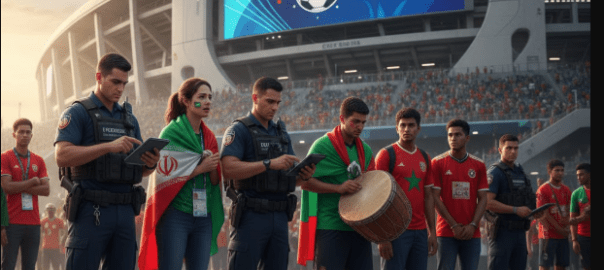
Jan. 9, 2026 /Mpelembe Media/ — The intersection of U.S. immigration policy and the 2026 FIFA World Cup has become a major flashpoint. The feasibility of a boycott and the “ruining” of the game are subjects of intense debate among human rights groups, fans, and governing bodies. Football without fans is like a movie without a soundtrack. You can still follow the plot, and the acting (the skill) is still world-class, but you lose the emotional crescendos that make you jump out of your seat. For a World Cup—an event built on the “unity” of humanity—a lack of fans doesn’t just change the score; it changes the soul of the event.
The 2026 FIFA World Cup is facing an unprecedented identity crisis as the United States’ restrictive immigration policies collide with the “universal” spirit of football. While the tournament’s scale is historic, the implementation of expanded travel bans, extreme vetting, and threats of stadium-level enforcement has created a starkly divided experience.
Qualified nations like Iran, Senegal, and Haiti find their fanbases largely barred from U.S. soil, shifting the emotional center of the tournament toward host cities in Mexico and Canada. While the “sporting exemptions” ensure that the athletes themselves can compete, the absence of authentic, diverse crowds threatens to transform the world’s most vibrant celebration into a sterile, corporate event. As fans face a choice between high-risk travel and a “practical boycott,” the 2026 World Cup stands as a case study in how national security policy can fundamentally alter the soul of global sport.
The Feasibility of a Boycott
While individual fans and certain civil society groups are calling for a boycott, a large-scale, country-led boycott remains complex but partially active.
Official Team Boycotts: Iran’s football federation already boycotted the World Cup draw in December 2025 after several delegation members were denied visas. However, they still intend to play in the tournament to avoid FIFA sanctions. Most qualified teams are unlikely to boycott the games themselves due to the massive financial and sporting consequences from FIFA.
Human Rights Advocacy: Over 50 human rights organizations, including Amnesty International and Human Rights Watch, have called on FIFA to demand binding guarantees from the U.S. government. They argue that without these, the tournament cannot be “safe for all.”
The “Invisible” Boycott: The most feasible “boycott” is actually a practical one: fans choosing not to come. Many are selling their tickets or deciding against travel due to fears of arbitrary detention, visa denials, or deportation raids—a trend that started during the 2025 Club World Cup in the U.S.
How Restrictions are Impacting the Game
Critics argue that the U.S. administration has fundamentally altered the spirit of the “Beautiful Game” through several restrictive measures:
| Policy Measure | Impact on the Tournament |
| Expanded Travel Bans | Fans from 39 countries (including qualified nations like Iran, Haiti, Senegal, and Côte d’Ivoire) are largely barred from entering the U.S. to watch their teams. |
| Stadium Surveillance | White House Task Force officials have declined to rule out ICE raids at stadiums. During the 2025 Club World Cup, CBP even boarded a FIFA-sanctioned event boat to check immigration statuses, causing a total cancellation. |
| Social Media Scrutiny | New “extreme vetting” requires visitors from even Visa Waiver countries (like the UK, France, and Germany) to provide 5 years of social media history and 10 years of email addresses. |
| Visa Backlogs | Wait times in countries like Colombia and Turkey have reached 500–700 days, effectively pricing out or timing out thousands of legitimate fans who didn’t apply years in advance. |
Has the US “Ruined” the Game?
Whether the game is “ruined” is subjective, but the traditional atmosphere of a World Cup—defined by global inclusion and the free movement of fans—is under significant strain.
The Counter-Argument: The U.S. government maintains that these measures are essential for national security and that “legal” visitors who “don’t do anything illegal” will have an “unbelievable experience.” They have also deployed 400 extra consular officers to help speed up visas for those not on the ban lists.
The Critical View: Many feel the “Global Village” aspect of the World Cup has been replaced by a “Fortress America” mentality. When fans are afraid to wear their team’s jersey to a stadium for fear of being “suited and booted” by federal agents, critics argue the cultural essence of the tournament is lost.
The U.S. government has established a specific framework of exemptions for the World Cup, but it creates a stark divide between the participants (who can come) and the public (who largely cannot).
The travel ban, which now covers 39 countries (including qualified nations like Iran, Haiti, Senegal, and Côte d’Ivoire), includes the following specific exemptions:
1. The “Sporting Exemption”
The June and December 2025 proclamations explicitly protect the “show” by exempting the following individuals from the travel ban:
Athletes and Teams: All players on the official squads of qualified teams.
Essential Staff: Coaches, trainers, medical staff, and “persons performing a necessary support role.”
Immediate Relatives: Spouses and children (under 21) of the players and staff.
National Interest Waivers: A vague category for individuals whose entry is deemed “beneficial to the U.S. national interest,” often used for high-ranking football officials (though this has been applied inconsistently, leading to the recent Iranian delegation snub).
2. The “Pre-Existing Visa” Grace Period
Fans from banned countries can still enter only if they already held a valid visa before the bans were enacted:
Original 19 Countries: Must have held a visa issued before June 9, 2025.
Added 20 Countries: Must have held a visa issued before January 1, 2026.
New Applications: For citizens of these 39 countries, new B-1/B-2 tourist visa applications are currently being automatically denied, even for those holding confirmed World Cup tickets.
The “FIFA PASS” (Priority Appointment Scheduling System)
For fans not in the 39 banned countries, the government has launched FIFA PASS. This is a fast-track system intended to solve the massive visa backlogs:
How it works: Ticket holders receive a unique code to jump to the front of the line for visa interviews.
The Vetting: While it speeds up the scheduling, it does not relax the vetting. Applicants must still provide 5 years of social media handles and 10 years of email history.
The Catch: This system is entirely unavailable to fans from the travel-ban list, effectively creating a “Two-Tier World Cup” where your ability to cheer for your team depends on your passport.
Current Reality for Fans
For a fan from Tehran or Port-au-Prince, the only remaining legal way to watch their team is to attend the matches hosted in Canada or Mexico, as those host nations have not mirrored the U.S. travel restrictions. However, because the vast majority of matches (including the later rounds) are in the U.S., many fans are calling this the “exclusionary games.”
Given the restrictive U.S. immigration policies, many fans from the “banned” countries are looking toward the 13 matches in Canada and 13 matches in Mexico as their only viable way to experience the tournament in person.
Because neither Canada nor Mexico has implemented similar travel bans, these host cities have become unofficial “sanctuary hubs” for the global fan base.
Matches for “Banned” Teams in Mexico and Canada
Below are the group-stage matches involving the key teams currently facing U.S. travel restrictions that are being held in Mexico and Canada:
| Date | Matchup | Host City | Venue |
| June 11, 2026 | Mexico vs. South Africa | Mexico City, MX | Estadio Azteca |
| June 15, 2026 | Tunisia vs. UEFA Winner B | Monterrey, MX | Estadio BBVA |
| June 20, 2026 | Germany vs. Côte d’Ivoire | Toronto, CAN | BMO Field |
| June 21, 2026 | Tunisia vs. Japan | Monterrey, MX | Estadio BBVA |
| June 23, 2026 | Norway vs. Senegal | Toronto, CAN | BMO Field |
| June 24, 2026 | South Africa vs. South Korea | Monterrey, MX | Estadio BBVA |
| June 26, 2026 | Senegal vs. IC Playoff 2 | Toronto, CAN | BMO Field |
The “U.S. Only” Problem
Unfortunately, for fans of certain teams, the schedule is particularly punishing. Some teams from banned or highly restricted countries are playing exclusively in U.S. cities during the group stage:
Iran: All three of their group games are in the U.S. (Los Angeles and Seattle). Fans without pre-existing visas or dual citizenship are essentially locked out of seeing Iran play at all.
Haiti: Their matches against Scotland and Brazil are in Boston and Philadelphia. Despite the large Haitian diaspora in North America, travel from the island to these matches is virtually impossible under current restrictions.
Logistics of a “Border-Crossing” Tournament
If a team like Senegal or Côte d’Ivoire advances to the Round of 32, there is a high statistical probability their next match will be in a U.S. city.
The Visa Gap: Fans who traveled to Toronto to see Senegal may find themselves unable to follow the team to the knockout rounds in Atlanta or Dallas.
Canada/Mexico Strategy: Travel agencies in West Africa and the Middle East are now specifically marketing “Canada-only” or “Mexico-only” fan packages, advising fans to avoid any itineraries that include a U.S. layover.
As of January 2026, the contrast between the three host nations is stark. While the U.S. has tightened its borders with travel bans and extreme vetting, Canada and Mexico have opted for a “Business as Usual” approach—which, ironically, offers both more freedom and fewer “shortcuts” than fans might expect.
Unlike Russia (2018) or Qatar (2022), there is no unified “Fan ID” or “Hayya Card” that grants visa-free entry to all three countries. You must satisfy the individual immigration laws of each nation.
Canada and Mexico: Entry Perks & Requirements
| Feature | Canada | Mexico |
| Special FIFA Visa? | No. You must apply for a standard Temporary Resident Visa (TRV) or eTA. | No. Standard visitor rules apply. |
| The “Secret” Perk | Fans are encouraged to type “FIFA World Cup 26” in their application’s “Purpose of Visit” section for tracking and potential (but not guaranteed) priority. | The “Golden Ticket”: If you have a valid U.S., Canadian, UK, or Schengen visa, you can enter Mexico without a Mexican visa, regardless of your nationality. |
| Visa-Free Access | eTA available for visa-exempt countries (approx. $7 CAD). | FMM (Tourist Card) is issued upon arrival for most; many countries are visa-exempt. |
| Processing Time | Can take weeks to months for TRVs; fans are urged to apply immediately. | Generally faster than the U.S., but consular appointments are filling up in major cities. |
Key Takeaways for “Banned” Fans
If you are from one of the 39 countries restricted by the U.S., here is how Canada and Mexico serve as your alternative gateways:
Mexico’s “Backdoor” Entry: Mexico is currently the most accessible host for fans from banned countries. If a fan from a restricted nation (like Iran or Senegal) manages to get a visa for Canada or the Schengen area (Europe), Mexico will honor that visa for entry. This bypasses the need for a specific Mexican visa.
The “Canada Tracking” System: Canada’s IRCC (Immigration, Refugees and Citizenship Canada) has created a dedicated web portal for the World Cup. While they aren’t waiving rules, they are using the “FIFA World Cup 26” tag to ensure football-related applications don’t get lost in the general tourist backlog.
No “ICE” Equivalent at Stadiums: Unlike the U.S., where the White House Task Force has been vague about immigration enforcement at venues, both Canada and Mexico have signaled that their focus is on stadium security, not status checks. This has made Toronto, Vancouver, Mexico City, Guadalajara, and Monterrey the “safe” zones for fans worried about the U.S. political climate.
The Knockout Stage Risk
The biggest “trap” for fans right now is the Quarter-Finals and beyond. Every match from the Quarter-Finals onward is scheduled to take place in the United States.
Warning: A fan could successfully watch their team in Mexico City or Toronto, but if their team wins and moves to the Quarter-Finals in Miami or Los Angeles, they will be legally unable to follow them if they fall under the U.S. travel ban.
Whether football remains “exciting” without fans is a question that science and history have actually tried to answer, particularly following the “ghost games” of the COVID-19 pandemic.
While the tactical quality of the play remains the same, research suggests that the emotional and psychological stakes of the game change fundamentally when the stands are empty.
The “Ghost Game” Data: What Changes?
Extensive studies from the 2020–2021 seasons in Europe and the 2025 Club World Cup in the U.S. highlight three major shifts in “empty” football:
Disappearance of Home Advantage: Statistically, home advantage is almost halved without fans. Research shows that home teams win about 10% less often when the “12th man” is absent.
Referee Bias Flattens: Without a roaring crowd to pressure them, referees are significantly less likely to give yellow cards to away teams or award “sympathy” extra time to the home side.
Clinical vs. Emotional Play: Analysts found that without fans, players act more “factually.” There are fewer “spark” moments—like a player attempting a risky overhead kick or a crunching tackle just to get a reaction. The game becomes more like a high-level chess match and less like a “battle of identities.”
The 2026 Context: “Sterile” Excitement?
In the context of the 2026 World Cup, the fear isn’t just about “empty” stadiums, but “sterile” ones. If immigration restrictions prevent the authentic, singing, drumming fans from countries like Iran, Senegal, or Haiti from entering, they are often replaced by “neutral” corporate guests or local fans who don’t have the same deep-rooted connection to the team.
Loss of the “Global Village”: Half of the excitement of a World Cup is the sea of different colors and the back-and-forth chanting between two cultures. If a stadium in Los Angeles is filled only with locals because the traveling fans were denied visas, the match may feel like a pre-season friendly rather than a World Cup showdown.
The “Sound of Silence” Problem: TV broadcasters often use “artificial crowd noise” to mask the silence, but players have noted that it feels eerie. Without the roar of a near-miss or the hush of a tense penalty, the TV viewer loses the emotional cues that make a game “exciting.”
The Counter-Argument: Pure Football
Some purists argue that without the distraction of the crowd, you actually see the purest form of the sport:
Communication: You can hear the players and coaches shouting instructions. You hear the actual “thwack” of the ball.
Focus: Some players who suffer from “social inhibition” (choking under pressure) actually perform better in quieter environments.
Is it Ruined?
To help you get your message to the right people, here is a directory of the most effective contact points. Since we are now in January 2026, these organizations are in high-gear for the tournament and are actively monitoring these channels.
FIFA Official Channels
These are the direct lines to the governing body in Zurich.
-
Primary Media/Public Inquiry Email: [email protected] (This is the most monitored inbox for public and press concerns).
-
General Inquiries: [email protected] or [email protected].
-
Official Phone: +41 43 222 7272 (FIFA HQ in Switzerland).
-
Twitter/X: @FIFAcom and @FIFAWorldCup.
-
Instagram: @FIFAWorldCup.
Human Rights Organizations
These groups are currently running the “Dignity 2026” campaign specifically to pressure the U.S. government on immigration and fan safety.
| Organization | Key Contact / Department | Social Media |
| Amnesty International | Daniel Noroña (Americas Advocacy Director) | @AmnestyUSA |
| Human Rights Watch | Minky Worden (Director of Global Initiatives) | @hrw |
| ACLU | Jamil Dakwar (Human Rights Program Director) | @ACLU |
| Sport & Rights Alliance | General Advocacy Team: [email protected] | @Sport_Rights |
Local Host Committees (The “Boots on the Ground”)
If you want to target specific cities where “banned” teams are playing (like Seattle or Los Angeles for Iran), contacting the Local Host Committees is highly effective as they fear the economic loss of a fan boycott.
-
Seattle Host Committee: @SeattleFWC26 | seattlefwc26.org
-
Los Angeles Host Committee: @LAFWC26 | losangelesfwc26.com
-
Toronto (Sanctuary Hub): @TorontoFWC26 | torontofwc26.ca
-
Mexico City (Sanctuary Hub): @MexicoCity26 | estadioazteca.com.mx
Pro-Tip for Sending Your Letter
When you email [email protected], use a clear and urgent subject line to ensure it bypasses the spam filters.
Suggested Subject Lines:
-
URGENT: Human Rights Concerns & Fan Access for World Cup 2026
-
Formal Inquiry: Protection of Fans from U.S. Immigration Enforcement
-
Statement Regarding Exclusion of Fans from Banned Nations