
The Palimpsest of the Tongue: 1,500 Years of History Written in the British Accent
George Bernard Shaw famously observed that “it is impossible for an Englishman to open his mouth without making some other Englishman hate or despise him.” While biting, Shaw’s aphorism captures a profound sociolinguistic reality: in Britain, an accent is rarely just a collection of phonetic habits. It is a social GPS, a historical palimpsest, and a political manifesto.For the uninitiated, the linguistic landscape of the British Isles is a bewildering minefield. Why does a resident of Liverpool sound fundamentally different from one in Manchester, a mere 30 miles away? Why are the terms “The UK” and “Great Britain” so often—and so erroneously—treated as synonyms? By peering through the lens of sociophonetics and cultural history, we find that these vocal variations are not random quirks of modern urbanity. They are the living echoes of ancient tribal migrations and 19th-century industrial upheavals.Here are five takeaways from recent research that reveal the secret history hiding in the way Britons speak.
1. Your Accent is a 1,500-Year-Old Map of the Dark Ages
We often view regional speech as a product of modern class structures, but the foundational phonological environment of Britain was settled in the 5th century. When the Germanic tribes—the Angles, Saxons, and Jutes—migrated from the European continent, they established distinct settlement patterns that serve as the blueprint for modern regionalism.The Angles settled primarily in the Midlands and the East, while the Saxons claimed the territory south and west of the Thames. The Jutes established themselves in Kent and along the South Coast. These ancient boundaries gave rise to the four major dialects of Old English: Northumbrian, Mercian, Kentish, and West Saxon.Today, this map persists with startling tenacity. The Mercian dialect remains the ancestor of the Midlands voice, while the West Saxon influence still colors the “rhotic” (the pronounced ‘r’) speech of the West Country. When you hear the specific “Kentish” lilt or the distinctive vowel shifts of the North, you are not merely listening to local slang; you are hearing a linguistic palimpsest where 5th-century tribal borders are still visible beneath the surface of modern English.
2. The Silent Architect of Scouse: The Welsh Influx
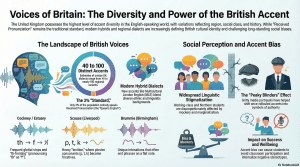
The Liverpool accent, or “Scouse,” is perhaps the most recognizable “linguistic outlier” in England. While popular history often attributes its unique, breathy quality solely to Irish migration during the 19th-century potato famine, researchers like Hannah Paton have identified a hidden architect: the Welsh.During the 1800s, Liverpool was effectively the “capital of North Wales.” At least 20,000 Welsh migrants arrived each decade, concentrated in northern districts like Anfield and Everton, where Welsh Anglican churches held services exclusively in their native tongue. This massive migration triggered koinéisation —a process of dialect leveling and mixing.The most salient feature of Scouse is lenition —the weakening of plosive sounds like /p/, /t/, and /k/ into fricatives. Paton’s research suggests these sounds are lenited “further than previous research suggests,” specifically incorporating the velar fricative x (the “ch” sound in Bach or Loch ). This sound exists in Welsh but not in standard English English. As Paton explains:”Mutation in Welsh holds many complex rules and environments… the aspirate mutation mutates initial /p, t, k/ to /f, θ, x/. When monolingual speakers who are used to this process in their language begin speaking a second language, mutation transfers… retained and regularised through inter-generational transmission.”While the Irish gave Scouse its spirit, it was the Welsh “aspirate mutation” that pushed the accent into its unique fricativized territory, separating it forever from its Lancashire neighbors.
3. The “Peaky Blinders” Effect: Stigmatization and the Shelby Allure
For decades, the West Midlands accent was the victim of intense social stigmatization . In the 1950s, the character “Marlene” in Educating Archie cemented a stereotype of the Birmingham (Brummie) accent as “monotonous,” “simplistic,” and “unintelligent.” This was reinforced by phonetic traits, such as the “BATH” vowel matching the “TRAP” vowel, which were unfairly viewed as markers of lower cognitive ability.However, we are witnessing a “Rags-to-Riches” narrative for the West Midlands voice, driven by the global success of Peaky Blinders . Yet, a sociolinguistic distinction is often missed by the public: the Shelby family actually speaks a Black Country (Walsall/Wolverhampton) dialect, which locals distinguish from a true Brummie accent.By associating these sounds with Cillian Murphy’s Tommy Shelby—a character defined by “allure and sophisticated menace”—the show has effectively dismantled decades of prejudice. The “monotone” has been rebranded as “authoritative” and “cool,” proving that media representation can shift the perceived prestige of an accent faster than any institutional policy.
4. RP: A Tool for Global Clarity, Not a Badge of Aristocracy
Received Pronunciation (RP) has long been synonymous with “The Queen’s English” or “Poshness,” traditionally representing the educated elite of Southern England. However, the contemporary reality of RP is moving away from social exclusion toward a concept of “Non-Regional Pronunciation.”Modern RP is no longer about sounding like a 1930s newsreader or a Downton Abbey aristocrat. Instead, it serves as a neutral standard for global communication, focusing on “neutrality” and “clear dictation.” As voiceover artist Maxim R. notes:”To me, RP isn’t so much putting on an accent as making sure your natural speaking voice is as clear as it can be; pronouncing every consonant, differentiating every vowel sound… and delivering it with a neutrality which allows it to be understood by a global audience.”In a globalized economy, RP has evolved from a class-based barrier into a professional tool for clarity, allowing the speaker’s message to take center stage without regional origin becoming a distraction.
5. The “Cardinal Sin” of Geography: Sovereignty and Identity
In British culture, confusing the terminology of the islands is considered a “cardinal sin” precisely because those terms carry the weight of centuries of constitutional conflict. To understand the UK today, one must understand the 1707 Act of Union , which marked the “death of two independent nations”—England and Scotland—to birth a new political entity: Great Britain.The Definitive Constitutional Cribsheet:
- The United Kingdom (UK): A sovereign state and “unitary state” composed of four countries: England, Scotland, Wales, and Northern Ireland.
- Great Britain: A geographical landmass containing England, Scotland, and Wales. It is not a country.
- The British Isles: A purely geographical term encompassing Great Britain, Ireland, and over 6,000 islands.
- Crown Dependencies: The Isle of Man and the Channel Islands (Jersey and Guernsey). These are self-governing possessions of the Crown and are not part of the UK.Today, the UK exists in a state of “quasi-federalism.” Through the process of Devolution , powers have been transferred to the nations, creating an asymmetrical union. This has led to the “West Lothian Question”—the democratic dilemma of why devolved MPs can vote on English-only matters when English MPs have no say over devolved issues. Furthermore, the “Sewel Convention” —the agreement that the UK Parliament will “not normally” legislate in devolved areas without consent—is being increasingly tested, highlighting a union still in a state of profound transition.
Conclusion: A Millennium of Mutation
The United Kingdom is a nation where language and politics are inextricably intertwined. From the 5th-century settlement of the Jutes to the 19th-century “koinéisation” of Liverpool, every shift in the way Britons speak reflects a shift in who they are.As power continues to move through devolution and the calls for independence grow louder, these 1,500-year-old vocal markers remain the most visceral expressions of identity. In our age of globalized media, we must ask: will these regional voices eventually level out into a neutral standard, or will the “Shelby Effect” and regional pride ensure that this linguistic diversity survives for another millennium?