
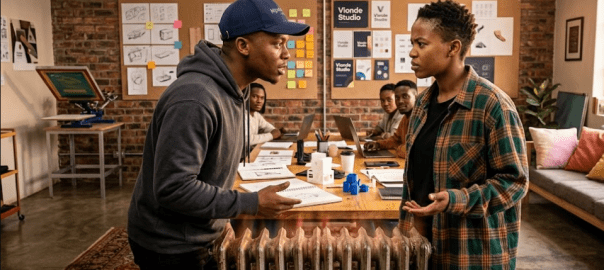
April 1, 2026 /Mpelembe Media/ — Vionde Studio represents a category of bespoke, cloud-native AI solutions—typically hosted on platforms like Google Cloud Run—that function as centralized command hubs for deploying custom AI agents. Its primary goal is to prioritize the preservation of human “soul,” voice, and intention through sophisticated technical workflows, avoiding the generic, flat content often produced by traditional AI.
Key features of the Vionde Studio architecture include:
The “Publishing Partner” Mechanism: Vionde integrates large language models (LLMs) with proprietary datasets to create a “Digital Twin” that deeply understands a creator’s specific vocabulary, rhythmic writing patterns, and ethical boundaries.
Soulful Agentic Workflows: The studio operates on a structured workflow that mirrors a human’s creative process. This includes editorial reviews that flag shallow arguments, SEO resonance analysis, title ideation, metadata automation, visual interpretation, and multi-channel content packaging.
The “Intel-Grade” Training Strategy: To scale soulfully, Vionde requires a deep injection of personal history into the model’s context window, utilizing extensive libraries of a creator’s past blogs, social media updates, and tags.
Acting as a Critical Partner: The system is explicitly configured to receive honest, critical feedback from the creator, allowing the AI to act as a space-holding “mirror” and critical partner rather than a simple “yes-man”.
While Vionde Studio focuses on bespoke, personalized AI agent workflows, the ecosystem also includes similarly named but distinct platforms like Vyond Studio, which is an all-in-one AI video creation tool that features drag-and-drop editing, AI scripting, custom avatars, and instant translation designed to humanize corporate media.
Beyond the Black Box: 5 Surprising Ways AI is Learning to Have a ‘Soul’
The Relatable Curiosity
We often fear AI as a cold, extractive force that flattens our humanity into a series of efficient data points. This “black box” anxiety stems from the potential loss of “ship sense”—that millennium-old legacy of somatic intuition and seafarer’s spirit that defines our most high-stakes endeavors. Yet, we are navigating a profound ontological shift where ancient seafaring legacy meets the vanguard of the Fourth Industrial Revolution, birthing systems designed with resonance at their core.
The Virtue of “Neurotic” AI: Why Anxiety is the New Safety Standard
In maritime automation, the “Digital Captain” is not a sterile automaton but a “model-based reflex agent” designed for perpetual vigilance. This “Neurotic AI” represents a design philosophy where simulated anxiety is a technical architecture prioritized for risk reduction over mere fuel efficiency. By mimicking the highly-strung awareness of an experienced human captain, these systems ensure safe transitions in cyber-physical-human ecosystems where ambiguity is the only constant.”Neurotic AI” is a “perpetually vigilant system designed to anticipate failures.
“Scaling Your Soul: The “Digital Twin” as a Creative Publishing Partner
The Vionde studio architecture redefines the “Digital Twin” as an intimate Publishing Partner capable of mirroring a creator’s unique rhythm. By injecting three years of blog posts, specific WordPress tags, and 20-30 social media updates into the context window, the AI adopts the author’s specific vocabulary and cadence. This allows the machine to act as a “space-holder,” offloading administrative “weather guessing” while the human remains the cognitive center of the work.”AI is more like training a new teammate than buying a superpower.
“Bionic Reflexes for 100-Year-Old Problems
A fascinating paradox exists where cutting-edge AI is used to preserve and navigate the textures of our human-designed environment. Consider the SAFFIR robot, a bionic structure designed with humanoid limbs to traverse the “narrow passages and ladderways” of historic ship architecture. This mirrors the “soulful” design ethos of spaces that highlight historic character—like exposed lath and plaster—proving that the future of robotics lies in adapting to our historical context rather than replacing it with sterile boxes.
The Multi-Disciplinary “Brain Trust”: Why Engineers Need Poets and Psychologists
True operational intuition requires a multi-disciplinary “Brain Trust” including theologians, psychologists, and poets alongside “Doctoral Captains.” This governance structure codifies “soul” through the STCW-AI Competency Matrix, turning human-centric virtues like social responsibility into verifiable, data-driven standards. Technical performance is viewed as secondary to ethical oversight, ensuring the “Digital Captain” functions as a social partner rather than a mere tool.”Because the real challenge with AI isn’t just technical—it’s human and organizational.
“Wellness as a High-Tech Workflow
The most advanced implementations, such as Ovira AI, utilize a “health summary injection” to ensure the user feels truly heard. By pulling 30 days of symptom context into each interaction, the AI aligns its resonance with women’s physiology and the rhythms of human experience. This Human-Centered AI Leadership pathway transforms “Wellness Wednesdays” from a simple perk into a technical necessity for preventing burnout in our fast-paced digital era.
Conclusion: The Forward-Looking Summary
We are not merely building software; we are cultivating “intel-grade” systems that act as a soulful extension of our deepest values. The transition toward Degree 4 autonomy necessitates that we harmonize the relentless efficiency of silicon with the resilient, human-centric values of the spirit. As we step into this new epoch, we must ask: are we building a “master-slave” relationship with our technology, or a true “hybrid intelligence” partnership?
source https://vionde.mpelembe.net/