
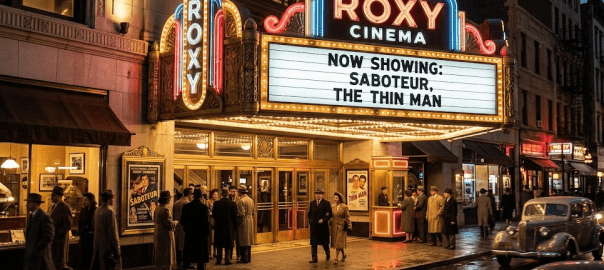
April 19, 2026 /Mpelembe Media/ — In the October 1941 script for Alfred Hitchcock’s Saboteur, the “Thin Man” (Bones) uses the circus troupe’s internal disagreements to explicitly allegorize the global political paralysis during World War II, specifically regarding the spread of Fascism. Please note that the provided sources do not contain information connecting this scene to the contemporary rise of the far-right in modern Europe and the USA; they only discuss this film within its original 1940s historical context.
When addressing the troupe’s inability to agree on how to handle the fugitives hiding among them, Bones outlines how different factions of a free society fail to effectively combat tyranny:
- Passive Sympathy: He points to Esmeralda, the Bearded Lady, noting that she has sympathy for the fugitives’ plight but is “willing to remain passive and let the inevitable happen”.
- Yielding to Force: He admits his own philosophical shortcomings, stating that he has a belief but is “tempted to let [himself] be overridden by force”.
- Ignorance and Confusion: He dismisses the rest of the troupe as being “ignorant of the facts and, therefore, confused”.
Bones contrasts these passive, well-meaning, and confused groups with the malicious Midget, whom he explicitly labels a “Fascist”. When the police arrive to search for the fugitives, Bones takes decisive, forceful action to bundle the Midget out of sight to prevent him from turning the fugitives in. To justify silencing this Fascist threat, Bones declares, “In an emergency the minority must suffer – an historical precedent”.
Ultimately, this scene serves as a gritty commentary on the “present world predicament” of the early 1940s, illustrating that to survive existential threats and make democracy work, free societies sometimes have to abandon textbook political correctness and act ruthlessly against those who wish to destroy them.
Production Case Study: Script-to-Screen Evolution and Strategic Editorial in Hitchcock’s Saboteur
1. The Strategic Landscape of the 1941 Production
The production of Saboteur (1942) represents a critical juncture in the Hitchcockian canon, occurring as the director navigated the shifting geopolitical currents of pre-war America. This period demanded a delicate calibration between the rigors of “Pure Cinema”—Hitchcock’s obsession with visual storytelling—and the escalating pressure to align with a burgeoning nationalistic rhetoric. While the film is often dismissed as a standard chase thriller, a rigorous examination of the October 30, 1941 script reveals a far more radical project. The evolution from script to screen was not merely a refinement of pace, but a strategic distillation that prioritized commercial running-time over the gritty, sociopolitical irony that initially defined the characterizations. The final theatrical cut, though efficient, reflects a significant loss of thematic residue, trading a profound “cross-section of humanity” for the streamlined requirements of the studio system.The Ground Truth of the 1941 Production| Feature | Details || —— | —— || Original Script Date | October 30, 1941 || Primary Attribution | Peter Viertel and Joan Harrison || Late-Stage Revisionist | Dorothy Parker (The “Political Conscience”) || Core Cinematic Focus | The Circus Troupe Sequence |
This editorial trajectory—from a complex blueprint to a simplified commercial artifact—is most apparent in the treatment of character subtext. By examining the excised radicalism of the circus sequence, one uncovers a film that was originally intended to challenge, rather than merely comfort, a democracy on the brink of war.
2. Thematic Depth and the Excised “Circus Troupe” Substance
The circus troupe sequence serves as the quintessential Hitchcockian “cross-section of humanity,” a motif that would find more elaborate expression in the “cross-section of history” represented by the felled Sequoia in Vertigo . In Saboteur , the troupe functions as the moral compass of the narrative; Hitchcock positions these social outcasts—labeled as “freaks”—as the ultimate arbiters of justice. By contrasting their inherent humanity with the cold-hearted indifference of the “normal” world, Hitchcock critiques a society that ignores the plight of the individual. In the original 1941 script, this moral weight was anchored in specific, radical backstories that provided the “substance and irony” now missing from the theatrical cut:
- ‘Bones’ (The Thin Man): Far from a passive observer, the original script establishes Bones as a radical philosopher-activist. His entry into the circus was a direct consequence of a hunger strike at Alcatraz, positioning him as an overt defender of the fugitive—one who has tasted the brutality of the state and refuses to remain silent.
- Lily (The Fat Lady): Her instinctive sympathy for the fugitives, Barry and Pat, is not sentimental but experiential. The script details her siblings’ “trouble with the police” at an early age, rooting her protection of the protagonists in a familial history of state conflict.
- Esmeralda (The Bearded Lady): She represents the “tender-hearted” but paralyzed citizen. Her conflict between innate sympathy and the temptation to remain passive mirrors the very world predicament Hitchcock sought to dramatize.The editorial excision of these radical backstories fundamentally compromised the film’s sociopolitical grit. By removing the Alcatraz striker and the “criminal” familial ties, the production traded Hitchcockian irony for a sanitized, commercial pace, shifting the film from a gritty critique of authority to a more conventional thriller.
3. The Dorothy Parker Contribution: Political Subtext and Amendments
While Viertel and Harrison provided the structure, Dorothy Parker served as the late-stage “political conscience” of the script. Her amendments transformed the dialogue into a parallel for the contemporary world predicament, infusing the narrative with a sophisticated take on individual agency.
- The “Free Country” Declaration: Pat’s remark, “It’s a free country, isn’t it?”, is a late Parker addition missing from the October draft. It serves as a declarative hallmark of democratic agency, emphasizing the individual’s right to choose their side in a national crisis.
- The Snake Charmer Distraction: In the early script, Esmeralda simply yawns to distract the police. Parker’s filmed version—casting Pat as a “snake charmer”—replaced a passive gesture with a performative visual metaphor, heightening the troupe’s role as defenders through creative deception.
- The “Normal World” Monologue: Parker sharpened Bones’s critique of the “egocentric” world. His specific irony—”Even freaks are normal in that respect egocentricity”—serves as a devastating observation. It suggests that the very selfishness defining the “normal” world is the only thing the outcasts share with society, a missed opportunity for depth in the final edit.These amendments ensure that even within a streamlined narrative, Parker’s rhetoric provokes the viewer to question the true nature of democracy during a global emergency.
4. Navigating the “Peremptory Justice” of Minority Suffering
Hitchcock strategically managed controversial or “politically incorrect” slants by using the global political crisis as a justification for harsh narrative logic. In Saboteur , the treatment of ‘The Major’ (The Midget) serves as a microcosm of this emergency-driven ethics.The character is branded a “Fascist” by Bones, providing a moral excuse to bundle the minority figure out of sight. The October 1941 script is blunt: “In an emergency the minority must suffer—an historical precedent.” Hitchcock was not merely making fun of “freaks”; he was arguing that in a moment of existential threat, the preservation of the democratic whole justifies the forceful suppression of dissenting elements. This “peremptory justice” echoes John Ford’s The Grapes of Wrath (1940), where men of action bypass the law to protect their community. In both films, the emotive weight is placed on the non-politically correct action, demonstrating a sophisticated historical insight: that democracy is often “made to work” through extra-legal measures and the suffering of the minority during a state of exception.
5. Psychoanalytic Post-Mortem: The Paternal Deficit in the Hitchcockian Universe
The invisible foundation of Hitchcockian suspense is the “Paternal Function.” Following the Freudian assertion that the need for a father’s protection is the strongest childhood need—surpassing even hunger—Hitchcock builds his narratives on the pathogenesis of paternal absence.The father represents the “Reality Principle,” the essential boundary between the “pure pleasure-ego” and the “threatening outside.” In Saboteur , the fugitives’ flight represents a desperate search for a “protective law” in a lawless landscape. Bones, in the 1941 script, acts as a surrogate paternal authority, organizing the ego’s response to external stressors and silencing the “malignant jerk” (The Major). Without this paternal boundary-setting, the ego becomes a “shrunken residue,” permeable to the “chthonian” forces of the abyss.This deficit typically results in the rise of the “Great Mother” archetype—figures who defeat the son because the protective paternal law is absent. We see this pathology across the Hitchcockian psyche: the suffocating Mrs. Stevens in To Catch a Thief , the terrifyingly rising Mother Superior in Vertigo , and the all-forbidding Mrs. Bates in Psycho . These figures represent the “abject” maternal claim to priority that destroys the protagonist’s search for wholeness when the father figure fails to modulate the Reality Principle.
6. Strategic Takeaways for Contemporary Production
The evolution of Saboteur offers vital professional insights for the modern producer and historian, emphasizing that script evolution is a high-stakes trade-off between narrative velocity and thematic longevity.
- The Sacrifice of Substance for Pace: Commercial editorial decisions frequently strip a film of the “substance and irony” found in early drafts. While this may satisfy immediate running-time constraints, it often removes the gritty, radical subtext required for a film to endure as a significant work of art.
- Subjective Styling as Visual Metaphor: “Pure Cinema” dictates that psychological truth should bypass literal plot logic. The “blanching” of the image in Vertigo to convey faintness is a masterclass in using visual metaphor to communicate internal states, a technique that remains more impactful than dialogue-heavy exposition.
- The Paradox of Democracy: Hitchcock’s use of social outcasts to provide a “Unified Picture” of humanity remains a potent strategy. By portraying “freaks” as the primary defenders of the state, he demonstrates that democracy is often most vital among those who have been marginalized by its literal laws.In conclusion, Saboteur demonstrates that while character humanity is often at risk during the editing process, the “thematic residue” of the original vision—grounded in the Reality Principle and the paradoxes of justice—is what ultimately secures a film’s place in the cinema historian’s archive.