“If I Don’t Speak Out, Who Will?”: Jon Snow’s Dual Fight Against Dementia and Corporate Greed
Thur, Jun 18 2026 /Mpelembe Media/ —The analyses detail two converging narratives: veteran British broadcaster Jon Snow’s public battle with Alzheimer’s disease and his final journalistic investigation into a devastating corporate environmental cover-up in Zambia.
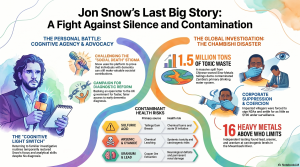
Jon Snow’s Alzheimer’s Diagnosis and Final Documentary: Former Channel 4 News anchor Jon Snow, who retired in 2021, was diagnosed with Alzheimer’s disease in 2023. Following his retirement, he experienced depression, social withdrawal, and progressive memory loss. With the encouragement of his wife, neuroscientist and epidemiologist Dr. Precious Lunga, Snow decided to combat the stigma of dementia by coming out of retirement for one last investigation. This journey is captured in the Channel 4 documentary Jon Snow: A Last Big Story, which airs in June 2026. Returning to his professional routines acted as a “light switch” for Snow, temporarily restoring his focus and demonstrating the therapeutic benefits of structured professional agency for those with cognitive decline. His public disclosure has prompted an outpouring of support and bolstered the Alzheimer’s Society’s campaigns for faster diagnosis and better care.
The 2025 Sino-Metals Leach Zambia Dam Disaster: While in Africa, Snow and his team uncovered an environmental catastrophe in Zambia’s Copperbelt Province. On February 18, 2025, a tailings dam operated by Sino-Metals Leach Zambia—a subsidiary of a Chinese state-owned enterprise—collapsed. The disaster released up to 1.5 million tons of highly toxic, acidic waste and 900,000 tons of heavy metals (including arsenic, lead, and uranium) into the Kafue River basin. This river system supports 60% of Zambia’s population. The spill decimated local agriculture, killed masses of aquatic life, and forced authorities to cut off the water supply to Kitwe, a city of 700,000 people.
Corporate Cover-Up and Exploitative NDAs: In the aftermath, Sino-Metals engaged in a systematic cover-up. They suppressed an independent ecological report that revealed the true, massive scale of the pollution. Furthermore, the company, sometimes accompanied by police, coerced impoverished local villagers into signing Non-Disclosure Agreements (NDAs) written in English. In exchange for paltry payouts ranging from $17 to $2,000 and temporary food rations, villagers unknowingly signed away their rights to sue the company or ever speak about the disaster.
The Legal Fight for Justice: In response to these human rights violations, a coalition led by Brigadier Siachitema of the Southern Africa Litigation Centre (SALC) launched a landmark constitutional petition on behalf of 176 affected residents. They are demanding an $80 billion escrow fund for ecological restoration and hundreds of millions in emergency compensation. Despite corporate attempts to have the case dismissed, the Zambian High Court ruled in favor of the victims, paving the way for a historic human rights and environmental trial set for December 10, 2025.
The Journalist Who Refused to Fade: Jon Snow’s Final Mission and the Cover-Up in the Copperbelt
The anchor who had explained the world to millions for three decades was suddenly lost in his own hallway. Ten months after stepping away from the Channel 4 News desk in 2021, Jon Snow stood in his home, devastated by the belief that he was late for a shift that no longer existed. This moment of confusion was the precursor to a 2023 diagnosis of Alzheimer’s disease. But for Snow, the diagnosis wasn’t an ending; it was the start of a final, desperate race against his own fading memory to expose a crime in the Zambian Copperbelt.What follows is a dual narrative: a personal battle with a neurodegenerative “genocide of the spirit” and an investigation into a massive environmental cover-up. It is a story of how one man chose to spend his remaining lucidity shining a light on the “Minerals Mafia” to defend the human right to a healthy environment.
The “Cognitive Light Switch” Effect
While traditional dementia care often prioritizes safety and domestic confinement, Snow’s experience suggests that “high-agency” activity may be the most potent therapeutic tool available. His wife, Dr. Precious Lunga—a neuroscientist and epidemiologist—rejected the idea of cognitive isolation. She understood that retreating from the world would only accelerate her husband’s decline.The physical toll of the disease was often visible; Snow’s anxiety frequently manifested as compulsive nail-biting, a gauge Lunga used to monitor his distress. Yet, when Snow returned to the field to investigate the mining industry, the transformation was startling. His long-term colleague, Ben de Pear, observed a phenomenon that challenged the standard clinical outlook on Alzheimer’s.”Returning to the familiar routines of journalism acted as a cognitive ‘light switch,’ temporarily restoring Snow’s focus, analytical capabilities, and communication skills, even as his short-term episodic memory continued to fade.”This “light switch” effect allowed Snow to navigate complex investigations and international travel, proving that professional identity and purpose can serve as a potent non-pharmacological support mechanism for those living with cognitive decay.
The Chambishi Disaster: A Tale of Two Reports
The core of Snow’s final mission began on February 18, 2025, when multiple tailings dams (specifically facilities TD15A through TD15F) collapsed at the Chambishi mine. Operated by Sino-Metals Leach Zambia—a subsidiary of the state-owned China Nonferrous Metal Mining Group—the failure released millions of liters of acidic effluent into the Mwambashi River.The discrepancy between the official corporate narrative and the truth uncovered by the suppressed Drizit environmental report is staggering:| Category | Initial Company Claims | Actual Findings (Suppressed Drizit Report) || —— | —— | —— || Volume of Waste | 50,000 tons | 1.5 million tons || Toxic Metal Content | Not specified | 900,000 tons || Scope of Impact | “Under control” | Exponentially larger; active leaching into groundwater |
The Drizit assessment, which Sino-Metals attempted to bury by citing “contractual breaches,” identified a lethal cocktail of contaminants. The Mwambashi River “died overnight,” turning a necrotic brown as Acid Mine Drainage (AMD) mobilized heavy metals:
- Arsenic & Cyanide: Caused acute systemic toxicity and chronic carcinogenic risks for villagers who used the water.
- Lead & Uranium: Resulted in neurological deficits, renal damage, and acute poisoning.
- Sulfuric Acid: Left residents with severe chemical burns and dermal sores.
Agnotology: The Corporate Strategy of Manufacturing Ignorance
Our investigation reveals a masterclass in “Agnotology”—the deliberate production of public ignorance. In Zambia, this strategy is bolstered by “media capture.” The Chinese state-owned enterprise holds a 60% stake in the Zambia National Broadcast Channel , allowing it to dominate the media narrative and drown out reports of the spill.To further silence the victims, Sino-Metals utilized tactics that exploited the economic asymmetry and high illiteracy rates of rural populations:
- Coercive Settlements: Villagers were pressured to sign English-only contracts they could not read. In exchange for meager payments of $100 to $150 and temporary food parcels, they signed away their right to sue.
- The Human Cost: One 80-year-old woman was pressured to sign away 50 acres of her family’s land. Another farmer, whose land was rendered sterile by the acid, saw his weekly income plummet from $200 to just $42 .
- Ironclad NDAs: The contracts banned signatories from speaking to NGOs or journalists and—crucially—forbade them from even revealing that the NDA existed.
- Surveillance: Private and state police established a regime of intimidation, arresting any villager caught taking photographs of the spill site.
The 10-Year Latency Rule and the Supreme Court Precedent
A landmark legal victory arrived on June 3, 2026. The Supreme Court of Zambia, hearing an appeal for 176 residents, made a critical observation regarding the “decadal latency” of environmental harm.The Court acknowledged that the health effects of heavy metal poisoning—particularly from lead and uranium—often do not manifest for a decade or more. This judicial recognition suggests that the immediate post-disaster settlements are “legally oppressive.” By settling weeks after a spill, victims cannot possibly understand the long-term pathology they are agreeing to live with. This precedent provides a vital legal pathway to set aside coercive NDAs and demand long-term medical monitoring.
Defying the Stigma of “Mental Decay”
Jon Snow’s journey also serves as a confrontation with the “social death” that usually follows a dementia diagnosis. Snow initially hesitated to seek help, haunted by the memory of his mother, Joan, who struggled with the same cognitive decline for a decade. He feared that any hint of decay would mean being treated as if he were already dead.With his young son, Tafara, as his motivation, Snow chose to go public to challenge the systemic 3.5-year delay for a diagnosis in the UK—a delay that leaves families in limbo and robs patients of the chance to participate in clinical trials.”At the beginning I wanted to hide it, there’s so much prejudice. Any sort of hint of mental decay, you’re sort of dead. There are moments when it pops up but it’s not an all-day, every-day condition, and that’s what I cling onto.”
Conclusion: A Final Story Worth Telling
Jon Snow’s “Last Big Story” is a powerful intersection of personal vulnerability and professional tenacity. By spending his remaining lucidity exposing the environmental crimes of the “Minerals Mafia,” he has transformed a personal struggle into a mission for global accountability.As he fades from the public eye, his legacy poses a fundamental question: Do we prioritize industrial growth and corporate secrecy, or do we defend the human right to a clean, safe, and healthy environment for future generations?