
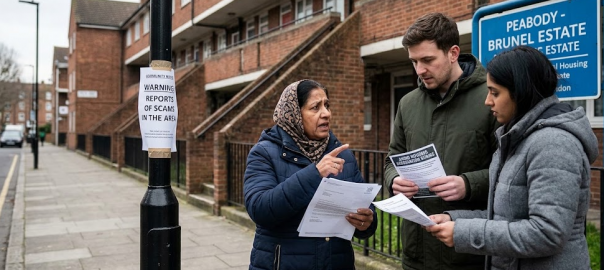
The £2 Million Shortcut: Inside the Scam Rigging London’s Social Housing
In London, a city where the wait for a stable home is measured in decades rather than years, desperation has a market price. For a family of seven packed into a damp, one-bedroom flat in Tower Hamlets, the official “bidding” system feels less like a ladder and more like a treadmill. But what if there was a way to jump the queue? What if a few thousand pounds could buy the keys that twenty years of waiting could not?This isn’t a hypothetical. It is the grim reality behind Operation Chandrila , a massive criminal investigation that has pulled back the curtain on a £2 million conspiracy. It is a story of “gatekeeper” corruption, social media predators, and a system so broken that authorities are now offering a “no questions asked” amnesty to people living in stolen homes just to get the keys back.
The “Gatekeeper” Corruption: A Betrayal for Cash
At the center of this scandal are not the shadowy figures of the underworld, but the very people entrusted with the keys to the city. Operation Chandrila has targeted a network of corrupt housing officers within the London Borough of Barking and Dagenham (LBBD) council.The scale of the betrayal is breathtaking. Between November 2020 and December 2024, investigators believe “several hundred” social homes were fraudulently allocated. These were properties meant for the vulnerable, instead sold to the highest bidder for personal financial gain.Crucially, we must draw a line in the sand regarding responsibility. While the properties involved were owned by B&D Reside , the council’s housing company, the rot was not within Reside itself. An investigation update in January 2026 confirmed that no Reside employees were involved; rather, the “gatekeepers” were LBBD council officers. B&D Reside has maintained a zero-tolerance stance, moving its entire letting process “in-house” to scrub the system clean.The financial impact? Upwards of £2 million. The cost to public trust? Immeasurable.”Every day, our fraud team are behind the scenes… Ultimately their job is to make sure public money is being spent in the way it should be, so I’m really pleased their proactive work has helped lead to today’s arrests.” — Dominic Twomey, Leader of Barking and Dagenham Council
Snapchat Voids and Facebook Slums: The Scammer’s Toolkit
The modern fraudster doesn’t meet in a dimly lit parking lot. They find their prey where the community gathers: on social media. Investigative findings show that scammers—posing as “consultants” or helpful council insiders—have turned platforms like Snapchat and Facebook into digital black markets for tenancies.The tactics are sophisticated and chillingly effective:
- Snapchat “Property Void Sheets”: Fraudsters post internal-looking documents of empty homes to Snapchat stories. These “void sheets” give the scam an air of officialdom, making the offer to jump the queue look like a legitimate “fast-track” bypass.
- The “Top 5” Promise: Scammers claim they can manipulate the bidding portal to ensure a client remains in the “top 1-5” of every bid, guaranteeing a home in less than a month.
- The “Finder’s Fee” Trap: Desperate families are squeezed for upfront payments, typically starting at £1,500 just to “start the process,” with total fees often reaching £5,000 or more.
- Inflated Rent Skimming: In some cases, victims are charged “inflated rents.” The scammers pay a portion back to the council to keep the lights on while pocketing the difference.
The “Key Amnesty”: A Bitter Pill for Justice
In a move that feels like a surrender to the scale of the problem, B&D Reside launched a “Key Amnesty” in November 2025. The logic is brutally pragmatic: it is faster and cheaper to let a fraudster walk away than to fight a two-year legal battle for every single flat.For three weeks, anyone who obtained a property through a “middleman” or was illegally sub-letting could return their keys “no questions asked.” No investigation. No prosecution. Just a clean slate for the fraudster and a roof for a family actually on the list.FACT CHECK: The 2025 Key Amnesty
- Dates: Monday 3 November to Friday 28 November 2025.
- Location: Barking Town Hall, 1 Town Square, Barking IG11.
- The Deal: Return keys to the reception team, fill in a short form, and avoid all legal action and financial redress.
Overcrowded and Overlooked: The Prey of the Middleman
The human cost of this fraud is felt most sharply in East London’s Somali community. When you are one of 23,000 households on a waiting list, and you are raising six children in a one-bedroom flat, a “middleman” doesn’t look like a criminal—they look like a lifeline.Scammers have been known to approach residents in parks near Jubilee Park or outside community centers like the Redcoat center, offering “an easy way out.” It is a predatory exploitation of chronic overcrowding. For a parent watching their children struggle to study or sleep in a room shared by eight people, a £3,000 bribe can seem like a rational investment in their children’s future.”People are in the worst predicament with housing at the moment that they’re taking risks… to pay out large amounts of money when you’re already really, really struggling with individuals that are claiming that they are linked to the council.” — Abdirahim Hassan, Founder of Coffee Afrik
The Law Catches Up: “Failure to Prevent”
While police continue to investigate the four individuals currently on bail under Operation Chandrila, the legal landscape for housing providers shifted permanently on 1 September 2025. Under the Economic Crime and Corporate Transparency Act 2023 , a new “Failure to Prevent Fraud” offence is now in effect.This is a game-changer. If an employee commits fraud for the organization’s benefit—for example, by manipulating accounts to secure better financing—the board itself can be held criminally liable if they didn’t have “reasonable prevention procedures” in place.For the “large organizations” (those with 250+ employees, £36m+ turnover, or £18m+ in assets), the days of plausible deniability are over. Anti-fraud is no longer a box-ticking exercise; it is a matter of corporate survival.
A System Under Pressure
As Operation Chandrila moves from arrests to potential charges, the lesson is clear: fraud thrives in the dark corners of opaque systems. When the official route to a home takes 15 years, the £2 million shortcut will always find a buyer.Local authorities are fighting back with “in-house” letting and biometric-level compliance, but the fundamental pressure remains. In a city where a secure tenancy is the ultimate currency, the question isn’t just about who we can trust to hold the keys—it’s about whether any system can remain honest when the price of a home is a desperate family’s entire life savings.How do we find the balance between trusting our public servants and the relentless oversight needed to stop the next shortcut?