
The Resume Is Dead (And Other Counter-Intuitive Truths About the 2026 Job Market)
March 10, 2026 /Mpelembe Media/ — The traditional employment résumé is becoming increasingly obsolete as generative AI allows job seekers to flood the market with indistinguishable, buzzword-heavy applications. Because digital tools can now easily fabricate credentials and cover letters, hiring managers are frequently ignoring these documents in favor of more authentic evaluation methods. Many companies are shifting toward skills-based hiring, which prioritizes practical assessments and paid work trials over prestigious degrees or past job titles. Recruiters find that a candidate’s actual real-time abilities are far better predictors of success than a polished list of achievements that may have been written by a bot. Consequently, the modern job market is demanding more tangible proof of talent, as traditional paper applications fail to distinguish high-quality candidates from automated noise.
1. The Application Void: Enter the Coasean Singularity
For decades, the job search was a linear, human affair: you polished a document, mailed it, and waited for a recruiter to pick up a highlighter. Today, that pipeline hasn’t just been upgraded; it has been hollowed out into a “black box” environment. While the headlines obsess over the 300 million jobs at risk of displacement globally, the more immediate disruption is occurring in the architecture of the hire itself.We are approaching what economists call the “Coasean Singularity.” Named after Nobel laureate Ronald Coase, this theory suggests that firms exist to minimize “transaction costs”—the friction of finding, negotiating, and hiring talent. In the 2026 market, vendor-neutral programs and AI agents are driving these costs toward zero. The “Application Void” you feel isn’t a glitch; it’s the sound of a legacy 1990s system being deleted in real-time.
2. The “Resume Slop” Paradox: Why Your Perfection Is a Liability
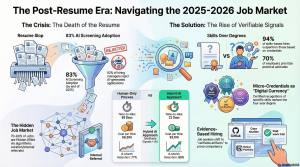
The paradox of the modern job search is that as applications become more “perfect,” they become less valuable. Generative AI has democratized the ability to mirror job descriptions with near-perfect accuracy, creating a flood of “resume slop”—hyper-optimized, buzzword-heavy noise that lacks an authentic human voice.When the marginal cost of a “flawless” application is zero, the signal-to-noise ratio collapses. Recruiters are now so overwhelmed by this automated static that 62% of hiring managers now reject AI-generated applications outright in a move toward “precision hiring.””I handed my résumé to the editor. Without looking up from her computer, she said, ‘I don’t read résumés,’ and flicked the paper to the floor.” — Business Insider anecdote on the terminal utility of the CV.Elite firms are already moving past the document. Expensify now lists engineering roles that bypass the resume entirely, requiring candidates to answer five specific questions instead. Automattic and Gumroad have followed suit, favoring “paid work trials” of four to six weeks where the only credential that matters is the ability to produce maintainable code.
3. The CEO Automation Irony: Leadership as a “Transaction Cost”
There is a persistent myth that AI is coming primarily for the “blue-collar” manufacturing sector—a field that indeed saw 90,000 jobs vanish in 2025 and faces a 58% displacement risk. However, the most savage irony of the current market is occurring at the top of the pyramid.According to an edX survey, 49% of CEOs believe “most” or “all” of their own roles should be automated, compared to just 20% of their employees. This isn’t self-deprecation; it’s cold economic logic. Leadership now views high-level executive functions as friction. This sentiment is echoed by Ford CEO Jim Farley, who predicts AI will eventually replace half of all white-collar workers in the U.S. In the eyes of the algorithm, even the C-suite is just another transaction cost to be optimized away.
4. Your AI Agent is Already Applying for Jobs You Haven’t Seen Yet
The “Hidden Job Market” has evolved from a social network of handshakes into an algorithmically curated layer of intent data. Between 70% and 80% of jobs are never publicly posted; they are filled by AI-driven sourcing tools that discover talent before a human even thinks to apply.Networking is no longer a social event—it is a data event. A battle is currently raging between “Bring-Your-Own” (BYO) Agents—personal AI that searches and negotiates for you—and “Platform Agents” that serve the interests of LinkedIn or Indeed. Traditional “post and pray” methods are being replaced by $199 flat-fee services like Scale Jobs that use human-AI hybrids to bypass the filters entirely.| Metric | Human-Centric Staffing (1990s) | Algorithmic Curation (2026) || —— | —— | —— || Primary Medium | Paper & Highlighters | Verifiable Data & AI Agents || Recruiter Focus | Personal Relationships | Intent Signals & Skill Maturity || Screen Volume | 50–100 per day | 1,000+ per day || Evaluation Goal | Managerial Fit | Predictive ROI & Career Momentum |
Visibility Signals Tracked by Recruiter Dashboards:
- Skill Maturity: AI looks for clean, consistent storylines in experience rather than “scattered” keyword stuffing.
- Career Momentum: Statistical probability of a candidate being “open to opportunities” based on promotion gaps or industry layoffs.
- Recent Activity: Small patterns of engagement, such as updated job titles or fresh project artifacts, signal readiness.
5. The Gendered Ageism Glitch: AI’s Hidden Regressive Bias
As hiring moves into the “black box,” societal biases are being woven into the software’s very fabric. Research from Stanford and the journal Nature has uncovered a disturbing trend of “gendered ageism” within generative AI models.When prompted to generate resumes for hypothetical candidates, ChatGPT systematically portrayed women as younger and less experienced than men, even when provided identical initial data. The AI consistently gave older men the highest ratings while penalizing older women, leaking stereotypes like the “men fix things” bias in technical roles directly into the screening process. As Douglas Guilbeault, Stanford Assistant Professor, notes: “The concepts we use really play a big role in creating the world that we live in.”
6. The “GenAI Premium” and the Death of the Graduate Role
The traditional four-year degree is no longer the sole arbiter of readiness. The market has shifted toward “Evidence-Based Hiring,” where the “GenAI Premium” reigns supreme: employers are 2.4 times more likely to hire a less experienced candidate with a verified GenAI credential over a veteran without one.This shift has been devastating for the entry-level market. Tech companies slashed graduate roles by 46% between 2023 and 2024, with more cuts expected by 2027. In this environment, your resume is a PDF of promises; your GitHub or digital portfolio is a repository of “verifiable artifacts.” If you want to be hired, you don’t list “coding” as a skill—you provide “maintainable code” as a clickable prototype.
7. Conclusion: The Human Moat
By the end of this year, 83% of companies will use AI to screen resumes. As AI dominates the “80%” of the workflow—the routine sourcing, screening, and scheduling—humans are retreating to the “Human Moat.” This is the 20% where AI fails: cultural nuance, complex stakeholder management, and genuine trust-building.This explains why certain “human-complementary” sectors, such as legal jobs, are actually projected to grow by 6.4%. These professionals aren’t fighting the machine; they are using it to automate the drudgery while they handle the high-stakes negotiation.In a world where an algorithm can predict your next career move before you do, the goal is no longer to be the “perfect” candidate on paper. It is to be the “verifiable” expert in the room.Are you building a resume for a machine, or a reputation for a human?