The Shift to Agentic AI and the “Silicon Workforce”
March 23, 2026 /Mpelembe Media/ — In 2026, artificial intelligence has moved beyond generative chatbots to become a structural, operational component of the enterprise. Organizations are rapidly adopting “Agentic AI,” where autonomous digital agents plan, coordinate, and execute complex, multi-step workflows across various applications without continuous human prompting. Because these multi-agent systems interact with live enterprise data to triage tasks, allocate resources, and mitigate risks, leaders are beginning to treat them as a “silicon-based workforce”. To harness this potential, successful companies are avoiding simply layering AI onto old processes; instead, they are redesigning workflows from the ground up and establishing “HR for agents” to manage digital onboarding, governance, and performance.
The Evolution of the “Work OS” and AI-Driven Project Management
Project management software has transformed from simple task-tracking lists into integrated Work Operating Systems (Work OS). Platforms like monday.com, Asana, ClickUp, and Wrike now serve as the central nervous system for enterprise operations by consolidating cross-departmental data, automating routine handoffs, and predicting project delays before they occur. Furthermore, a philosophical split has emerged in the software market: while major incumbents focus heavily on automating the administrative execution of tasks, an emerging category of “framework-guided tools” (such as Storyflow) embeds strategic business methodologies directly into the planning canvas, teaching users how to think strategically while they build their projects.
The Productivity Paradox and Remote Collaboration
Despite the widespread adoption of collaboration giants like Slack, Microsoft Teams, and Google Workspace, remote and hybrid workers are battling a severe “Productivity Paradox”. While workdays have slightly condensed and total productive hours are up, “Focus Efficiency” has fallen to a three-year low of 60%. This erosion of deep work is fueled by endless app-switching, notification fatigue, and excessive collaboration overhead. To combat this burnout and growing disengagement, high-performing distributed teams are adopting centralized “virtual offices”, heavily prioritizing asynchronous communication, and relying on AI to summarize missed threads and extract meeting action items automatically.
Structured Digital Transformation and Industry-Specific Solutions
Given that 70% of digital transformation initiatives fail due to poor alignment, organizations are leaning on proven models like McKinsey’s 7S, Gartner’s Digital Business Framework, and MIT Sloan’s Digital Capability Framework. These frameworks ensure that new technology adoption harmonizes with company culture, staff skills, and operational models. Concurrently, industries with strict compliance or physical footprints are abandoning generic tools for hyper-specialized solutions:
Construction: Adopting Building Information Modeling (BIM) and Digital Twins to create live, data-rich digital replicas of physical buildings, allowing for proactive risk management, clash detection, and predictive maintenance.
Healthcare: Relying on secure, HIPAA-compliant platforms to manage complex clinical trials, automate regulatory audits, and coordinate hospital expansions without disrupting patient care.
Legal: Utilizing robust practice management platforms (like Clio, Filevine, and Smokeball) that centralize case documentation, automate time-tracking to prevent revenue leakage, and handle intricate e-discovery workflows.
The “Coordination Tax” and the End of Performative Work: 5 Surprising Truths About Productivity in 2026
1. The Hook: Why 80% of Your Soldiers Aren’t Firing Their Weapons
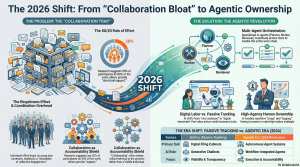
In 1944, during the Battle of the Bulge, U.S. Army historian S.L.A. Marshall discovered a dark truth about human effort: only 15% to 20% of infantrymen in active combat actually fired their weapons. The rest weren’t cowards; they were “present and accounted for,” following orders to move and holding their positions. They meticulously mimicked the outward appearance of a soldier in battle, but they never pulled the trigger.This 80/20 fracture is the fundamental law of group physics. IBM saw it in the 1960s when they realized 80% of computer usage came from 20% of the features. By 2026, the data is clear: your organization is likely suffering from the same rot. While a high-agency 20% operates with a “killer instinct” to drive mission-critical output, the remaining 80% provides what is charitably called “structural support.” In the modern C-suite, “structural support” is just a polite euphemism for a lack of individual contribution. We’ve built a corporate culture where being visible in the system is mistaken for being lethal in the market.
2. The Collaboration Simulation: Why More Tools Equal Less Output
For a decade, the tech industry sold us a “teamwork revolution” as the cure for the silent 80%. We were told that if we just layered enough Notion pages, Slack channels, Jira tickets, and Monday boards, we’d unlock collective genius. Instead, we’ve created what I call the “Collaboration Simulation”—a staggering amount of coordinated activity that rarely translates into actual output. This is the “fuckery-upon-fuckery” of modern operations:
Transparency is confused with progress.
Visibility is confused with accountability.
Inclusion in a thread is equated with owning the outcome.The psychological draw of this simulation is obvious: personal accountability is terrifying. If you own a task, you can fail visibly and individually. But as the strategist JA Westenberg notes:”Collaborating means the failure belongs to the process.”Collaboration-as-ideology has made individual ownership feel antisocial. By hiding in the “warm, expensive fiction” of collective endeavor, employees have built a social safety net where no one ever has to stand alone with a bad result.
3. The Ringelmann Effect: The Physics of “Pulling Less Hard”
The physics of the rope don’t lie. In 1913, Maximilien Ringelmann conducted a study on group effort that remains the most ignored metric in management. He found that as more people are added to a task—literally pulling a rope—individual effort drops. People instinctively pull less hard when they aren’t the only ones on the line.This combines lethally with Brooks’ Law (1975) , which famously proved that adding manpower to a late software project makes it later. Every new hire adds a compounding web of relationships that require “emotional labor” and “relationship maintenance.” In 2026, many organizations find that their “coordination overhead”—the time spent in the theater of standups and retrospectives—now dwarfs execution time. We are spending more energy maintaining the alignment of the people on the rope than we are actually pulling it.
4. The 2026 Pivot: From “General Helpers” to “Agentic AI Clusters”
The era of the “general helper” is dead. Forward-thinking firms are replacing the messy, error-prone human chain of command— Intake → Interpretation → Decision → Execution —with Multi-Agent Orchestration.Unlike human teams, AI agents don’t require “relationship maintenance.” They don’t have egos to soothe or social safety nets to hide in. They break Brooks’ Law by scaling capacity without scaling coordination costs. Using the Cabot Solutions framework, organizations are deploying clusters of specialized agents:
Planner Agents: Break high-level goals into tactical steps and order of operations.
Worker Agents: Execute “Digital Labor”—updating CRMs, drafting code, or analyzing “should-cost” values for materials.
Reviewer Agents: Acts as the “Tactical Governance” layer, checking outputs against policy and audit logs before finalization.By 2026, this shift provides three non-negotiable strategic benefits:
Predictive Analytics & Risk Management: Autonomously flagging Tier 1 and Tier 2 supplier disruptions before the human team even sees the news.
Autonomous Task Orchestration: Identifying and engaging alternative suppliers or reallocating resources without waiting for a committee consensus.
Verifiable Auditing: Providing a “reasoning log” at the edge, ensuring every decision is traceable and compliant, removing the “black box” of group failure.
5. Vertical Expertise: Why The “One App for Everything” Dream is Dying
The dream of the general-purpose PM tool is over. High-stakes industries are abandoning the “one-size-fits-all” Kanban boards for specialized vertical infrastructure. With the passage of the “One Big Beautiful Bill Act,” manufacturing investment is surging, and these firms require more than a “visual helper”—they need hard-coded compliance and Tier 2 supplier visibility.| Feature | General PM Tools (Trello, Asana) | Vertical Platforms (SmartSuite, Orangescrum) || —— | —— | —— || Operational Goal | Visual tracking & “Simulation” | End-to-end industry governance || Security/Compliance | Standard Cloud Encryption | HIPAA, SOC-2, SMART on FHIR, ISO 27001 || Supply Chain Depth | Surface-level task cards | Tier 1/Tier 2 visibility & “Should-Cost” analysis || Data Ownership | Cloud-only (Vendor Lock-in) | Self-Hosted / On-Premise options for total control || Decision Model | Group Consensus / “Antisocial” to lead | High-Agency Individual Ownership support |
“Ownership” in 2026 looks like an individual making a high-stakes call supported by specialized infrastructure, rather than a group waiting for the “feeling” of alignment.
6. Conclusion: The Path Back to Personal Agency
As we navigate 2026, the competitive advantage belongs to those who stop trying to digitize chaos . The “coordination tax” has become a bankruptcy-level event for slow-moving organizations. The future of work belongs to the return of personal agency, where individuals are empowered by agentic clusters to “sink or swim” based on their actual output rather than their “team-level visibility.”Real ownership is the only mechanism that gets anything across the finish line. We must dismantle the collaborative apparatus that makes the individual invisible.Ask yourself: In your current organization, are you part of the 20% pulling the trigger, or is the collaborative apparatus just making it easier for you to keep your head down and hold the rope?