
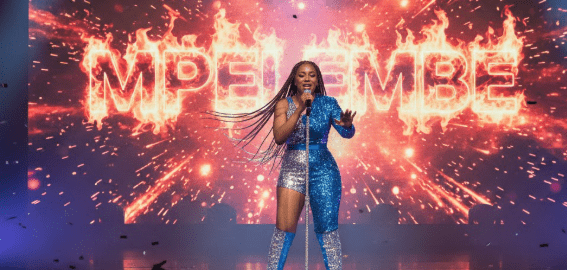
More Than a Melody: How Salma Sky Redefined the Zambian Sound
Feb 11, 2026 /Mpelembe media/ — Salma Sky (born Salma Dodia) is a leading figure in the Zambian music scene who has played a pivotal role in popularizing and shaping the local R&B genre. Born in Lusaka to a Zambian father and a Lebanese mother, she transitioned from a modeling career to music, eventually becoming half of a noticeable “power couple” alongside her husband and producer, Tivo Shikapwashya.
Her influence and artistry are defined by the following elements:
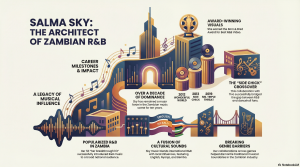
- Cultural Fusion: Her music blends Zambian and international sounds, utilizing a mix of English, Nyanja, and Bemba languages.
- Genre-Breaking Hits: She is credited with introducing R&B to a wider audience through hits like “Wonderful World” and breaking musical barriers with crossover tracks like the dancehall-infused “Side Chick”.
- Role Model Status: Beyond her critically acclaimed albums like FREE, she uses her platform to address social issues and serves as an inspiration for young women in the Zambian music industry.
For decades, the Zambian music landscape was defined by rigid traditional boundaries and high-energy folk rhythms, leaving little room for the subtle, atmospheric textures of contemporary R&B. To break into such a market required more than a pleasant voice; it demanded a visionary capable of reimagining the nation’s sonic identity. Salma Sky (born Salma Dodia) emerged as the seminal architect of this shift. Born in Lusaka to a Zambian father and a Lebanese mother, Sky utilized her multicultural heritage not as a barrier, but as a rich sonic palette. Her trajectory—from the gospel roots of church choirs to her status as a transatlantic icon—is a masterclass in how an artist can move the cultural needle through sheer creative agency and technical precision.
The “Wonderful World” Effect: Mainstreaming a Genre
Before Salma Sky’s ascent, R&B remained a niche interest in Zambia, often dismissed as a polished but foreign import. That changed irrevocably in 2012 with “Wonderful World.” The track was a revelation: a masterfully crafted piece of soul that paired Sky’s silky, effortless vocals with a velvety production style that felt both globally competitive and intimately local.This wasn’t merely a “hit”; it was a proof of concept. By delivering a sophisticated R&B sensibility to a wider, traditionally-minded audience, Sky demonstrated that the genre could possess deep local resonance. The song’s success dismantled the “foreign” stigma, paving the way for the genre to become a dominant force on Zambian airwaves. It was the moment R&B found its Zambian heart.
The Power of Linguistic and Cultural Fusion
Sky’s brilliance lies in her refusal to choose between her roots and her global ambitions. By weaving English, Nyanja, and Bemba into a single narrative thread, she practices a form of musical “code-switching” that bridges the gap between the Lusaka streets and the international stage. This linguistic fluidity allows her to maintain an authentic local pulse while ensuring her music remains a highly exportable product.Her work—evidenced in tracks like “Tantule” and “Zambezi”—functions as a sonic tapestry where multicultural heritage meets local pride. This fusion isn’t just a marketing strategy; it is a reflection of a modern, interconnected Zambia.”Salma Sky’s music is a fusion of Zambian and international influences,” a blend that allows her to navigate diverse cultural spaces without losing the core of her identity.
The Strategic Career Pivot: From Runway to Recording
Rarely do artists have the maturity to step away at the peak of their potential, but Sky’s early career was defined by a calculated hiatus. In her early twenties, she transitioned from singing to a successful modeling career—a move that provided her with a unique vantage point on the mechanics of branding and public image.When she returned to the studio, she did so not as a passive performer, but as a songwriter with a sharpened sense of agency. This pivot was transformative; the hiatus allowed her to return with a matured perspective, ready to build a career from the ground up on her own terms. It was this period of growth that transitioned her from a “talent to watch” to a definitive “voice of a generation.”
The Industry Power Couple Synergy
The narrative of Salma Sky reached a new level of professionalization in 2013, following her marriage to musician and producer Tivo Shikapwashya. Together, they formed a powerhouse partnership that stabilized and elevated the local industry’s standards. Their 2013 collaboration “Side Chick” remains a case study in genre-blurring strategic mastery.By injecting R&B soul into the rhythmic urgency of Dancehall, they captured the club-heavy energy of the era while maintaining the melodic integrity of Sky’s brand. This partnership goes beyond personal affection; it serves as a professional model for how collaborative synergy can produce high-value, genre-defying art that appeals across disparate fanbases, from R&B purists to dancehall devotees.
Breaking the “Glass Ceiling” for Female Artists
Sky’s most enduring legacy is perhaps her role as the premier “barrier-breaker” for female independence in a male-dominated industry. Her victory at the Born & Bred Awards for Best R&B Video was a signal to the industry that women could dominate the technical and creative aspects of the craft. Crucially, Sky is not just a vocalist; she is an accomplished producer who has actively developed the R&B sound in Zambia, mentoring younger artists and shaping the production standards of hits like “Ruby,” “Over You,” and “Mr. DJ.”Through her music, she provides a sophisticated platform for social commentary, addressing the complexities of love and relationships with a modern, empowered lens. She has moved beyond being a celebrity to becoming a blueprint for longevity and creative control.”She is also a role model for young women in Zambia, showing them that they can achieve their dreams in the music industry,” proving that a woman can lead both in the vocal booth and the producer’s chair.
Conclusion: The Legacy of a Pioneer
The story of Salma Sky is far from a finished anthology. Her footprint is visible across the entire spectrum of modern Zambian music, from the diverse, critically acclaimed explorations of her album FREE to the genre-bending depths of Kalubango . She did not simply enter the Zambian music scene; she renovated it, carving out a permanent space for R&B, linguistic fusion, and female leadership.As the African music landscape continues its meteoric rise on the global stage, one must wonder: would the contemporary “Zambian Sound” have even found its way to the global playlists of today without the linguistic and stylistic bridge Sky meticulously engineered a decade ago? The foundation she laid ensures that those who follow her are no longer just making music—they are building a culture.
Source
Salma Sky