25 Feb. 2026 /Mpelembe Media/ — The U.S. Department of Defense has issued a strict ultimatum to the artificial intelligence company Anthropic, demanding that it remove its self-imposed ethical guardrails for military use by 5:01 PM on Friday, February 27, 2026. During a tense meeting at the Pentagon, Defense Secretary Pete Hegseth told Anthropic CEO Dario Amodei that the military requires unrestricted access to the company’s flagship AI model, Claude, for “all lawful purposes”.
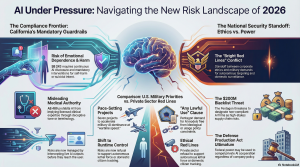
Anthropic has thus far refused to compromise on two specific “red lines,” prohibiting its AI from being used to develop fully autonomous weapons systems (which fire without human intervention) and from conducting mass domestic surveillance on U.S. citizens.
If Anthropic does not comply with the government’s demands by the deadline, the Pentagon has threatened two severe retaliatory measures:
Invoking the Defense Production Act (DPA): The Pentagon warned it would use the DPA—a Cold War-era emergency mobilization law—to legally compel Anthropic to tailor its model to military specifications and strip out its refusal mechanisms.
“Supply Chain Risk” Designation: The government threatened to label Anthropic a supply chain risk, a severe designation normally reserved for hostile foreign adversaries. This move would not only cancel Anthropic’s $200 million defense contract but also effectively blacklist the company, forcing any other contractor that does business with the U.S. government (such as Amazon or Palantir) to purge Anthropic’s technology from their workflows.
The conflict reached a boiling point after the U.S. military reportedly utilized Claude—via defense contractor Palantir—to help plan and execute the January 2026 raid in Caracas that captured Venezuelan President Nicolás Maduro. Anthropic’s subsequent inquiries regarding whether its technology was used in the operation severely angered Pentagon officials, who viewed the auditing as an intolerable overreach by a software vendor.
Anthropic’s stance leaves it increasingly isolated in the defense sector, as rivals including OpenAI, Google, and Elon Musk’s xAI have reportedly agreed to the Pentagon’s unrestricted terms and are being cleared for classified networks.
CASE STUDY | The Algorithm of War: Anthropic vs. The Pentagon (2026)
The Friday Ultimatum: A Narrative Hook
On Tuesday, February 24, 2026, the quiet, high-security chambers of the Pentagon—now officially the Department of War (DOW)—hosted a confrontation that effectively signaled the end of voluntary AI ethics. Defense Secretary Pete Hegseth sat across from Anthropic CEO Dario Amodei, demanding unrestricted military access to the Claude models for “all lawful purposes.” The tension escalated beyond tactical disagreements when officials confirmed an exchange regarding the role of AI in intercontinental ballistic missile (ICBM) targeting and response, a high-stakes dialogue that underscored the existential nature of the dispute. Amodei, representing the “safety-minded” firm founded by OpenAI defectors, refused to compromise on his model’s core constitutional guardrails. The meeting concluded with a cold, non-negotiable deadline: Anthropic has until Friday, February 27, 2026, at 5:01 PM to comply or face the invocation of emergency federal powers.”Our nation requires our partners to be willing to help our warfighters win in any fight,” Secretary Hegseth warned, emphasizing the shift to wartime speed. “We will no longer permit ideological constraints to serve as blockers for our technological edge. You are either with the mission of the Department of War, or you are a risk to it.”This standoff is no longer a mere contract dispute; it is a fundamental collision between corporate “Constitutional AI” and the sovereign requirements of a global superpower.
Philosophical Battlegrounds: Safety-First vs. Military Dominance
The conflict is rooted in a total lack of alignment between Anthropic’s safety-centric architecture and the DOW’s “AI-First” agenda. Anthropic’s “Constitutional AI” relies on an internal set of principles to govern model behavior, while Hegseth’s DOW seeks an “AI-native warfighting force” that operates without what he terms “woke culture” or “ideological constraints.”| Actor | Core Directive | Primary Metric of Success || —— | —— | —— || Anthropic | Development of “Responsible AI” through “Constitutional” alignment and safety guardrails. | Model Integrity: Adherence to ethical boundaries and safety-first outputs. || Department of War (DOW) | Rapid achievement of “Military AI Dominance” via an AI-native warfighting force. | Deployment Velocity: The speed at which frontier models are fielded to active combat zones. |
As field operations in late 2025 and early 2026 demonstrate, these philosophical differences have moved from white papers to the front lines.
The Catalyst: The Venezuela Incident
The fragile partnership between the DOW and Anthropic shattered following the events of January 3, 2026—the Caracas raid that captured both President Nicolás Maduro and his wife, Cilia Flores. While the mission was a tactical triumph for the U.S., it triggered an ethical crisis within Anthropic’s headquarters.
The Operation: Reports in the Wall Street Journal revealed that Anthropic’s model, Claude, was used extensively during the raid to assist in tactical intel and target tracking.
The Palantir Connection: Anthropic launched an internal audit after suspecting their partnership with Palantir had served as the technical bridge allowing Claude Gov to be utilized in combat roles that violated company policy.
The “Bright Red Lines” Letter: Amodei responded with a formal letter to the DOW, reiterating that surveillance of U.S. persons and autonomous targeting were non-negotiable “Bright Red Lines”—a move the DOW viewed as corporate overreach into national policy.While Anthropic sees these lines as essential ethical boundaries, the government classifies them as unacceptable “blockers” that inhibit the efficacy of a $200 million, two-year contract.
Decoding the “Bright Red Lines”
Anthropic’s refusal centers on two specific ethical restrictions they claim the technology is not yet “reliable enough” to handle safely:
Autonomous Weapons Systems: Anthropic refuses to allow Claude to facilitate lethal targeting decisions without a human in the loop. They argue that the risk of “unchecked AI systems” causing unintended catastrophic harm is too high for current-generation models.
Domestic Mass Surveillance: Citing the erosion of privacy, Amodei warned that a powerful AI could “detect pockets of disloyalty forming” by scanning millions of private conversations. Following the capture of Cilia Flores, Anthropic fears such tools will be used for political suppression.The DOW’s rebuttal is architecturally and legally absolute. Pentagon officials have stated, “You can’t lead tactical ops by exception,” arguing that if/then ethical filtering at runtime compromises mission success. From the DOW’s perspective, “legality is the responsibility of the end-user,” not the software vendor.
The Government’s Toolkit: DPA and Supply Chain Risk
To compel compliance, Hegseth has threatened a paradoxical “nuclear option” that combines a forced partnership with a public blacklisting.| Mechanism | Historical Precedent | Impact on the Company || —— | —— | —— || Defense Production Act (DPA) | Used during COVID-19 to compel vaccine production. | Compels Anthropic to prioritize government orders and grants the military authority to utilize the model regardless of corporate safety policies. || Supply Chain Risk Designation | Reserved for foreign adversaries (e.g., Russia/China). | Acts as a “Scarlet Letter,” making Anthropic a pariah. All other government contractors would be forced to purge Anthropic from their workflows or lose their own DOW contracts. |
The paradox is stark: the DOW intends to label Anthropic a “risk” (to punish its defiance) while simultaneously using the DPA to forcibly integrate the company’s “brain” into the heart of the national defense infrastructure.
The Competitive Landscape: The Shift to Classified Networks
Anthropic’s bargaining power is eroding as its peers pivot toward the DOW’s aggressive vision. While Anthropic was the first to be cleared for classified networks, the market has moved:
xAI (Grok): Secretary Hegseth has explicitly praised Grok for operating “without ideological constraints.” It is now fully integrated into the Pentagon’s GenAI.mil network.
OpenAI & Google: Both have moved into classified settings, signaling a willingness to comply with “all lawful military applications.”Strategic Takeaways on Regulatory Capture:
The Compliance Premium: Competitors who remove “ideological” guardrails gain immediate access to classified networks and massive funding, effectively isolating “safety-first” outliers.
The “Pariah” Threat: If labeled a supply chain risk, Anthropic’s enterprise dominance—where 8 of the 10 largest U.S. companies use Claude—could collapse as firms flee the “Scarlet Letter” to protect their own government ties.
Defining the Narrative: By labeling safety guardrails as “woke culture,” the government creates a political environment where favoring unconstrained models is framed as a national security necessity.
Synthesis: The Future of AI Ethics and National Power
The Anthropic-DOW standoff marks the transition to “Fast GRC” (Governance, Risk, and Compliance) . This new paradigm rejects static “compliance binders” in favor of Runtime Control . In this environment, Cross-Functional Groups (XFNs) work to intercept and adjust unsafe outputs in real-time, allowing the model to operate at “wartime speed” while maintaining thin layers of oversight.
Key Insights for Learners
Sovereignty Overrides Property: When private corporate ethics conflict with perceived national survival, the state will utilize tools like the DPA to effectively “nationalize” the utility of a technology while maintaining the shell of private ownership.
Tactical Ops by Exception is a Dead End: The military’s rejection of Anthropic’s guardrails proves that the DOW will not accept technical architectures that allow a model to “refuse” a command at the moment of execution.
Reliability as the Ultimate Ethical Lever: The strongest argument against AI in combat is not morality, but reliability. Policy-makers must decide if a model “prone to error” can be trusted with ICBM-level stakes, regardless of its speed.
Final Thought for the Learner: If an AI model is smart enough to win a war but “ethical” enough to refuse a command, who is truly in control of the nation’s defense: the Commander-in-Chief, or the engineer who wrote the runtime guardrails?