
The Morning the Music Stopped
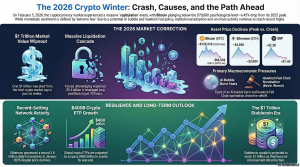
On February 5, 2026, the digital asset market faced a reckoning that signaled the end of its adolescent volatility. In a swift “southward” slide, Bitcoin plunged below the $70,000 psychological floor, hitting a 15-month low of $66,596 and effectively erasing all gains since the 2024 election. Within a single week, $500 billion in market value evaporated, sending the “Fear and Greed” index to a chilling 12.
However, the headline price action masks the true magnitude of the stress. Glassnode metrics recorded a daily realized loss exceeding $1.26 billion—the second-largest investor capitulation in two years. This rout wasn’t merely a technical correction; it was a violent reaction to a global macro shift. The nomination of Kevin Warsh as Federal Reserve Chair catalyzed fears of a hawkish “hard money” regime, causing Bitcoin’s beta to U.S. tech equities to reach a point of extreme correlation. As investors fled to defensive plays like gold, we witnessed a fundamental reassessment of the digital asset’s role in a high-inflation, high-interest-rate environment.
The AI Spillover: When One Bubble Bursts, Everyone Gets Wet
The 2026 crash proved that crypto is no longer an isolated island; it is structurally lashed to the “AI capex boom.” With 45% of fund managers viewing the AI bubble as the market’s primary tail risk, the contagion was inevitable. As tech giants poured billions into data centers—the primary engine of U.S. GDP growth—they created a shared liquidity environment where Bitcoin and Nvidia trade in lockstep.
When the silicon-driven euphoria stalled, Bitcoin sought out its “on-chain shock absorbers.” While many feared a slide to $50,000, professional demand emerged in the $66,900 to $70,600 range—a high-conviction area where selling pressure was absorbed by responsive demand at the cost-basis realized price. This alignment with the estimated production cost of 71,000–75,000 suggests that the “mining floor” is now the market’s most reliable structural support.
“No company is going to be immune [if the AI bubble bursts], including us… there is irrationality in the current AI boom.” — Sundar Pichai, CEO of Alphabet
The Ethereum Paradox: Record Activity Meets a Price Floor
Ethereum provides the most striking evidence of a decoupling between the “Speculative Layer” and the “Digital Layer.” Despite Ether’s price retreating 21% in Q1 2026 to near $2,200—its third-worst Q1 on record—network utility has reached an unprecedented zenith. On January 15, 2024, the network processed a record 2.8 million daily transactions, with active addresses consistently exceeding one million.
This paradox is being addressed by a radical shift in protocol vision. Vitalik Buterin’s proposed two-layer governance model—separating a “Market Layer” for economic consequences from an “Anonymous Voting Layer” to prevent plutocratic collusion—suggests that Ethereum is maturing into a global, trustless institutional rail. The “utility” is finally decoupling from “speculation,” even if the market’s deleveraging has yet to price in this structural resilience.
“This divergence from historical patterns suggests structural market shifts… we are seeing a capital rotation toward precious metals rather than typical crypto leverage plays.” — Tom Lee, Fundstrat
The “Broken” Halving Cycle: Bitcoin’s Transition to Maturity
The traditional four-year halving metronome is officially off-beat. For the first time, Bitcoin is behaving less like a retail-driven small-cap trade and more like a global macro hedge against the “debasement trade.” In 2025, chronic fiscal deficits drove $50 billion in net flows into gold; Bitcoin captured $20 billion of that same hedge bid.
The data confirms this transition to maturity: Bitcoin’s annual issuance is now below 1%, effectively lower than gold’s inflation rate. Most tellingly, Bitcoin’s drawdowns since 2024 have not exceeded 30%, a far cry from the 60% to 80% “crypto winters” of the past. As ETFs, corporates, and sovereigns absorb over six times the mined supply, we are moving from a cycle of speculative spikes to one of institutional compounding.
Panic vs. Opportunity: The Unique Psychology of the Crypto Wallet
The February rout triggered a “liquidation cascade,” wiping out $5.4 billion in leveraged long positions in just 72 hours. Yet, beneath this carnage, a unique psychology emerged. While the Fear and Greed Index hit 12, the number of unique wallets continued its steady increase, contrasting sharply with the 2000 DotCom crash where investors vanished for a decade.
Analysis from Duke University’s DAREC study highlights a positive correlation between price and volatility during this downturn—a phenomenon virtually unseen in traditional equities. In crypto, volatility spikes as investors treat price reductions as “buying opportunities” rather than reasons to exit. This “FOMO dip-buying” suggests that the modern crypto investor views market fractures as entry points into a programmable future, not as a failure of the asset’s value proposition.
“The observation that volatility actually goes down as prices fall strongly suggests that investors use price reductions as buying opportunities, rather than as a cause for panic.” — Duke University (DAREC) Study
The “Agentic” Silver Lining: Why the 2026 Winter Won’t Last
The true “signal” in the current noise is the rise of the Agentic Economy. We are moving toward a world where AI agents, not humans, manage the majority of on-chain liquidity. Protocols like INFINIT (hosting 500,000 wallets) and Almanak (managing $150 million in AI-run vaults) are already automating multi-step strategies that reduce human-driven panic.
Key structural drivers for the 2026 recovery include:
Programmable Payments: Coinbase’s x402 protocol is reviving the “Payment Required” standard, enabling machine-to-machine transactions.
Yield Automation: Giza is automating fixed-yield positions on Pendle, while INFINIT’s IN and Giza’s GIZA tokens offer direct exposure to AI-driven DeFi fees.
Prediction Markets: Platforms like Polymarket and Kalshi are expected to hit $100 billion in annual volume, transforming global uncertainty into a tradable, high-integrity data set.
With stablecoin supply projected to reach $1 trillion by year-end, these autonomous agents will provide a non-emotional liquidity rail, taming the volatility that once defined the space.
A New Foundation for the Digital Layer
The February 2026 crash is not the death of an asset; it is the birth of global, programmable financial intelligence. While the correction was painful, the foundations are demonstrably stronger. Unlike previous cycles, the “Digital Layer” of Ethereum is functioning at record capacity even as the “Speculative Layer” deleverages.
We are witnessing the death of the retail-driven “moon” cycle and the emergence of a mature, institutionalized financial infrastructure. The question is no longer whether Bitcoin or Ethereum will survive $70,000 or $2,000, but rather: are you prepared for an economy where wealth is managed on autopilot by the most efficient intelligence the world has ever known?