Beyond the Bazinga: 5 Surprising Truths About the Big Bang (and the Show That Hijacked It)
01 Mar. 2026 /Mpelembe Media/ — The sources explore two distinct but intimately connected subjects: the scientific model explaining the origin of the universe, and the massively popular television franchise that shares its name and brought complex physics into mainstream pop culture.
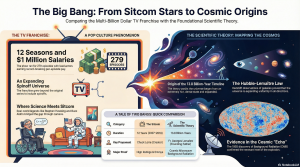
The Scientific Big Bang Theory The scientific Big Bang theory is the prevailing cosmological model, postulating that the universe expanded from an extremely hot, infinitely dense state approximately 13.8 billion years ago. The theory is supported by three major observational pillars: the continuous expansion of spacetime (Hubble’s Law), the precise abundance of light elements like hydrogen and helium formed during Big Bang Nucleosynthesis, and the pervasive presence of Cosmic Microwave Background (CMB) radiation, which acts as the cooled “echo” of the universe’s initial expansion.
To solve lingering issues in the original model—namely the “horizon problem” (why the universe has a uniform temperature everywhere) and the “flatness problem” (why the universe’s geometry appears perfectly flat)—physicist Alan Guth proposed Inflation Theory. This theory modifies the Big Bang by suggesting that the universe underwent an impossibly rapid, exponential expansion a fraction of a second after its birth, smoothing out the cosmos. While this is the standard model, theoretical alternatives exist, such as the Ekpyrotic universe (which posits the universe was created by a collision of higher-dimensional “branes” rather than a singularity) and Conformal Cyclic Cosmology (which suggests the universe goes through infinite cycles of expansion and rebirth).
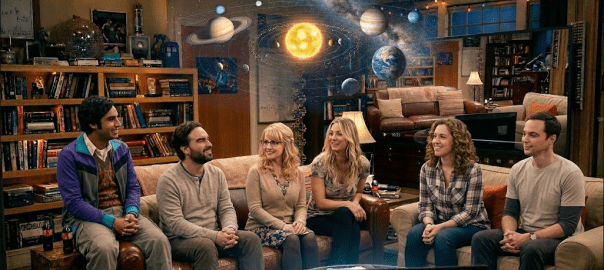
The Television Franchise Premiering in 2007, The Big Bang Theory is a CBS sitcom created by Chuck Lorre and Bill Prady. The show centers on a group of socially awkward Caltech physicists and their interactions with their socially adept, non-scientist neighbor, Penny. The series was a massive commercial success that spawned a multimedia franchise, including the prequel series Young Sheldon and the recent 2024 sequel Georgie & Mandy’s First Marriage.
A defining feature of the show was its dedication to scientific authenticity. The producers employed UCLA physicist David Saltzberg to review scripts and fill the set’s whiteboards with accurate equations, and the show frequently featured cameos from real-world science icons, including Stephen Hawking, Neil deGrasse Tyson, and Buzz Aldrin.
Cultural Impact and the Perception of Scientists The sitcom has had a profound sociological impact, even being credited with sparking a “physics boom” that increased university physics applications and enrollments by making the subject appear “cool” to younger generations.
Extensive focus group research indicates that the show successfully humanized the image of scientists for the general public. By depicting researchers navigating friendships, romantic relationships, and everyday problems, the series challenged the traditional, isolated “mad scientist” stereotype, though it did heavily utilize exaggerated “nerd” tropes for its comedy.
Furthermore, the introduction of accomplished female scientists to the main cast—such as microbiologist Bernadette and neuroscientist Amy (played by real-life neuroscientist Mayim Bialik)—provided a platform to challenge the male-dominated image of STEM fields. While viewers noted that the show sometimes perpetuated the divide between “hard” and “soft” sciences or initially reduced these women to romantic interests, the characters ultimately offered a rare, capable representation of women in academia. Ultimately, the show acted as a cultural bridge, utilizing humor to foster broader public engagement with the scientific community.
The Google Struggle is Real
If you type “The Big Bang Theory” into a search engine today, you will likely traverse five pages of sitcom syndication news, cast salary disputes, and “Bazinga” memes before you encounter a single reference to actual cosmology. For the modern seeker of knowledge, a group of fictional physicists in Pasadena has effectively eclipsed the scientific study of the very origin of our universe.We are peeling back the curtain on a 13.8-billion-year-old expansion and the 12-season juggernaut that became its unexpected press agent. Why did society allow a sitcom to “hijack” one of the most profound terms in physics? Perhaps because the show did something the ivory tower often struggles to do: it made the unreachable reachable. By humanizing the people who study the stars, it turned a cold, mathematical singularity into a warm, relatable living room.
The Neuroscience of a Sitcom: Mayim Bialik’s Real-World Credentials
One of the most compelling examples of art mimicking life is Mayim Bialik, who portrayed Amy Farrah Fowler. While most actors require a “science for dummies” crash course before stepping onto a lab set, Bialik entered the production with a PhD in neuroscience from UCLA, earned in 2007.The “meta” origin story of her academic career is pure pop-culture history: while starring in the 1990s hit Blossom , Bialik was inspired to pursue science by a female biology tutor who served as her first one-on-one professional role model. This real-world expertise allowed Bialik to serve as an informal consultant, ensuring that laboratory settings and dialogue felt grounded in actual academic rigor.”A lot of people believe in the stereotype, but we hope that The Big Bang Theory is changing the way people think of nerds and geeks by showing them having active social lives and relationships. I think that is an important way to portray them.” — Mayim Bialik
The Priest, the Redshift, and the Primeval Atom: The Lemaître Legacy
While the name Edwin Hubble is synonymous with the expanding universe, the theory’s architectural foundation was laid by Fr. Georges Lemaître, a Belgian priest and physicist. In 1927, Lemaître published a paper—later translated by his Cambridge professor, Sir Arthur Eddington—calculating that the universe was indeed expanding from what he called a “primeval atom.”At the time, Lemaître’s “Big Bang” was the underdog of cosmology. It was dismissed by titans like Albert Einstein and Fred Hoyle, who preferred the “Steady State” model—the idea that the universe was eternal and unchanging. Lemaître’s evidence rested on “redshift,” a concept best explained by the Doppler effect: much like the pitch of a siren drops as an ambulance moves away from you, light from distant galaxies shifts toward the red (lower frequency) end of the spectrum as they recede.In 2018, the International Astronomical Union officially corrected the historical record by renaming the “Hubble Law” to the “Hubble-Lemaître Law.” Validation for Lemaître came at the ultimate moment; he was informed of the discovery of Cosmic Microwave Background Radiation (CMBR)—the “faint remnant of the original fireball”—while on his deathbed in 1965.
Brane Collisions: Was the “Big Bang” a Cosmic Crash?
In the show, the “Big Bang” refers to the explosion of a social circle when new personalities collide. In theoretical physics, a provocative alternative to the standard model suggests the universe began in much the same way. The Ekpyrotic Universe model, rooted in string theory, suggests our universe is a three-dimensional “brane” (surface) floating in a higher-dimensional space.Instead of a singular explosion from nothingness, this theory proposes that our universe was sparked by a collision between two such branes. This “cosmic crash” suggests that the “Bang” isn’t a one-time event, but perhaps a recurring cycle in an ancient, eternal universe.
- Standard Model (Singularity): Space, time, and matter erupted 13.8 billion years ago from a single point of infinite density.
- Ekpyrotic Model (Brane Collision): The universe undergoes a slow contraction followed by a collision of branes, implying our cosmos is much older and potentially cyclic.
The $1 Million Sacrifice: Hollywood’s Version of Symbiosis
The chemistry that made the show a global phenomenon was reinforced by a rare display of real-world solidarity. In 2017, the original five cast members—Jim Parsons, Johnny Galecki, Kaley Cuoco, Simon Helberg, and Kunal Nayyar—each took a $100,000-per-episode pay cut to ensure pay parity for Mayim Bialik and Melissa Rauch, who had become indispensable to the ensemble.This gesture stood in stark contrast to the usual “explosion of money and fame” that Kaley Cuoco admits brought its share of drama to the set. Interestingly, Cuoco reflected on her career during this time with a historian’s irony; despite being a television presence for over 20 years, she was frequently labeled a “newcomer” by the media once the show reached its peak.
Science Non-Fiction: The Ultimate Cameo List
The series famously blurred the line between sitcom fiction and scientific reality by hosting the icons of “science non-fiction.” These cameos weren’t just for show; they anchored the series within the actual scientific community.
- Stephen Hawking: Appearing seven times, the legendary physicist often played a boastful version of himself, once even calling Sheldon’s work “erroneous.”
- Neil deGrasse Tyson: In a classic “pop-culture historian” moment, Tyson engaged in a Twitter feud with Raj, eventually threatening a “deGrasse-kicking” and reminding the characters, “I’m the guy who kicked Pluto out of the Solar System.”
- Bill Gates & Elon Musk: Both moguls appeared, playing themselves as they navigated the awkwardness of being idolized by the Pasadena crew.
- Buzz Aldrin: The second man on the moon provided one of the show’s most famous lines while bragging to trick-or-treaters: “I walked on the moon. What have you done?”
Conclusion: The Echoes of the Fireball
Whether viewed through the lens of a telescope or a television screen, the “Big Bang” remains our most compelling story of how everything began. While the scientific theory continues to evolve—pondering whether we face a “Big Crunch” or a “thermal death”—the cultural franchise is only expanding. With spin-offs like Georgie & Mandy’s First Marriage and the upcoming Stuart Fails to Save the Universe , the legacy of the Pasadena physicists is as permanent as the CMBR itself.The next time you search for “Big Bang,” take a moment to appreciate the dual history: the 13.8-billion-year-old expansion that gave us matter, and the 12-season juggernaut that gave us a seat at the table. Are we merely a single expansion, or part of an infinite cycle of cosmic—and comedic—collisions?