Nov. 2, 2025 /Mpelembe Media/ — An article from The Economist titled “OpenAI and Anthropic v app developers: tech’s Cronos syndrome,” examines the emerging competitive dynamic between large language model (LLM) providers, such as OpenAI and Anthropic, and the specialised AI application developers that build their businesses atop these models. The article uses the metaphor of Cronos devouring his children to illustrate the fear that the powerful, highly-valued AI labs may eventually usurp the profits of the smaller app-makers like Cursor and Harvey. Continue reading
Tag Archives: Prediction
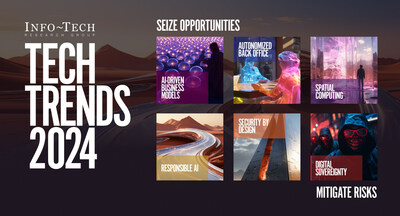
Tech Trends 2024 Report: Six Trends of the Generative Enterprise Revealed by Info-Tech Research Group
To prepare technology leaders for what’s to come in 2024, global IT research and advisory firm Info-Tech Research Group has released its highly anticipated annual technology report: Tech Trends 2024. As the technological landscape experiences exponential acceleration, as predicted by the enduring legacy of Moore’s Law and Gordon Moore’s unmatched vision, IT leaders across the globe find themselves navigating both the transformative innovations and the ethical considerations they bring. As the boundaries of technological possibilities expand and the implications become more pronounced, IT faces the dual challenge of harnessing the raw power of emerging technologies and setting the ethical and operational compass for AI’s expansive influence. Drawing from a comprehensive survey of IT leaders and experts, the firm’s 2024 report highlights six pivotal AI-centric trends, as well as the promises and intricacies of an AI-integrated future. Continue reading
How a quest for mathematical truth and complex models can lead to useless scientific predictions – new research
Arnald Puy, University of Birmingham
A dominant view in science is that there is a mathematical truth structuring the universe. It is assumed that the scientist’s job is to decipher these mathematical relations: once understood, they can be translated into mathematical models. Running the resulting “silicon reality” in a computer may then provide us with useful insights into how the world works.