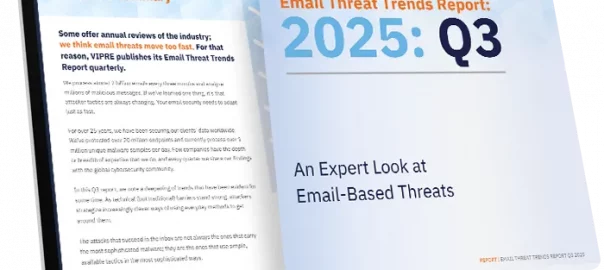
The report provided by VIPRE Security Group concerning their Q3 2025 Email Threat Landscape Report, which details how cybercriminals are using increasingly sophisticated methods to bypass traditional email defences. The report reveals that commercial clutter makes up the largest proportion of email volume and is intentionally used to desensitise users, enabling malicious emails like phishing attempts to blend in. Key findings highlight that attackers frequently exploit compromised URLs or open redirects and are strategically targeting Outlook and Google mailboxes, which together constitute ninety per cent of observed phishing attacks. Furthermore, the report notes emerging technical trends such as the use of Fetch API for credential exfiltration and the abuse of Apple’s TestFlight platform to distribute malicious iOS applications, while acknowledging that geographic dispersion across spam-sending markets is making traditional IP blocking ineffective. Overall, the source stresses that organisations must adopt equally adaptive and layered defences to counter the evolving threat landscape. Continue reading
Tag Archives: Social engineering
As an ethical hacker, I can’t believe the risks people routinely take when they access the internet in public
Christopher Patrick Hawkins, University of Staffordshire
In the modern world we are all constantly connected, but this comes with risks. As most cybersecurity specialists will tell you, the biggest vulnerability in any system is the user – whether at home or work.
Introducing Norton Genie – Real-Time AI-powered Scam Detection at Your Fingertips
Scams are one of the most pervasive Cyber Safety threats of our time. The sheer volume is staggering – people are collectively wading through 3.4 billion phishing emails on a daily basis – and scams are becoming more sophisticated and harder to spot without help. Today, Norton, a leader in Cyber Safety and part of Gen™ (NASDAQ: GEN), is inviting people to join in the fight against scams by offering early access to Norton Genie, a real-time AI-powered scam detector, to provide an easy, fast and free way to check if texts, emails, websites and social media posts are a scam. Continue reading
How scammers use psychology to create some of the most convincing internet cons – and what to watch out for
Stacey Wood, Scripps College and Yaniv Hanoch, University of Southampton
Online fraud is today’s most common crime. Victims are often told they are foolish for falling for it, but fraudsters use psychological mechanisms to infiltrate the defences of their targets, regardless of how intelligent they are.
So it’s important to keep up with the latest scams and understand how they work.