Tag Archives: West Coast hip-hop

16Mar/26

Crip Walking from Compton to Super Bowl

The Kinematic Language of Compton: 5 Realities Behind the C-Walk’s Sophisticated Evolution

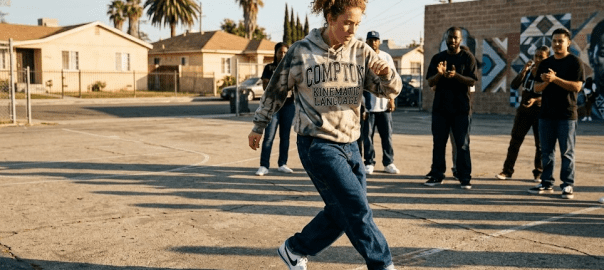
March 16, 2026 /Mpelembe Media/ — The provided sources explore the Crip Walk, a distinctive hip-hop dance characterized by intricate and fluid footwork. Originally developed in Compton, California, in the 1970s, the movement served as a symbolic communication tool for gang members to display loyalty or taunt rivals. Over time, the dance evolved into several variations, including the high-speed Clown Walk and the hybrid Crown Walk, which often seek to decouple the technique from its original gang associations. Famous cultural icons like Snoop Dogg and Kendrick Lamar have played pivotal roles in bringing the dance to global stages, such as the Super Bowl, transforming it into a broader symbol of West Coast identity. Despite its mainstream popularity and use as a victory celebration by athletes like Serena Williams, the dance remains a subject of controversy due to its historical ties. Instructional materials also detail specific technical components, such as the V-Step, the Heel-Toe, and Toe Tipping, which require significant balance and rhythmic precision.

To decode the C-Walk, one must analyze the urban environment of 1970s Compton as a crucible for a unique kinetic language. What the casual observer perceives as a fluid, effortless sequence of pivots and shuffles is, in reality, a sophisticated semiotic system born from the sociopolitical pressures of South Los Angeles. Once a ritualized performance banned by school districts and censored by MTV, the C-Walk has undergone a mainstream institutionalization that culminated in the Super Bowl halftime show. This evolution represents a transition from a high-stakes “secret language” of the streets to a global vernacular of movement.

1. It Was Originally a Linguistic Tool, Not a Dance

At its 1970s inception, the Crip Walk (C-Walk) was not intended for entertainment; it functioned as a sophisticated semiotic tool used by first-generation Crip members to map affiliation onto physical space. This “secret language” of the feet allowed practitioners to “spell” out words like “C-R-I-P” or the names of specific neighborhoods.This was a performance of symbolic dominance and psychological warfare. A practitioner might use their feet to spell the name of a rival gang—most specifically the Bloods—only to “cross it out” or “erase” the name with aggressive shuffles and pivots. For original members, this was never a “performance” for an audience, but a “way of living.””Thugs don’t dance—they sway and represent.” — Ice-T

2. The “Clown Walk” Was a Survival Mechanism for the Art Form

As the C-Walk permeated 1980s and 90s hip-hop culture, it faced significant institutional friction, leading to widespread bans in schools and community centers. To preserve the technical footwork while navigating these safety concerns, three distinct sub-styles emerged:

  • The OG Crip Walk:  The original ritual—slow, rhythmic, and deeply tied to symbolic spelling and “stacking” (gang signs).
  • The Clown Walk:  Developed in the early 90s (partially attributed to Tommy the Clown), this style focused on speed and freestyle athleticism. Crucially, it omitted all gang signs and symbolic spelling to create a “safe space” for non-affiliated dancers.
  • The Crown Walk:  A sophisticated hybrid that utilizes the speed of Clown Walking but retains the grounded, steady tempo and specific foot positions of the OG style.This divergence allowed the dance to survive as an art form by decoupling the kinetic movement from its original gang associations.
3. The Secret Biomechanics of the “Talon” Balance

The technical complexity of the C-Walk is often underestimated. The aesthetic of “weightlessness” is achieved through precise neuromuscular coordination and an understanding of the body’s Center of Mass ( $CM$ ). A critical element is the “popped” foot, where the heel is raised and weight is concentrated on the ball. Specialist analysis identifies the index toe (adjacent to the big toe) as the “talon”—the primary anchor for stability during rapid pivots.The foundational pillars of this kinematic language include:

  • The V-Step:  A pivot-based lateral movement requiring rotational torque ( $\tau$ ) generated through the gastrocnemius to shift weight between open (heels together) and inverted (toes together) positions.
  • The Shuffle:  A rhythmic glide mechanic characterized by the simultaneous switching of feet on the balls/toes to create an illusion of weightlessness through minimized vertical displacement.
  • The Heel-Toe:  A complex swivel balancing the body’s center of mass between the front heel and the “popped” back toe to execute 180-degree diagonal transitions.
4. The Super Bowl as a Watershed Moment of Reclamation

The mainstream institutionalization of the C-Walk reached a zenith through the performances of Snoop Dogg and Kendrick Lamar. Snoop Dogg’s 2022 Super Bowl LVI performance served as a global moment of cultural reclamation, as he executed a synchronized Crip Walk on one of the world’s most-watched stages.This narrative of reclamation was furthered during Kendrick Lamar’s 2025 Super Bowl LIX performance. Lamar notably utilized both the C-Walk and the B-Walk (Blood Walk), a move originally created by rival sets. By performing both, Lamar transformed previously divisive symbols into a statement of regional unity and shared community pride, effectively using the “vernacular of movement” to rewrite a history of conflict into a testament of resilience.

5. The “Serena Williams Effect” and Media Perception

The sociopolitical weight of the C-Walk is best exemplified by the media scrutiny of tennis legend Serena Williams. In 2012, her victory dance on the grass courts of Wimbledon was branded a “gangster ritual” by pundits, prompting Williams to downplay the move’s origins.However, her appearance at Super Bowl LIX in 2025 alongside Kendrick Lamar served as a symbolic “nod” to her earlier critics. Williams’ return to the move in a celebratory, institutionalized context highlights the shifting narrative of the dance: what was once interpreted as a “threat” by the observer is now recognized as a “triumph” of cultural survival. It underscores that while the dance has entered the mainstream, it remains a potent symbol of identity.

Conclusion: A Universal Vernacular of Movement

The C-Walk has successfully transitioned from the marginalized street corners of Compton to a global phenomenon on platforms like TikTok. Today, millions perform “Toe Tipping” sequences, often unaware of the movement’s linguistic roots. This leads to a complex philosophical question: Is the global popularity of the C-Walk a victory of survival, or is the dilution of its semiotic origins the cost of success? Regardless, the C-Walk remains a universal vernacular of movement—a kinetic language that continues to walk through the world as a living artifact of the American urban experience.