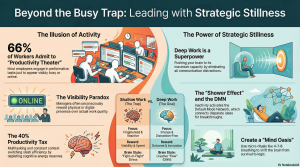

March 26, 2026 /Mpelembe Media/ — The Illusion of Busyness vs. The Power of Deep Work The modern workplace is plagued by “productivity theater” or “fauxductivity,” where employees prioritize visible activity over meaningful output. Research identifies this as “Dramaturgical Work Behavior” (DWB), where workers consciously perform tasks to look busy—such as sending late-night emails or constantly rearranging files—merely to signal compliance and protect their status. This is driven by organizations that reward “passive face time” and speed rather than actual results. To combat this, experts advocate for Deep Work: distraction-free concentration that pushes cognitive capabilities to their limit and produces true value. Transitioning away from shallow, performative tasks requires setting strict boundaries, implementing a “strategic no,” and embracing “career minimalism” or “slow business” to prioritize sustainable, high-quality output over frantic activity.
The Neuroscience of Stillness and Rest While society often equates rest with laziness, neuroscience proves that doing nothing is a biological necessity for high performance. When the brain is at rest, it activates the Default Mode Network (DMN), a system crucial for creative insight, self-awareness, and complex problem-solving. Furthermore, periods of complete silence have been shown to lower cortisol (the stress hormone) and stimulate neurogenesis—the growth of new neurons—particularly in the hippocampus, which governs learning and memory. Leaders who engage in strategic stillness and prioritize recovery avoid the cognitive exhaustion of “continuous partial attention” and make significantly better long-term decisions.
The Rise of the Quiet Leader Traditional leadership archetypes favor loud, charismatic, and extroverted personalities, but the most trusted leaders often practice “quiet leadership”. Quiet leaders prioritize emotional steadiness, deep listening, and psychological safety over dominating the room. A prime example of this is Satya Nadella’s transformation of Microsoft; by shifting the company culture from a competitive “know-it-all” environment to an empathetic, collaborative “learn-it-all” mindset, he dramatically increased the company’s innovation and market value. Similarly, in moments of crisis, leaders who maintain composure—such as Captain Chesley “Sully” Sullenberger during the “Miracle on the Hudson”—demonstrate that calm, decisive action is far more effective than reactive urgency.
The Visibility Paradox and the Double Bind In the corporate world, competence alone rarely guarantees advancement; visibility is often the deciding factor. Quiet high-performers frequently get passed over for promotions in favor of vocal colleagues who are skilled at shaping their own narratives. However, this “Visibility Paradox” presents a unique trap for women and minorities. Due to societal biases and role congruity theory, women and minority professionals face a “double bind”: if they stay quiet, they are undervalued and remain invisible; if they self-promote, they face severe backlash and are penalized for being “too aggressive” or violating gender norms. To navigate this, experts suggest “tempered visibility” or “strategic sharing”—building alliances, letting outcomes speak for themselves, and carefully choosing when, how, and what to make visible without triggering negative stereotypes.
The Real Cost of Burnout The relentless demand for visibility and constant connectivity is physically and financially destructive. Burnout, officially recognized by the World Health Organization, costs companies millions of dollars annually due to lost productivity, high turnover, and healthcare expenses. Employees forced to sustain a facade of non-stop busyness experience deep cognitive dissonance, emotional exhaustion, and workplace anxiety. Organizations must treat employee well-being as a strategic imperative by enforcing work-life boundaries, measuring outcomes instead of hours, and destigmatizing rest.
The High Cost of Looking Productive: Why Your “Busy” Schedule is Killing Your Best Ideas
1. Introduction: The Badge of Honor That’s Burning You Out
In the high-stakes theater of modern corporate leadership, the professional brain is locked in a never-ending marathon. For many executives, “busy” has morphed into a status symbol—a badge of honor that signals importance, demand, and commitment. However, as a specialist in neuro-productivity, I must be clear: this relentless motion is a deceptive trap.While your team spends their days reflexively clearing inboxes and sprinting between back-to-back meetings, they are likely trapped in a state of Urgency-Driven Reactivity . This is a cognitive basement where immediate responses are prioritized over high-impact, strategic work. In an era where AI-driven disruption is the baseline, speed and volume are no longer your competitive edges; algorithms will always outpace you. Your true advantage—the only one that remains—is internal mastery and the cultivation of intentional stillness.
2. Takeaway 1: The Trap of “Productivity Theater”
The data is staggering: much of the activity occurring in your organization right now is performative, not impactful. According to a Connext Global survey, 66% of U.S. workers admit to engaging in “productivity theater”—performing tasks solely to appear productive. Even more concerning, research from Visier reveals that employees spend an average of 1.25 days per week on work designed only to signal effort and availability to their superiors.This is not a character flaw in your staff; it is a rational response to an outdated management system. When leaders rely on “passive face time” to evaluate performance, they trigger what psychologists call Spontaneous Trait Inference . This is an automatic, unconscious judgment where a manager sees a person at their desk (or visibly “green” on a messaging app) and immediately infers that the individual is more dependable and committed.“Visibility signals confidence, and confidence is frequently mistaken for competence—to the ultimate detriment of quiet, high-impact performers who prioritize results over optics.”
3. Takeaway 2: Why “Doing Nothing” is a Neuro-Power Move
To lead effectively, you must understand the biological necessity of downtime, specifically the role of the Default Mode Network (DMN) . This system of connected brain regions activates when you are not focused on an external, demanding task. It is the engine behind the “Shower Effect”—that moment when an elusive solution suddenly crystallizes while your mind is disengaged.However, a critical distinction must be made. While the DMN is the fertile ground for connecting disparate ideas and fostering creativity, it is a double-edged sword. If the mind is not trained in stillness, the DMN can easily hijack the brain, leading to toxic rumination and anxiety as you obsess over past failures or future threats. Productive downtime requires “relaxed attention” rather than “unfocused worry.”“Insight and creativity are biological byproducts of rest, not activity. If you are always ‘on,’ your brain never has the opportunity to connect the dots.”
4. Takeaway 3: The 23-Minute Tax on Your Attention
As a leader, you must recognize that context-switching is a quiet killer of your organization’s bottom line. Research from the University of California, Irvine, shows that it takes an average of 23 minutes and 15 seconds to refocus after a single interruption. When your calendar is a patchwork of 30-minute meetings, your brain is in a state of Continuous Partial Attention .This is not just a time management issue; it is a physiological crisis. Every time you switch tasks, your prefrontal cortex—the seat of executive function—is forced to burn through its limited reserves of glucose and oxygen at a rapid rate. This leads to decision fatigue and emotional reactivity. The APA is clear: multitasking can slash your total productivity by up to 40%. You are essentially running a marathon by sprinting every 100 meters.
5. Takeaway 4: S.T.R.E.A.M. – Understanding the Status Economy
Why do your smartest people waste time on busywork? The answer lies in the STREAM framework: Status Rules Everything Around Me. In environments where high-value impact is difficult to measure, status becomes the proxy for competence. Status in an organization is established through five factors:
Position: Formal title and rank.
Performance: Track record and expertise.
Proximity: Perceived access to power and decision-makers.
Prestige: Recognition and informal roles.
Visibility of Activity: The performance of “busyness.”Status is a zero-sum, positional good. When impact is ambiguous, your employees are forced to compete for survival in a perceived scarcity environment by amplifying “signals of presence”—CC’ing half the company on emails or sending late-night messages to signal indispensability.“Busywork is often nothing more than status-seeking under conditions of uncertainty and scarcity. When you cannot see the value, you reward the motion.”
6. Takeaway 5: Perspective is Your Real Thinking Problem
Most leaders believe they have a “clear thinking” problem, but the neuro-productivity data suggests they actually have a Perspective Problem . Under stress, your “cognitive distance” shrinks. This creates a “Perspective Collapse” where every minor complication feels massive and urgent.To solve this, we utilize the PULse Framework :
Perspective: Regaining the “high ground” to see the whole field.
Unlock Patterns: Identifying repeating loops in behavior or markets.
Leverage Insights: Turning identified patterns into actionable data.
Strategy: Mapping the intentional path forward.
Evaluation: Assessing the impact of the execution.Without Perspective , you cannot achieve Purity —a state of clean thinking free from noise and fear. Leaders must learn to use tools, including AI as a “neutral second mind,” to create the distance required to see the map rather than just the immediate terrain.
7. The Executive’s “Mind Oasis” Toolbox
To regain stillness and shift from reactive to responsive leadership, you must treat mental conditioning as a trained, intentional skill. Use these science-backed protocols to reset your biology:
The 4-7-8 Breathing Technique: Inhale for 4 seconds, hold for 7, and exhale for 8. This is a manual override for your parasympathetic nervous system, shifting you from “fight-or-flight” to “rest-and-digest.”
The 90-Second Reset: Neuroscience indicates that emotional chemicals—the physiological “surge”—flush through your body in roughly 90 seconds. If you can acknowledge the emotion without reacting for those 90 seconds, you prevent the emotional hijack of a high-stakes meeting.
Strategic Thinking-Time Blocks: Schedule 30 minutes of daily “thinking time” with zero agenda and zero notifications. This provides the necessary environment for the DMN to function without veering into rumination.
The “Stop Doing” List: Apply the 80/20 rule ruthlessly. Identify the 80% of activities that provide only 20% of your results. Delegate or eliminate them to create the space required for “Deep Work.”
8. Conclusion: Leading from Depth, Not Noise
True productivity is measured by impact and clarity, not motion and volume. In a culture that reflexively rewards speed, choosing stillness is an act of high-level leadership courage. It requires the internal mastery to trust that your value is not tied to how many emails you sent before 8:00 AM, but to the quality of the decisions you make when the stakes are highest.Stillness is not the absence of work; it is the environment in which your most significant work begins.The Closing Challenge: If you stopped trying to look busy tomorrow, what is the one truly impactful project you’ve been ignoring that would finally have the space to breathe?