March 27, 2026 /Mpelembe Media/ — Zambia’s integration of Artificial Intelligence (AI) into its educational and economic sectors is accelerating through strategic partnerships and new policy frameworks, though these advancements face significant governance and human rights challenges.
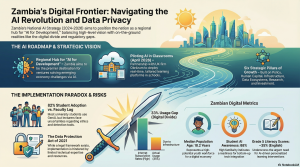
Zambia’s National Artificial Intelligence Strategy (2024-2026) outlines a comprehensive roadmap to transform higher education through sweeping changes to curricula, pedagogical practices, digital infrastructure, and research innovation.
Curriculum Integration and Capacity Building The strategy mandates the integration of AI-related courses across all tertiary institutions, shifting the focus to ensure students are trained not only to use AI tools but also to understand the foundational principles of data science and machine learning,. To equip educators, the government is rolling out a “train-the-trainer” capacity-building model, which provides faculty, IT staff, and policy-makers with specialized workshops in AI literacy, ethics, and technical maintenance,. This approach ensures that university lecturers and Technical Education, Vocational and Entrepreneurship Training (TEVET) instructors are kept up-to-date with evolving global technical standards.
Pedagogical Shifts and Administrative Efficiency The strategy envisions a transition from traditional, one-size-fits-all instruction to a personalized and responsive learning environment. In this new framework, university educators will redefine their roles to become “coordinators of personalized learning,” leveraging AI-generated analytics to tailor educational experiences to individual student capabilities. Additionally, AI is set to drastically improve university administration; early pilot studies of AI-powered analytics dashboards at the University of Lusaka demonstrated a 20 percent reduction in time spent on administrative reporting, while also improving the accuracy of early-warning systems for at-risk students,.
Infrastructure and Data Stewardship Recognizing that AI requires a strong technological backbone, the strategy commits to expanding digital infrastructure through targeted grants and public-private partnerships, with a specific goal to achieve broadband access of 100 Mbps per institution by 2026,. In terms of data governance, universities will be required to adopt “secure, interoperable data platforms” and adhere to strict protocols under the Zambia Data Protection Act for the collection, storage, and sharing of sensitive student and research data,.
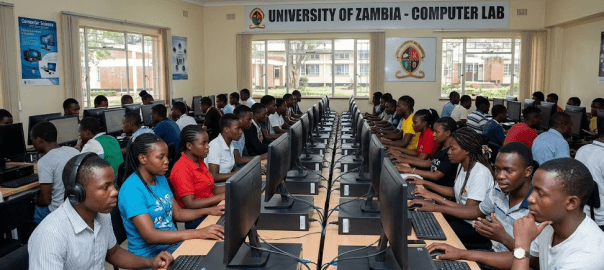
Research, Innovation, and Localized Solutions To ensure digital sovereignty and prevent “digital colonization,” the strategy emphasizes creating “localized epistemologies” that ground AI systems in local knowledge and cultural contexts. A major milestone in this effort is the establishment of an AI Center of Excellence at the University of Zambia (UNZA) in partnership with Google. This center will function as a premier research hub, enabling Zambian researchers to develop homegrown AI tools uniquely adapted to local realities, such as platforms that function efficiently in low-bandwidth environments and accommodate the country’s 70-plus local languages.
Ethical Governance and Accountability To balance this rapid innovation with ethical oversight, the strategy dictates that all AI systems deployed in higher education must undergo a mandatory “Ethics Impact Assessment”. This measure is designed to evaluate potential harms, mitigate algorithmic biases, and ensure that AI applications remain compliant with national human-rights norms and international benchmarks. However, realizing this governance vision will require universities to overcome current challenges related to funding shortages, legacy IT systems, and a lack of dedicated institutional oversight bodies,.
Educational Transformation Through AI: In a bid to modernize its economy and address chronically low educational outcomes, Zambia has signed a Memorandum of Understanding with the UK-based Obrizum Group. Launching in mid-April 2026, this pilot program will introduce “true adaptive learning” technology to secondary schools and Technical Education, Vocational and Entrepreneurship Training (TEVET) institutions. The Obrizum platform utilizes AI to map personalized, non-linear learning paths based on real-time analytics and metacognitive assessments, aiming to bridge the educational divide between urban and rural students by allowing learners to progress at their own optimal pace.
The National AI Strategy (2024-2026): To govern this technological transition, Zambia has launched a comprehensive National AI Strategy built on six pillars: Policy and Regulation, Human Capital Development, Infrastructure and Data Ecosystems, Research and Innovation, Industry and Sectoral Development, and International Collaboration. The strategy mandates the creation of a National AI Council to oversee ethical deployment and proposes an Emerging Technologies Centre of Excellence to serve as a research hub. The ultimate goal is to position Zambia as a regional hub for “AI for development” and achieve full AI integration in primary and secondary schools by 2030.
Data Protection and Surveillance Concerns: While the Data Protection Act of 2021 establishes rules for data processing and requires explicit parental consent for minors, its enforcement remains weak due to capacity constraints, limited resources, and low public awareness. Furthermore, the newly enacted Cyber Security Act and Cyber Crimes Act of 2025 have sparked severe backlash from civil society and organizations like the Global Network Initiative (GNI). These laws introduce disproportionate state surveillance powers without sufficient judicial safeguards and criminalize vague categories of speech such as “false information,” raising alarms about potential threats to privacy, media freedom, and freedom of expression.
The Mingomba Miracle vs. The 33% Paradox: Inside Zambia’s $60 Billion AI Gamble
Zambia stands at a historic crossroads where high-stakes economic ambition meets the gritty reality of a developing infrastructure. In the high-level boardrooms of Lusaka, policymakers articulate a bold $60 billion vision powered by Artificial Intelligence to leapfrog traditional developmental hurdles. Yet, a few hundred kilometers away, a student in a rural library likely struggles to prompt a generative AI tool on a shared device, hampered by unstable power and a flickering signal. This “Double-Edged Sword” defines the Zambian context: a world-class strategic aspiration pinned against systemic bottlenecks that risk widening the very inequalities the technology promises to close.
The “Mining Miracle” and the $60 Billion Ambition
Zambia’s AI gamble isn’t being validated in a Lusaka lab, but in the dark, data-rich tunnels of the Mingomba mine. Kobold Metals, a Silicon Valley startup, recently utilized machine learning to discover the largest copper deposit in over a century—a feat that proved AI could solve the “blind search” problem in resource extraction. With a staggering $150 million investment already on the line, this discovery serves as the ultimate proof of concept for the National AI Strategy. For Minister Felix Mutati, this “Mining Miracle” validates the idea that AI is not just a luxury, but a primary engine for industrial sovereignty.”The impact of AI is comparable to that of the steam engine, electricity, and the internet during past industrial revolutions. It is estimated that AI will create over $10 trillion in economic value over the next decade… Through this National AI Strategy and Vision, Zambia seeks to lay the foundations to enable our country and region to take full advantage of this new revolution.” — Hon. Felix Mutati, Minister of Technology and Science
The 33% Paradox: Access vs. Actual Usage
Despite an impressive 64.1% internet subscription rate recorded in late 2023, the actual usage rate plummeted to roughly 33% by early 2025. This “33% Paradox” reveals a systemic bottleneck where connectivity exists on paper but remains inaccessible in practice due to prohibitive costs and poor service. This digital divide is sharply gendered and regional, with rural female students often left entirely off the grid. Deploying advanced AI without first fixing the fundamental “pipes”—and meeting the national goal of 100 Mbps broadband per institution—risks cementing a two-tier society.Primary Infrastructural Barriers:
- Unstable Power Supplies: Frequent electricity interruptions prevent the consistent uptime required for sophisticated AI engagement and digital learning.
- Limited Bandwidth and High Costs: High internet prices and low speeds in remote provinces effectively lock out data-heavy AI applications for the majority.
- Restricted Device Access: A critical shortage of affordable hardware means that for many students, “access” is a shared, fleeting experience rather than a personal tool.
The Silent Revolution: Students Lead, Faculty Lags
While the government drafts frameworks, a student-led revolution has already captured the classroom. At Copperbelt University, data shows an 88% awareness level and an 82% adoption rate of generative AI, yet most faculty remain trapped in a “policy and ethical vacuum.” Using the Technology Acceptance Model (TAM), we see that “Ease of Use” is winning the day for students seeking efficiency. However, “Perceived Usefulness” remains a question mark for teachers who fear students are using AI as a cognitive crutch rather than a tool for deep learning.This rapid, uncontrolled adaptation occurs in a field rife with the dangers of surveillance capitalism and academic erosion. Without institutional guidance, there is a risk that students will favor passive copy-pasting over critical engagement, weakening their own cognitive development. The tension lies in whether universities can pivot fast enough to manage this transition before the educational standard is fundamentally compromised.”There are concerns about superficial AI use, which might weaken cognitive engagement through passive, copy-and-paste habits.” — Daniel Chinyama Phiri, Lecturer of Sociology
Decolonizing the Algorithm: Beyond Western Templates
A burgeoning critique among local scholars suggests that Zambian AI policies often replicate Western “template clauses” that ignore local specificities. True digital sovereignty requires “epistemic disobedience”—a strategic refusal to internalize imported hierarchies in favor of localized pedagogies and indigenous knowledge systems. Without this effort, Zambia risks becoming a passive consumer of Western data models that are culturally and linguistically misaligned with its own citizens’ needs.Actionable Imperatives for Decolonial Capacity Building:
- Co-create Curricula: Develop training programs alongside local academic experts that reflect Zambian worldviews and pedagogical realities.
- Incorporate Indigenous Knowledge: Ensure data repositories include local languages and knowledge systems to prevent algorithmic marginalization.
- Localized Governance: Establish inclusive structures that elevate the voices of local epistemic communities over foreign data brokers.
Personalization at Scale: AI as the New Classroom Coordinator
Zambia has partnered with the UK-based Obrizum Group Ltd to launch a pilot program in April 2026, targeting secondary schools and TEVET institutions. This partnership serves as a high-stakes test case: can a foreign AI tool be successfully “localized” to address Zambia’s specific skills mismatches and its median age of 18.2 years? The goal is to move the educator from a standard lecturer to a “Strategic Coordinator,” using real-time data to bridge the geographic quality gap.”The quality of education must not be determined by geographic location… students in remote rural areas should have access to the same educational resources as those in urban schools.” — Hon. Felix Mutati, Minister of Technology and Science
Conclusion: The Ecological Path Forward
The future of AI in Zambia is an ecological matter, requiring the harmonious growth of infrastructure, policy, and human capital. While the $60 billion vision is an inspiring North Star, the ground-level reality is threatened by a significant “Data Protection Gap.” Though the Data Protection Act of 2021 exists, researchers like Nalumino Moola note that implementation remains inadequate due to resource constraints and a lack of technical expertise.This enforcement vacuum leaves Zambian citizens vulnerable to identity theft, surveillance, and a thriving global market for data trading. As the nation pushes toward a digital-first economy, the most pressing challenge is not the complexity of the code, but the strength of the guardrails. Can Zambia close its digital divide and protect its citizens’ data before the AI revolution matures beyond the reach of its current laws?