Empowering the Next Frontier: Zambia’s Quest for Innovation, Tech Skills, and Data Sovereignty
March 28, 2026 /Mpelembe Media/ — Zambia is currently undergoing a massive technological evolution designed to achieve the socio-economic goals outlined in its Eighth National Development Plan (8NDP) and Vision 2030. This transition is anchored in aggressive infrastructure expansion, e-government reforms, and strategic international partnerships.
Infrastructure and Global Connectivity: To overcome historical vulnerabilities in its network and reduce reliance on infrastructure largely built by Chinese firms like Huawei and ZTE, Zambia has partnered with Google on the Umoja subsea fiber-optic cable project. This cable, which links Kenya through Zambia down to South Africa and across to Australia, establishes a vital “data superhighway” and provides the region with crucial network redundancy. Domestically, recent government tax incentives have accelerated private sector investments, leading to the laying of 5,000 kilometers of new fiber optic cable and boosting internet penetration from 53% to 64% within a single year.
AI and Homegrown Innovation: A flagship initiative of this digital leap is the establishment of the first Artificial Intelligence (AI) Center of Excellence in Southern Africa, located at the University of Zambia (UNZA) and hosted by the Zambia Research and Education Network (ZAMREN). Integrated into the broader vision for an “UNZA Innovation Village” (I-Village), this center will empower young innovators to develop AI-driven solutions in priority sectors such as precision mining and AgriTech, supporting national goals to reach 3 million tons of copper and 10 million tons of agricultural output by 2031.
E-Government and Public Service Modernization: Driven by the SMART Zambia Institute, the government is transitioning from fragmented, manual processes to a centralized, “cloud-smart” digital administration. The deployment of the Government Service Bus (GSB) and Zamportal has brought hundreds of public services online, creating a one-stop-shop for citizens to securely access information and process payments, thereby improving transparency and efficiency.
Youth Empowerment and Digital Skills: Recognizing that a digital economy requires a skilled workforce, Zambia is mobilizing its youth. Programs such as the ZICTA ICT Innovation Programme and the UN’s Robotics for Good Youth Challenge are training students and young entrepreneurs in coding, robotics, and AI to address local issues like food security. This aligns with Google’s broader accelerator programs aimed at funding and scaling “AI-first” African startups.
Data Sovereignty and Policy Frameworks: As digital adoption grows, Zambia is working to mitigate cybersecurity risks and the threat of “data colonialism”. The government has enacted foundational legislation, such as the Data Protection Act and Cyber Security and Cyber Crimes Act. By partnering with diversified international tech providers, Zambia is building a “hybrid cloud model” that ensures both high-performance computing and sovereign control over sensitive national data.
The Invisible Price of Progress: 6 Takeaways from Zambia’s Fight for Digital Sovereignty
In the contemporary landscape of the Global South, connectivity is the ultimate currency. At the click of a button, the world shrinks; through the arrival of Starlink’s direct-to-cell phone satellite services—rolled out globally in April 2025—nations previously on the periphery find themselves suddenly integrated into the global web. But this convenience masks a sobering shift in geopolitics. Physical imperial occupation is a relic of the past; today, a nation can be dominated without a single soldier crossing its borders.Zambia stands as a primary case study for this new frontier. As the country accelerates its digital transformation, it faces a profound vulnerability: the “invisible” price tag of data integrity. In an era where a single tech giant possesses the power to unilaterally “switch off” a nation’s connectivity—a reality underscored by Starlink’s role in recent global conflicts—Zambia’s struggle for digital sovereignty is a warning to every emerging economy.
Takeaway 1: The Conceptual Divide—Means vs. Matter
To navigate this terrain, we must first distinguish between digital colonialism and data colonialism . While often used interchangeably, they target different layers of a nation’s autonomy.Digital Colonialism is the monopolization of the means of data generation. It is the control of the physical and digital infrastructure—the fiber optics, server racks, and proprietary software—that third-party clients are forced to use. Data Colonialism , conversely, is the appropriation of the data itself —the raw resource generated by users, which is then processed, sold, or used for surveillance. In Zambia, as in much of Africa, these forces act in a pincer movement: nations surrender their rights to the very data they produce the moment they enter a foreign-controlled ecosystem.As noted in recent scholarship on the Global South:”The process of “digital colonialism” — whereby the Global North monopolizes the digital technology supply — can impede Southern economies, particularly in Africa, to develop their own digital economies, manufacturing capabilities, and other domestic industries.”
Takeaway 2: The $65 Million Infrastructure Trap
Zambia’s entry into “Smart Zambia” Phase I was heralded as a leap toward modernization, funded by a $65.4 million concessional loan from the China Eximbank in 2015. However, this progress came with heavy political and economic tethers. The “no-bid contract” issued to Huawei Technologies as the primary contractor became a lightning rod for corruption investigations.This scenario evokes the biblical analogy of Esau and Jacob : a nation trading its “birthright” (long-term digital sovereignty) for a temporary “stew” (short-term infrastructure). The “stew” has proved bitter. By 2022, the project was mired in financial failure, with the Zambia University College of Technology (ZUT) accumulating over $2.5 million in arrears . The Auditor General revealed that the training programs intended to fund the loan repayment lacked the “envisaged uptake,” proving that the “infrastructure trap” is often a double-edged sword of economic debt and political dependency.
Takeaway 3: The Surveillance Reality—Technicians as Monitors
Perhaps the most troubling takeaway is the erosion of the line between technical support and state monitoring. Investigative reports have shed light on the Cybercrime Crack Squad , housed within Zambia’s national data facility.The squad’s operations reveal a startling level of corporate-state integration. Of the 40-strong staff, roughly 50% are Huawei employees who possess biometric access to the facility. This “embedded” relationship allegedly facilitated the tracking of the opposition news site Koswe (The Rat). According to reports, Huawei technicians utilized their expertise to access Facebook pages, identify phone numbers, and deploy spyware to pinpoint the physical locations of bloggers. This transforms digital infrastructure into a tool for narrative control, where tech giants operate with near-total impunity, often with no legal consequences for bypassing privacy protocols.
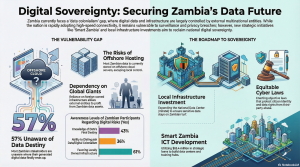
Takeaway 4: The Awareness Gap—The 93% Discomfort
Zambia’s vulnerability is compounded by a staggering information asymmetry. A stakeholder study involving government officials, academics, and ICT experts revealed a population largely in the dark about their digital destiny:
- 57% of respondents were unaware of where their digital data finally ended up or who had access to it.
- 64% could not distinguish between digital and data colonialism.
- Most tellingly, 93% expressed deep discomfort once the implications of this lack of control were explained to them.This “digital divide” is not merely about a lack of hardware; it is an “ignorance of digital technologies and the implications of their use.” In the absence of literacy regarding data harvesting, the public remains an easy target for surveillance capitalism.
Takeaway 5: The Umoja Connection—A Shift in Power?
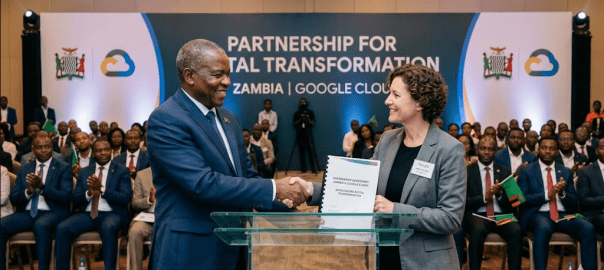
As we move into 2025–2026, the narrative is shifting with the entry of Western giants like Google Cloud . The signing of a Memorandum of Understanding for a Center of Excellence and the launch of the Umoja project —the first fiber optic link connecting Africa directly to Australia—promises to revolutionize internet penetration, which has already climbed from 53% to 64%.Alongside these massive infrastructure projects are “AI for Good” initiatives, such as the Robotics for Good Youth Challenge , focusing on food security. While these partnerships appear more benevolent than previous deals, the underlying power dynamic remains familiar. By relying on Google Cloud and Western-led AI frameworks, Zambia risks merely shifting the “center” of its colonial dependence from the East to the West. Whether these collaborations are truly “equitable and mutually beneficial” or a more sophisticated form of data extraction remains the critical question for the next decade.
Takeaway 6: The Remedy—Building “On the Edge”
For Zambia to reclaim its sovereignty, it must move from being a consumer of foreign technology to an architect of its own digital safety nets. The study proposes three primary remedial actions:
- Algorithms “on the edge”: Developing technology that secures and sifts sensitive information locally before it ever reaches a third-party cloud.
- Locally Owned Infrastructure: Expanding Infratel (the National Data Center) to ensure the state retains a ground-level record and total control of its information.
- Equitable Cyber Laws: Moving away from laws that protect political power and toward regulations that prioritize data integrity and the fundamental rights of citizens.The path forward is defined by the necessity for self-reliance:”Zambia must heavily invest in locally owned digital infrastructure (e.g. servers, cloud storage and computing, data centres etc.) so that it could assert total control and locally manage this data for citizen identity protection and growth of contextual AI.”
A Ponderable Future
Connectivity is an undeniable engine for development, but in the 21st century, data integrity is the new frontier of national security. Zambia’s journey illustrates that the price of progress is often hidden in the fine print of loan agreements and server-access protocols. As the world continues to consolidate into a digital village, we must ask ourselves: When the infrastructure belongs to a foreign power and the data is harvested by a global conglomerate, who will ultimately own the deed to your identity?