
Beyond the Sandbox: 6 Surprising Takeaways from the New Full-Stack Google AI Studio
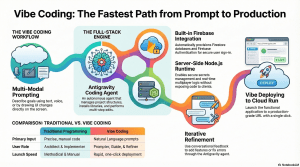
March 16, 2026 /Mpelembe Media/ — For years, the “weekend prototype” has been a rite of passage for developers—and its graveyard. We’ve all been there: a brilliant AI demo that lives and dies in a single browser tab because the friction of setting up a backend, managing authentication, and scaling to the cloud was too high. For most, the “localhost:3000” barrier is where ambition goes to sleep, leaving behind nothing but a folder of abandoned .zip files.That era of throwaway prototypes is over. We are entering the age of “vibe coding.” As defined by the latest shifts in the Google ecosystem, vibe coding isn’t just about generating snippets; it’s a paradigm shift from writing lines of syntax to guiding an autonomous agentic system. With the integration of the Antigravity development platform and Firebase into Google AI Studio, the browser is no longer a sandbox—it’s a launchpad.Here are the six most significant takeaways from this new full-stack reality.
1. The Backend Is No Longer an Afterthought (It’s Automatic)
In the old world, the frontend was the “vibe” and the backend was the bottleneck. Traditionally, solo creators would stall out the moment they needed to handle user identity or persistent data. Google AI Studio has demolished this wall by introducing a dedicated server-side runtime powered by Node.js . This allows for the execution of secure logic—like secrets management and third-party API calls—that should never be exposed to a client-side browser.The standout feature here is “proactive detection.” The AI doesn’t just wait for you to write a schema; it listens to your intent. If you describe an app that needs to remember a user’s grocery list, the system realizes you need infrastructure before you even ask for it.”The agent will proactively detect when you need data storage and user identity based on cues in your prompt—and offer to set up Firestore and Firebase Authentication, with your approval. By clicking ‘Enable Firebase,’ the agent will set up your project, provision Firestore, and enable Authentication automatically.” — Firebase BlogBy automating the provisioning of Cloud Firestore and Firebase Authentication , Google has removed the DevOps tax. You aren’t just building a UI; you’re deploying a secure, multi-user environment with the click of a button.
2. The Antigravity Agent: Your New “Overenthusiastic Junior Developer”
The engine driving this experience is the Antigravity coding agent. It’s important to distinguish the two: Google AI Studio is your creative sketchbook, while Antigravity is the “Agentic Development Platform” (the IDE) that powers the heavy lifting. Within AI Studio, the agent acts like an “overenthusiastic junior developer”—brilliantly capable, tireless, but requiring the human to act as the senior architect.The most common failure in vibe coding is “dependency drift,” where an AI suggests a library but fails to install it. Antigravity solves this by resolving imports and installing npm packages —like Framer Motion for physics-based animations or Shadcn for high-end UI components—before it even writes the first line of code. This ensures the agent isn’t just hallucinating plain HTML/CSS, but is building with the modern web’s most sophisticated tools.The Antigravity Agent’s Core Skills:
- Agentic Planning: Decomposes high-level “vibes” into a structured task checklist and implementation blueprint.
- Autonomous Implementation: Manages file structures, installs dependencies, and handles multi-step code edits.
- Self-Verification: Runs its own code in a dev container and iterates until the “vibe” matches the reality.
3. Model Choice: Why “Thinking” Beats “Fast” for Complex Builds
In vibe coding, the model you choose is the difference between a quick sketch and a structural blueprint. While lighter models like Gemini 3.1 Flash are optimized for speed and rapid UI iterations, complex architectural tasks require a “thinking” model.The current gold standard is Gemini 3.1 Pro . Unlike “Fast” models, reasoning models like the 3.1 Pro use an internal “chain of thought” to break complex engineering problems into smaller, logical segments. In head-to-head experiments, the 3.1 Pro is significantly better at resolving persistent bugs and maintaining the structural integrity of a project as it grows.”The AI model you choose to vibe code with can dramatically affect your final output.” — CNETFor developers, the strategy is clear: Use the Flash models for “vibe-ing” through design changes, but switch to Gemini 3.1 Pro when you need the agent to act as a senior engineer capable of deep reasoning and issue resolution.
4. Responsible Vibe Coding: The “Veto” Power and File Splitting
Building large-scale applications without them “breaking” requires the human to step into the role of Mission Control. The greatest danger in AI development is the “Monolith”—a single, three-thousand-line file where the AI eventually loses its orientation. To build production-grade software, you must exercise your Veto Power .If an agent fails to fix a bug after two rounds, stop. Don’t argue with the AI. Revert to a previous state and re-prompt with better context. To stay ahead of “context drift,” you must enforce the Golden Rule of Vibe Coding: Separate your features into distinct files and components immediately.Pro Tips for Professional Execution:
- Enforce Modular Architecture: Explicitly command the agent to keep logic in separate files (e.g., auth-service.js vs UI-components.tsx). This makes generation faster and reduces hallucinations.
- Use the “Annotate App” Tool: Visual context is superior to text. Take a screenshot of your UI, draw your requested changes directly on it, and let the model “see” what you mean.
- Voice Input for Iteration: Use voice commands for on-the-fly UI tweaks. It’s faster for “vibe” adjustments while you observe the app in real-time.
- Maintain a Design Doc: Require the AI to maintain a design.md file at the project root to serve as a shared “source of truth” for both you and the agent.
5. The “Privacy First” Advantage in a Public World
A major differentiator for Google AI Studio is its privacy-first model. In a landscape where many free-tier AI builders make every generated app public by default—exposing your proprietary ideas and sensitive client data—Google AI Studio keeps your work strictly private.Sharing is handled through a system identical to Google Drive . You control who has access via specific link permissions. This allows professional developers to prototype proprietary logic or sensitive enterprise tools in a secure, zero-setup environment without the fear of their “source vibe” leaking to a public gallery.
6. “Vibe Deploying”: The One-Click Path to Cloud Run
The lifecycle of a vibe-coded app culminates in “vibe deploying.” This is the transition from a browser-based container to a live, production-grade URL on Cloud Run . This isn’t a “toy” deployment; it leverages Google Cloud’s scalable infrastructure to handle real-world traffic.For projects that outgrow the browser’s “sketchbook” environment, Google provides a seamless migration path to the full Antigravity IDE —the standalone workshop for high-level engineering. This unified stack approach is the reason behind the sunsetting of Firebase Studio (officially ending on March 22, 2027) . Google is consolidating its ecosystem: AI Studio for the spark of an idea, and Antigravity for the full mission.
Conclusion: From Idea to Mission Control
We are moving past the era where a developer’s value was measured by their ability to memorize syntax. We are now in the era of mission direction. The barrier to software creation has been permanently lowered, but the ceiling for what can be built has been raised.As AI begins to direct both the development of applications and the automated defenses required to protect them from AI-powered attacks, the concept of software ownership is changing. In a world where the “vibe” is the new source code, the developer is no longer a laborer of lines, but a director of outcomes. The mission starts at aistudio.google.com.