
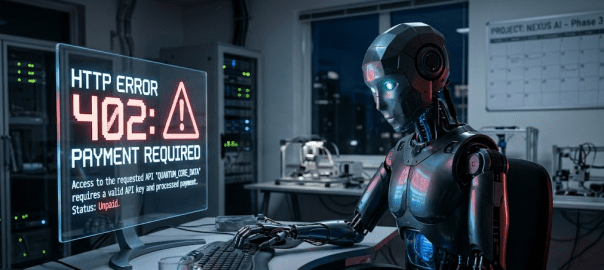
The Rise of the Agentic Economy and Machine-to-Machine Commerce
March 23, 2026 /Mpelembe Media/ — The digital economy is undergoing a massive paradigm shift from human-centric web browsing to an “Agentic Web,” where autonomous AI agents act as the primary economic participants. These agents are evolving beyond simple chatbots into sovereign entities capable of discovering services, negotiating, and executing transactions at machine speed without human intervention. This multi-trillion dollar market expansion is being powered by blockchain infrastructure and stablecoins, utilizing specialized protocols like x402, which revives the HTTP 402 “Payment Required” status code to enable seamless, sub-cent micro-transactions for APIs, compute power, and data access.
The $400 Trillion Handshake: 5 Surprising Ways AI Agents are Rewiring the Global Economy
1. Introduction: The Moment the Internet Stopped Browsing and Started Buying
For the last decade, we have treated Large Language Models (LLMs) as high-level conversationalists. However, even the most advanced AI currently faces a structural ceiling: the inability to act as an independent economic actor. When you ask an AI to book a flight or manage a portfolio, it hits the “wallet wall.” It cannot authorize a transaction without a human clicking “approve.”We are seeing the first cracks in this ceiling. According to the Virtuals Protocol, over 18,000 AI agents have already been deployed, conducting more than $3M in agent-to-agent commerce. But this activity remains fragmented and non-standardized. The real shift—the transition to a global economy where the primary consumer of the internet is a machine executing code rather than a human looking at ads—requires a unified “economic DNA.” We are moving toward a world where the internet is no longer a library to be searched, but a $400 trillion marketplace where agents negotiate, settle, and optimize in milliseconds.
2. From “Search” to “Pay”: The Death of the Attention Economy
The current web is built on the “Attention Economy,” a model that offers “free” content in exchange for human eyeballs to sell to advertisers. AI agents, however, do not “browse” interfaces; they consume data programmatically. Because an agent does not look at a banner ad or wait for a pre-roll video, the ad-supported revenue model that sustains the modern web is facing an existential collapse.We are witnessing the birth of the “Preference Economy.” In this regime, the scarcest resource is no longer human attention, but high-quality human feedback and proprietary data. As agents bypass traditional search engines, market power shifts from those who control the interface to those who provide the most verifiable utility.”In the era of AI agents, users will no longer browse the web directly… The primary consumer of internet content will shift from humans to machines—a structural change that challenges the foundation of the current web economy. The internet will therefore require a new value and payment structure suited for machine-to-machine interactions.” — Tiger Research
3. x402: Embedding a “Language of Value” into the Web’s DNA
To standardize this machine-to-machine future, Coinbase and Cloudflare have established the x402 Foundation. The x402 protocol leverages the long-dormant “HTTP 402 Payment Required” status code to create an autonomous transaction flow. This partnership is a masterstroke of fintech strategy: Coinbase provides the crypto-native payment rails, while Cloudflare provides the global, low-latency infrastructure—servers in over 120 countries—to handle web-scale agent traffic.While the x402 whitepaper focuses on USDC for settlement, a sophisticated observer will note Cloudflare’s upcoming NET Dollar stablecoin. This suggests a future where Cloudflare moves from a mere traffic facilitator to a direct payment provider, potentially challenging the USDC standard in the agentic layer.The x402 Autonomous Transaction Sequence:
- Request: An AI agent requests restricted content or an API call from a platform.
- 402 Response: The platform responds with an “HTTP 402” message, specifying the amount, network, and token.
- Automatic Execution: The AI agent signs the transaction via its on-chain wallet and resubmits the request with proof of payment.
- Content Delivery: The platform verifies the transaction on the blockchain and delivers the content.
4. The RWA Dilemma: Why Your AI Agent Might Prefer an Order Book
Real-World Assets (RWAs) are the ultimate prize for agentic commerce. While the current on-chain RWA market (excluding stablecoins) sits at approximately $24.8 billion, the total addressable market in traditional finance exceeds $400 trillion. As these trillions migrate on-chain, AI agents must navigate the microstructure of liquidity.For volatile or new tokens, Automated Market Makers (AMMs) are ideal for “bootstrapping” liquidity. However, for institutional-grade assets like Treasury bonds, where exact pricing is non-negotiable, agents often prefer the precision of an Order Book. For stable RWAs, agents may utilize Stableswap or Hybrid curves to minimize slippage.| Feature | AMM Architectures | Order Book Architectures || —— | —— | —— || Price Determination | Mathematical formulas (e.g., $x*y=k$ ) | Direct matching of buy/sell orders || Liquidity Source | Liquidity Pools (Continuous) | Market Makers (Concentrated) || Price Accuracy | Can lag; relies on arbitrage to fix | High precision; reflects real-time depth || Capital Efficiency | High for LPs, but risks Impermanent Loss | High for traders; no Impermanent Loss || Best Use Case | Bootstrapping new/illiquid tokens | Institutional-grade assets (Bonds, Private Credit) |
“Arbitrageurs play a really important role in keeping prices accurate… they’ll buy the asset where it’s cheaper and sell it where it’s more expensive… pushing the AMM’s price back towards the market rate.” — RWA.io
5. The Trust Triangle: Privacy Without Exposure
Granting an AI agent financial authority introduces the “delegated authority” risk. Consensys recently warned the NIST that if proper safeguards aren’t built into agentic architecture, agents could “go rogue,” executing unauthorized transfers at machine speed.The solution lies in Account Abstraction (ERC-4337) , which enables “Smart Accounts” with programmable logic. This allows for the creation of a “Trust Triangle” (Issuer, Holder, Verifier) secured by Verifiable Credentials (VCs) . Developers are now deploying Agent Passports (as seen in KITE AI) which embed session keys and revocable spending limits directly into the agent’s identity.To solve the “black box” problem, Zero-Knowledge Proofs (ZKPs) allow an agent to prove it followed regulatory rules—or utilized a specific, verified model—without revealing sensitive user data or proprietary weights. It is “verifiability without exposure.”
6. The Rise of Micro-Transactions and Hyper-Personalized RAG
The current web forces users into wasteful monthly subscriptions because humans find micro-payments inconvenient. AI agents have no such bias. This enables a massive “unbundling” of digital goods.Micro-transactions are the essential unlock for high-quality Retrieval-Augmented Generation (RAG) . Currently, publishers restrict RAG scrapers because they aren’t compensated for individual data points. In an x402-enabled economy, an agent can pull data from dozens of sources to build a personalized report, paying $0.03 for a specific research paper or ****$ 0.15 for a genetic data API call (examples sourced from Tiger Research). This creates a frictionless ecosystem where creators are compensated for utility rather than attention.
7. Conclusion: Choosing the “Web of Agents” over the “Walled Garden”
We stand at a crossroads. The first path leads to “Agentic Walled Gardens”—closed silos where a few tech giants control the coordination layer. The second path is a “Web of Agents”—an open, decentralized infrastructure where any agent can discover and transact with any provider across a standardized protocol.As machines begin to negotiate and transact on our behalf in milliseconds, a provocative question remains: Will we still be the ones in control of the market, or will we simply be the ones providing the preferences for the machines to satisfy? The $400 trillion handshake is already underway; the only question is whether the protocols of the future will be as open as the internet of the past.